06 August, 2026
Unusual Ozone Enhancement over the North Bay of Bengal
Tue 11 Aug, 2026
Context
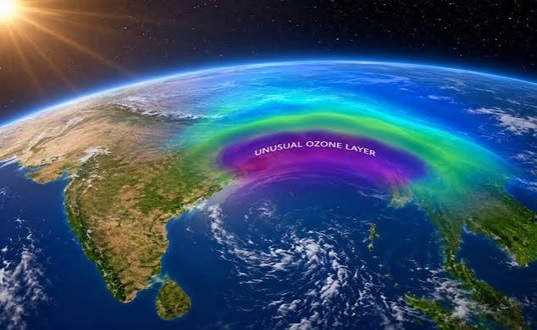
Scientists have detected an unusually concentrated layer of stratospheric ozone over the North Bay of Bengal at an altitude of about 21–23 km, significantly below the altitude where the normal maximum ozone concentration is generally observed. The finding emerged from the NetRAD-ASMA 2024 winter campaign and was reported in the journal Earth and Space Science in 2026. The study provides important insights into how atmospheric circulation can redistribute ozone and modify its vertical distribution over the Indian subtropical region.
What Was Observed?
- The study detected a secondary and unusually strong ozone layer between 21 and 23 km, whereas the principal stratospheric ozone maximum normally occurs around 25–30 km.
- At Balasore, Odisha, the maximum ozone concentration reached approximately 150 nbar between 21.2 and 22.1 km, around 50 nbar higher than the normal maximum observed on non-event days. The enhanced layer had a thickness of approximately 2.1–2.4 km and persisted for more than 24 hours.
- Importantly, the phenomenon was observed during both daytime and nighttime. However, the satellite observations did not show equal enhancement:
- Aura-MLS detected approximately 20–25 nbar enhancement during the day and 8–10 nbar at night. Its persistence across both periods nevertheless indicates that short-term sunlight-driven photochemical production was not the principal explanation.
- Why Is the Finding Important?
- Ozone is continuously produced, transported and destroyed in the atmosphere. The stratospheric ozone layer acts as a natural shield by absorbing harmful ultraviolet-B radiation, thereby protecting living organisms from excessive UV exposure.
- The new observation is significant because it demonstrates that atmospheric dynamics can substantially redistribute ozone over a localized region. The study describes this as the first experimental evidence of a localized, dynamically driven enhancement of stratospheric ozone over the North Bay of Bengal.
- This should not, however, be interpreted as evidence of a global recovery of the ozone layer. The observation represents a localized redistribution and temporary enhancement, rather than a permanent increase in global stratospheric ozone.
Scientific Mechanism
- The researchers attribute the phenomenon primarily to horizontal advection and vertical compression of stratospheric air.
- First, ozone-rich air from the mid-latitudes was transported horizontally towards the North Bay of Bengal. Potential-vorticity analysis supported this movement of air masses. Second, radar observations indicated persistent downward motion in the lower stratosphere near the region. Such subsidence compressed the air mass vertically, contributing to the observed increase in ozone concentration.
Thus, the key mechanism can be represented as:
|
Mid-latitude ozone-rich air → Horizontal advection → Downward motion/subsidence → Air compression → Localised ozone enhancement This finding expands the understanding of stratospheric ozone beyond conventional explanations based solely on photochemical processes. |
NetRAD-ASMA Campaign
- The observation was made under the Network of ST/MST (Stratosphere-Troposphere/Mesosphere-Stratosphere-Troposphere) Radars and Balloon-borne Measurement Campaigns of the Asian Summer Monsoon Anticyclone (NetRAD-ASMA).
- The winter campaign was conducted from 12–16 February 2024, with Balasore, Odisha, serving as the focal station. The location is particularly important because it lies near the region of intense deep convection over the North Bay of Bengal and is influenced by the wintertime Subtropical Jet (STJ).
- The study used a multi-platform observational approach involving ozonesondes, radiosondes, ground-based ST/MST radars and satellite observations. T
- he radar network included stations at Gadanki, Haringhata, Kochi and Nainital. The 206.5 MHz ST radar at Nainital, operated by ARIES, was among the important indigenous observational systems used in the campaign.
- Data from NASA's Aura Microwave Limb Sounder (MLS) and INSAT-3DR were also used to support the observations.
Why the North Bay of Bengal?
- The North Bay of Bengal is a dynamically active atmospheric region. It experiences intense deep convection and lies within an area influenced by important atmospheric circulation systems.
- The study highlights the role of the Subtropical Jet and atmospheric transport in controlling the horizontal distribution of ozone over the Indian subtropical region.
- The finding therefore has broader significance for understanding stratosphere–troposphere interactions, atmospheric transport, ozone variability and regional circulation.
Good Ozone vs Bad Ozone
| Feature | Stratospheric Ozone | Tropospheric Ozone |
| Location | Stratosphere | Troposphere |
| Nature | “Good ozone” | “Bad ozone” |
| Major role | Absorbs harmful UV radiation | Air pollutant and greenhouse gas |
| Formation | Mainly through photochemical processes involving oxygen | Secondary pollutant formed through reactions involving NOx and VOCs |
| Environmental significance | Protects life from excessive UV radiation | Damages human health, vegetation and ecosystems |
Broader Environmental Significance
- The discovery demonstrates why continuous atmospheric monitoring is essential. Changes in ozone distribution can influence radiative balance, atmospheric temperature structure and regional circulation.
- However, the precise climatic implications of this localized phenomenon require further observations and high-resolution numerical modelling. The researchers themselves call for additional in-situ observations and simulations to establish how frequently such events occur and how they interact with larger atmospheric systems.
Way Forward
- India should strengthen integrated atmospheric observation networks combining ground-based radars, balloon-borne instruments, satellites and numerical weather and chemistry models. Long-term monitoring can determine whether similar ozone enhancements recur over the Bay of Bengal and improve understanding of stratosphere–troposphere coupling.
- The finding also highlights the importance of maintaining international cooperation on ozone protection through frameworks such as the Montreal Protocol, while simultaneously improving scientific understanding of natural atmospheric variability.
Conclusion
- The unusual ozone enhancement over the North Bay of Bengal is an important scientific observation because it demonstrates the powerful role of atmospheric transport and dynamics in redistributing stratospheric ozone.
- The approximately 50 nbar enhancement at 21–22 km, persistence for more than 24 hours, and evidence of mid-latitude advection and lower-stratospheric subsidence make the event particularly significant.
About Ozone
Global Conventions:
World Ozone Day is celebrated globally on September 16 every year to commemorate the signing of the Montreal Protocol. |