06 August, 2026
Mecca Joint Defence Agreement
Sat 08 Aug, 2026
Context
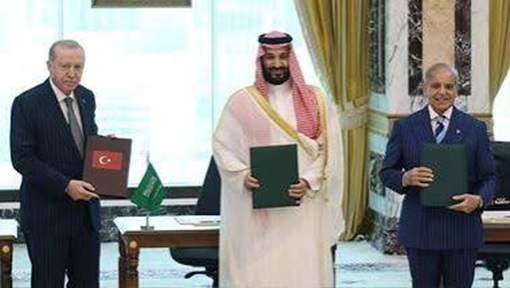
Recently, Pakistan, Saudi Arabia and Türkiye signed the Mecca Joint Defence Agreement, establishing a landmark trilateral security framework in West Asia. The agreement was concluded at the Mecca Al-Mukarramah Summit for Joint Defence and represents a significant evolution in strategic cooperation among the three countries. Its most important provision is a collective defence clause, under which an armed attack against any one of the three signatories will be treated as an attack against all three.
Background
- The agreement builds upon growing defence and strategic cooperation between the participating countries. It also follows the Strategic Mutual Defence Agreement signed between Saudi Arabia and Pakistan in September 2025.
- The expansion into a trilateral framework with Türkiye potentially gives the arrangement a wider military, technological and geopolitical dimension.
- The agreement comes amid heightened instability in the region, including continuing tensions involving Iran, Israel and the United States, as well as repeated drone and maritime attacks affecting critical Gulf infrastructure and energy routes. These developments have encouraged regional states to strengthen collective deterrence and security mechanisms.
Key Features of the Agreement
- The agreement was signed at Al-Safa Palace in Mecca by Saudi Crown Prince Mohammed bin Salman, Turkish President Recep Tayyip Erdoğan and Pakistani Prime Minister Shehbaz Sharif.
- Its central feature is the mutual defence commitment. The arrangement resembles the principle underlying Article 5 of the North Atlantic Treaty, although the agreement is a separate regional security arrangement. The collective-defence clause is designed to strengthen deterrence by ensuring that aggression against one member would trigger a collective response framework.
- Beyond mutual defence, the pact provides for institutionalised intelligence sharing, joint military exercises and defence-industrial cooperation and co-production. These mechanisms could improve interoperability among the armed forces of the three countries and facilitate greater exchange of military expertise and technology.
Strategic Importance of the Three Countries
- The alliance brings together three countries possessing complementary strategic capabilities.
- Saudi Arabia contributes substantial financial resources, strategic geographical depth and control over important energy routes. Its position in the Gulf gives the partnership significance for regional energy security.
- Türkiye contributes advanced defence technologies, including drone systems, aerospace and defence-manufacturing capabilities, and extensive military experience through its membership in NATO. Its geographical position also provides an important bridge between Europe, West Asia and Asia.
- Pakistan brings a large conventional military establishment, extensive combat experience and nuclear deterrence capabilities. Its strategic location and military capacity further strengthen the alliance's security dimension.
- Together, these capabilities create a framework combining financial strength, defence technology and military capacity.
Geopolitical Significance
- The agreement has been described by commentators as an emerging “Islamic NATO”, although this is an informal description rather than the official name of the arrangement. The comparison primarily arises from the agreement's collective-defence provision.
- However, the participating countries have sought to emphasise the defensive character of the pact. Saudi and Turkish officials have reportedly downplayed suggestions that the agreement is intended to create an offensive military bloc or initiate a regional arms race. The framework has also been described as potentially open to participation by other regional countries.
- For the wider region, the pact could influence existing security alignments and defence partnerships. Its implications are particularly relevant for Gulf security, energy infrastructure, counter-drone capabilities, intelligence cooperation and regional deterrence.
India and Regional Implications
- The emergence of a formal defence arrangement involving Pakistan, Saudi Arabia and Türkiye is also relevant from India's strategic perspective. India maintains important economic, energy and diplomatic relations with Saudi Arabia and has significant engagement with the Gulf region.
- At the same time, India's relations with Pakistan and Türkiye involve longstanding strategic and political differences.
- The agreement therefore creates a new regional security dynamic that New Delhi will need to monitor carefully.
- However, the available material indicates that Indian authorities are closely monitoring developments, rather than suggesting any immediate change in India's policy.
Limitations and Challenges
- Despite its strategic significance, the agreement faces several challenges. Translating a political commitment into an effective collective-defence mechanism will require detailed operational arrangements, military interoperability and sustained intelligence and defence cooperation.
- Differences in the strategic priorities of the three countries could also influence the alliance's future direction. Saudi Arabia's focus on regional stability and economic transformation, Türkiye's broader geopolitical ambitions and NATO commitments, and Pakistan's security priorities may not always converge.
- Furthermore, the agreement's effectiveness will depend on how its collective-defence clause is interpreted and implemented during an actual crisis.
Conclusion
- The Mecca Joint Defence Agreement of 7 August 2026 marks an important development in the evolving security architecture of West Asia and its surrounding regions.
- By combining Saudi Arabia's financial and energy significance, Türkiye's defence-industrial capabilities and Pakistan's military and nuclear deterrence, the trilateral framework creates a potentially influential regional security partnership.
- Its collective-defence clause, intelligence-sharing mechanisms, joint exercises and defence-industrial cooperation indicate an ambition to move beyond symbolic diplomacy towards institutionalised security cooperation.
- Nevertheless, its long-term significance will depend on implementation, regional responses and the ability of the three countries to maintain strategic cohesion.