


 Don't Have an Account?




SSC Foundation Eklavya - 2 Offline Cum Online Batch Lucknow Branch
10 September, 2026



Enter your Email ID and we'll send you a link to get back into your account.

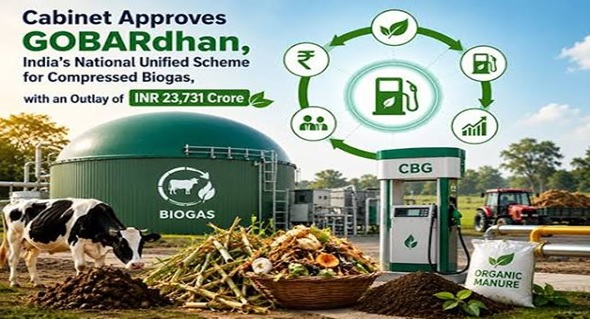

GOBARdhan: The National Circular Bioenergy Scheme
Thu 06 Aug, 2026
Context
The Union Cabinet has approved GOBARdhan: The National Circular Bioenergy Scheme with a total financial outlay of ₹23,731 crore for a period of ten years (FY 2026–27 to FY 2035–36). The scheme aims to transform India's vast organic waste resources into clean energy, strengthen rural livelihoods, reduce dependence on fossil fuels, and promote a circular economy. By integrating multiple existing bioenergy initiatives under one umbrella, the scheme seeks to significantly scale up Compressed Biogas (CBG) production while contributing towards India's climate commitments, waste management goals, and sustainable agricultural practices.
Background
India generates enormous quantities of agricultural residues, cattle dung, municipal solid waste, food waste, sewage sludge, and industrial organic waste every year. Much of this biomass remains underutilized or is disposed of through open burning and dumping, leading to severe environmental pollution and greenhouse gas emissions. Recognizing the economic potential of organic waste, the Government has introduced the GOBARdhan (Galvanizing Organic Bio-Agro Resources Dhan) Scheme as a comprehensive national framework for converting waste into valuable bioenergy and organic manure. The initiative supports the broader vision of "Waste-to-Wealth", circular economy, energy security, and sustainable rural development.
Why is it in News?
Key Features of the Scheme
The scheme will be implemented by the Ministry of Petroleum and Natural Gas (MoPNG) over a period of ten years.
Major highlights include:
The scheme is built upon six major strategic pillars:
Feedstock and Bioenergy Production
These feedstocks are converted into Compressed Biogas (CBG), which contains more than 90% methane and serves as a clean substitute for Compressed Natural Gas (CNG).
Another valuable by-product is Fermented Organic Manure (FOM), which improves soil fertility and reduces dependence on chemical fertilizers.
Significance
The GOBARdhan Scheme represents a major step towards India's transition to a circular bioeconomy.
Its significance includes:
The scheme also strengthens India's long-term objective of achieving energy security while simultaneously addressing environmental and climate challenges.
Challenges
Addressing these challenges through institutional coordination and capacity building will determine the long-term success of the programme.
Way Forward
Conclusion
National Policy on Biofuels
| Particular | Details |
| Policy Name | National Policy on Biofuels |
| Launched | 2018 |
| Amended | 2022 |
| Nodal Ministry | Ministry of Petroleum and Natural Gas (MoPNG) |
| Objective | Promote biofuels, reduce crude oil imports, improve energy security and reduce emissions |
| Major Biofuels Covered | Bioethanol, Biodiesel, Compressed Biogas (CBG), Sustainable Aviation Fuel (SAF), Advanced Biofuels |
| Biofuel | Generations 1G (Sugarcane, Food Crops), 2G (Agricultural Residues), 3G (Algae), 4G (Genetically Engineered Feedstocks) |
| Ethanol Blending Target | 20% Ethanol Blended Petrol (EBP) |
| Feedstock Permitted | Sugarcane juice, B-heavy molasses, C-heavy molasses, damaged food grains, maize, surplus rice, agricultural residues, bamboo, municipal waste etc. |
| Major Objectives | Energy Security, Farmer Income Enhancement, Waste-to-Wealth, Employment Generation, Climate Change Mitigation |
| Supporting Missions | SATAT, GOBARdhan, National Green Hydrogen Mission, EBP Programme |
Major Government Initiatives for Biofuels & Bioenergy
| Initiative | Year Started | Nodal Ministry/Agency |
| National Policy on Biofuels | 2018 | Ministry of Petroleum & Natural Gas |
| National Bio-Energy Programme | 2022 | Ministry of New & Renewable Energy (MNRE) |
| SATAT (Sustainable Alternative Towards Affordable Transportation) | 2018 | Ministry of Petroleum & Natural Gas |
| GOBARdhan Scheme | 2018 | Department of Drinking Water & Sanitation, Ministry of Jal Shakti |
| GOBARdhan: National Circular Bioenergy Scheme | 2026 | Ministry of Petroleum & Natural Gas |
| Ethanol Blended Petrol (EBP) Programme | 2003 | Ministry of Petroleum & Natural Gas |
| Pradhan Mantri JI-VAN Yojana | 2019 | Ministry of Petroleum & Natural Gas |
| Waste-to-Energy Programme | 2022 | MNRE |
| National Green Hydrogen Mission | 2023 | Ministry of New & Renewable Energy |
| Market Development Assistance (MDA) for Fermented Organic Manure (FOM) | 2023 | Ministry of Petroleum & Natural Gas |
10 September, 2026
24 August, 2026
06 August, 2026
28 July, 2026
27 July, 2026
22 July, 2026
20 July, 2026
26 May, 2026
08 May, 2026
20 April, 2026
