Repo Rate Unchanged at 5.25%
 
  • Mobile Menu
HOME BUY MAGAZINEnew course icon
LOG IN SIGN UP

Sign-Up IcanDon't Have an Account?


SIGN UP


Login Icon

Have an Account?


LOG IN
 

or
By clicking on Register, you are agreeing to our Terms & Conditions.


or


Repo Rate Unchanged at 5.25%

Wed 05 Aug, 2026

Context

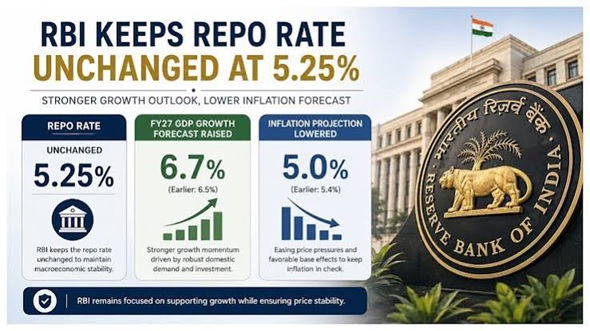
The Reserve Bank of India (RBI)'s Monetary Policy Committee (MPC), during its 62nd Monetary Policy Meeting held on 5 August 2026, unanimously decided to retain the policy Repo Rate at 5.25% while maintaining a "Neutral" monetary policy stance. The decision reflects RBI's cautious approach towards balancing economic growth with inflation management amid global geopolitical uncertainties, volatile crude oil prices, and domestic macroeconomic stability.

Background

  • The Monetary Policy Committee (MPC) is a statutory body constituted under the Reserve Bank of India Act, 1934, to formulate India's monetary policy with the primary objective of maintaining price stability while supporting economic growth.
  • The committee consists of six members and determines the benchmark policy interest rates after assessing inflation, GDP growth, liquidity, global developments, and financial stability. During its August 2026 meeting, the MPC unanimously decided to keep the repo rate unchanged, signalling confidence in India's resilient economic fundamentals despite external challenges.

Why is it in News?

  • The RBI's Monetary Policy Committee unanimously retained the Repo Rate at 5.25% and continued with a Neutral Stance.
  • The policy decision came against the backdrop of persistent global inflationary pressures, geopolitical tensions in West Asia, volatile crude oil prices, and concerns arising from El Niño affecting agriculture and rural demand. RBI emphasized maintaining flexibility to respond to evolving domestic and global economic conditions.

Key Highlights of the Monetary Policy

  • The Repo Rate was kept unchanged at 5.25%.
  • The Standing Deposit Facility (SDF) Rate remained at 5.00%.
  • The Marginal Standing Facility (MSF) Rate and Bank Rate continued at 5.50%.
  • RBI maintained a Neutral Monetary Policy Stance, allowing flexibility for future policy action depending on inflation and growth trends.
  • The MPC projected Real GDP Growth at 6.7% for FY 2026-27.
  • Consumer Price Index (CPI) inflation stood at 4.4% in June 2026, remaining within the RBI's inflation target band but requiring close monitoring.
  • The policy stressed the importance of supply-side measures, particularly in agriculture, to counter risks from deficient monsoon and El Niño conditions.

Significance

  • The decision demonstrates RBI's commitment to maintaining macroeconomic stability while supporting sustainable economic growth.
  • Keeping the repo rate unchanged ensures stability in borrowing costs for banks, businesses, and consumers, thereby promoting investment and credit growth.
  • A neutral stance provides policy flexibility, enabling RBI to either tighten or ease monetary policy depending on future inflationary or growth developments. The decision also reassures financial markets regarding policy predictability amid uncertain global conditions.

Challenges

Despite strong domestic fundamentals, several risks continue to pose challenges to India's monetary policy:

  • Geopolitical conflicts in West Asia leading to volatile crude oil prices.
  • El Niño-induced deficient monsoon affecting agricultural production and rural demand.
  • Rising inflationary pressures with the risk of second-round inflation effects.
  • Global financial market volatility due to shifting monetary policies of advanced economies.
  • Supply chain disruptions increasing production costs and affecting exports.

Way Forward

  • The RBI emphasized continuous monitoring of global geopolitical developments and crude oil prices while strengthening supply-side interventions in agriculture through crop diversification, water conservation, and climate-resilient practices.
  • Enhancing inflation monitoring, promoting export diversification, improving infrastructure investment, and supporting rural demand through targeted interventions will help sustain economic resilience. Maintaining a flexible monetary policy framework remains essential to address evolving domestic and international challenges.

Conclusion

  • The August 2026 Monetary Policy reflects RBI's balanced approach towards safeguarding economic growth without compromising price stability.
  • By retaining the Repo Rate at 5.25% and continuing with a neutral stance, the MPC has provided stability to financial markets while preserving flexibility to respond to future macroeconomic developments. Going forward, effective coordination between monetary policy, fiscal policy, and structural reforms will remain crucial for sustaining India's long-term economic growth amid an uncertain global environment.


RBI Policy Rates (August 2026)

Policy Rate / Tool Rate Purpose / Significance
Repo Rate 5.25% Rate at which RBI lends short-term funds to commercial banks against government securities.
Standing Deposit Facility (SDF) Rate 5.00% Rate at which banks park surplus funds with RBI without collateral.
Marginal Standing Facility (MSF) Rate 5.50% Emergency overnight borrowing facility for banks by dipping into SLR securities.
Bank Rate 5.50% Long-term rate at which RBI lends to commercial banks without repurchase agreement.
Monetary Policy Stance Neutral RBI retains flexibility to either increase or decrease policy rates depending on macroeconomic conditions.


About RBI


  • Established on the recommendation of the Hilton Young Commission (1926)
  • Established: 1 April 1935 under the Reserve Bank of India Act, 1934
  • Initial Headquarters: Kolkata
  • Permanent Headquarters (since 1937): Mumbai
  • Nationalized: 1 January 1949 under the Reserve Bank of India (Transfer to Public Ownership) Act, 1948
  • First Governor: Sir Osborne Smith
  • First Indian Governor: C. D. Deshmukh
  • Current Governor (2026): Sanjay Malhotra
  • Deputy Governors: Swaminathan J., Dr. Poonam Gupta, M. Rajeshwar Rao and T. Rabi Sankar
  • Administration: Governed by the Central Board of Directors
  • Accounting Year: April–March
  • Currency Issuance: Issues currency notes (except ₹1 notes and coins)
  • Monetary Policy: Formulates and implements monetary policy to control inflation through the Monetary Policy Committee (MPC)

Banker to Government and Banks

  • Foreign Exchange Management: Administers FEMA, 1999 and manages the country's foreign exchange reserves

Monetary Policy Committee (MPC)

  • The Monetary Policy Committee (MPC) is a statutory six-member body constituted under Section 45ZB of the amended Reserve Bank of India (RBI) Act, 1934.
  • It is chaired ex-officio by the RBI Governor and is responsible for determining the policy Repo Rate to achieve the inflation target while balancing price stability and economic growth.

Constitutional & Legal Framework

  • Legal Basis: Section 45ZB of the Reserve Bank of India Act, 1934 (amended through the Finance Act, 2016).
  • Recommendation: Constituted based on the recommendations of the Urjit Patel Committee on revising India's Monetary Policy Framework.
  • Nature: A statutory body whose decisions on the policy rate are legally binding on the Reserve Bank of India.

Composition of MPC

Category Members
Total Members 6 Members

Internal Members (3) 


  • RBI Governor (Chairperson)
  • Deputy Governor in charge of Monetary Policy
  • One officer nominated by the RBI Central Board
External Members (3) Experts in Economics, Banking, Finance or Monetary Policy appointed by the Central Government

Tenure

  • External Members: 4 years
  • Reappointment: Not eligible for reappointment.

Meetings

  • Minimum Meetings: At least 4 meetings every year.
  • Usual Practice: 6 meetings annually (Bi-monthly Monetary Policy Reviews).
  • Quorum: Minimum 4 members must be present for a valid meeting.

Voting Procedure

  • Every member has one vote.
  • Decisions are taken by majority voting.
  • In case of a tie, the RBI Governor exercises a casting (second) vote.

Objectives of MPC

The Monetary Policy Committee aims to:

  • Maintain Price Stability (Control Inflation).
  • Support Sustainable Economic Growth.
  • Ensure financial and macroeconomic stability through appropriate monetary policy decisions.

Inflation Target

Parameter Details
Target Inflation 4% (Consumer Price Index - CPI)
Upper Tolerance Limit  6%
Lower Tolerance Limit 2%
Inflation Band 4% ± 2%
Index Targeted Consumer Price Index (CPI) (Not Wholesale Price Index - WPI)

Accountability of RBI

  • If the average CPI inflation remains outside the prescribed tolerance band (2%–6%) for three consecutive quarters, the Reserve Bank of India must:
    • Submit a formal report to the Central Government.
    • Explain the reasons for failure.
    • Outline the corrective measures proposed.
    • Indicate the expected time frame for returning inflation to the target range.


Latest Courses