Cabinet Approves PM Surya Sarovar Yojana (PM-SSY)
 
  • Mobile Menu
HOME BUY MAGAZINEnew course icon
LOG IN SIGN UP

Sign-Up IcanDon't Have an Account?


SIGN UP


Login Icon

Have an Account?


LOG IN
 

or
By clicking on Register, you are agreeing to our Terms & Conditions.


or


Cabinet Approves PM Surya Sarovar Yojana (PM-SSY)

Sat 01 Aug, 2026

Context:

  • The Union Cabinet, chaired by Prime Minister Narendra Modi, approved the Pradhan Mantri Surya Sarovar Yojana (PM-SSY) on July 31, 2026.

Key Highlights:

  • Scheme Name: Pradhan Mantri Surya Sarovar Yojana (PM-SSY)
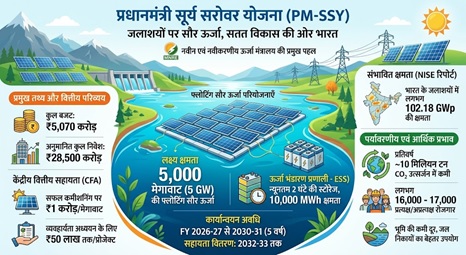
  • Objective: To develop 5,000 Megawatt (MW) capacity Floating Solar Photovoltaic (FSPV) projects across the country’s reservoirs and inland water bodies.
  • Total Financial Outlay: ₹5,070 Crore
  • Target Capacity: 5,000 MW (5 GW) Floating Solar Photovoltaic (FSPV) capacity
  • Energy Storage: Co-located Energy Storage Systems (ESS) with a minimum storage duration of 2 hours — totaling 10,000 MWh
  • Implementation Period: FY 2026-27 to FY 2030-31 (Financial assistance distribution will continue up to FY 2032-33)
  • Implementing Agencies: Ministry of New and Renewable Energy (MNRE) and Solar Energy Corporation of India (SECI)

Key Features of the Scheme:

  • Project Commissioning Support: Central Financial Assistance (CFA) of ₹1 Crore per MW for eligible FSPV projects after successful commissioning.
  • Feasibility Study Support: Grant of up to ₹50 Lakh per project for Bathymetry, Hydrography, and Environmental Impact Assessment (EIA).

Technical & Infrastructure Aspect:

  • Floating Technology: Installation of solar panels on the surface of reservoirs, dams, lakes, and industrial ponds.
  • Energy Storage: Mandatory minimum 2-hour battery storage integrated into each project to ensure seamless and stable power supply to the grid.
  • National Capacity Expansion: India’s current floating solar capacity is around 700 MW, which this scheme aims to scale up to 5,700 MW.

Need and Background of the Scheme:

  • Vast Potential: According to the assessment by the National Institute of Solar Energy (NISE), India possesses a potential capacity of approximately 102.18 GWp for floating solar on reservoirs and inland water bodies.
  • Land Acquisition Bottlenecks: Given the land scarcity and land acquisition disputes/delays in India, utilizing water bodies presents an ideal alternative.
  • Climate Commitments (COP-26 & NDCs): Accelerates India's targets of achieving 500 GW of non-fossil energy capacity by 2030 and 'Net-Zero' carbon emissions by 2070.

Significance and Potential Benefits:

┌──► Land Conservation (Zero Land Friction)

├──► Water Conservation (Reduced Evaporation)

Benefits of PM-SSY ─┼──► Higher Efficiency (Cooling Effect -> High Efficiency)

├──► Grid Stability (Energy Storage System)

└──► Environment & Employment (10M tonnes CO2 Cut | 17k Jobs)

  • Land Conservation: Development of massive solar energy capacity without acquiring agricultural or commercial land.
  • Water Conservation: Solar panels installed over water surfaces reduce direct sunlight exposure, significantly curbing water evaporation losses.
  • Higher Panel Efficiency: The natural cooling effect of water regulates panel temperature, boosting electricity generation efficiency by 5–10%.
  • Grid Stability & Dispatchability: Integration with ESS (Energy Storage) allows power supply during peak hours, maintaining grid frequency balance.

Environmental and Socio-Economic Impact:

  • Reduction of approximately 10 Million Tonnes (1 Crore Tonnes) of $\text{CO}_2$ emissions annually.
  • Creation of 16,000 to 17,000 direct and indirect jobs across the entire value chain.

Challenges and Concerns:

  • High Initial Capital Cost: Due to floating structures, anchoring systems, and anti-corrosive materials, the installation cost of FSPV is 20–30% higher than ground-mounted solar plants.
  • Impact on Aquatic Ecosystems: Covering water body surfaces can limit sunlight and oxygen penetration, potentially affecting aquatic life (fish, plankton).
  • Operation & Maintenance (O&M) Complexities: Fluctuations in water levels, storms, corrosion, and bio-fouling pose risks of damage to panels and anchoring grids.
  • Power Evacuation & Grid Connectivity: Many remote reservoirs lack high-capacity transmission lines nearby, requiring additional infrastructure investments.

Current Status and Potential of Floating Solar in India:

  • Total Capacity: As of 2026, India's installed floating solar power capacity stands at merely ~700 Megawatts (MW) or 0.7 Gigawatts (GW).
  • Development Status: This accounts for a very small fraction of India's total installed solar grid (which is close to ~100 GW), prompting the government to launch the 'Pradhan Mantri Surya Sarovar Yojana' to boost it.

Top States by Floating Solar Potential:

  • Maharashtra: 16.28 Gigawatts (GW)
  • Madhya Pradesh: 14.89 Gigawatts (GW)
  • Karnataka: 13.69 Gigawatts (GW)
  • Odisha: 12.81 Gigawatts (GW)
  • Telangana: 10.72 Gigawatts (GW)

Major Floating Solar Plants in India:

Project Name State Capacity Key Facts
Omkareshwar Floating Solar Park Madhya Pradesh (Khandwa District) 600 MW (Total)


278 MW Operational Located on the reservoir of the Narmada River, this is India's largest floating solar project.

Ramagundam FSPV Telangana 100 MW Developed by NTPC on the balancing reservoir of a thermal power plant.
Kayamkulam FSPV Kerala 92 MW Another major operational project constructed by NTPC.
Simhadri FSPV Andhra Pradesh 25 MW Based on the reservoir of NTPC's Simhadri Thermal Power Station.

Latest Courses