China's 'Artificial Sun' and 582-Ton Superconducting Magnet
 
  • Mobile Menu
HOME BUY MAGAZINEnew course icon
LOG IN SIGN UP

Sign-Up IcanDon't Have an Account?


SIGN UP


Login Icon

Have an Account?


LOG IN
 

or
By clicking on Register, you are agreeing to our Terms & Conditions.


or


China's 'Artificial Sun' and 582-Ton Superconducting Magnet

Fri 31 Jul, 2026

Context:

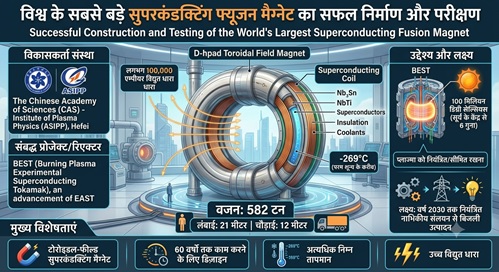
  • Under its 'Artificial Sun' program, China successfully completed the construction and testing of the world's largest superconducting fusion magnet, weighing 582 tons.

Key Points:

  • Event: Construction and testing of the world's largest superconducting fusion magnet.
  • Weight and Size: Weight of 582 tons and length of 21 meters.
  • Type of Magnet: Toroidal-field superconducting magnet.
  • Developer Organization: Institute of Plasma Physics, Chinese Academy of Sciences, Hefei.
  • Associated Project/Reactor: BEST (Burning Plasma Experimental Superconducting Tokamak) – this is the next version of EAST (Experimental Advanced Superconducting Tokamak).
  • Objective: To control and confine plasma at temperatures exceeding 100 million degrees Celsius (more than 6 times hotter than the core of the Sun).
  • Target: To demonstrate electricity generation from controlled nuclear fusion by the year 2030.
  • Shape and Dimensions: It is a 'D'-shaped toroidal-field magnet, with a length of 21 meters and a width of 12 meters. It is 13% larger in volume compared to the magnets built for the International Thermonuclear Experimental Reactor (ITER).
  • ITER: 'International Thermonuclear Experimental Reactor' located in France (India is also a member country).
  • Working Principle: It is designed to operate at an extremely low temperature of minus 269 degrees Celsius (near absolute zero) for 60 years and carry an electric current of more than 100,000 Amperes.
  • Nuclear Fusion: The energy-generating process in the Sun and stars, in which light hydrogen atoms combine to form heavy helium atoms.
  • Tokamak: A donut-shaped device that uses a magnetic field to control plasma.
  • Superconductivity: A state of zero electrical resistance at extremely low temperatures, allowing massive electrical currents to flow without energy loss.

Nuclear Fusion:

  • Definition: When two or more light nuclei combine under extremely high temperature and pressure to form a heavy nucleus, it is called nuclear fusion.
  • Energy: This process releases several times more energy compared to nuclear fission.
  • Equation (Example): Deuterium + Tritium → Helium + Neutron + Energy

Source of Energy in the Universe:

  • Sun and Stars: Nuclear fusion is the primary source of energy in the Sun and other stars in the universe.
  • Process: In the core of the Sun, hydrogen nuclei continuously fuse to form helium, releasing unlimited light and heat.

Hydrogen Bomb:

  • Principle: The hydrogen bomb works entirely on the principle of Uncontrolled Nuclear Fusion.
  • Invention: The hydrogen bomb was invented by Edward Teller in 1952.
  • Lethality: It is thousands of times more powerful and destructive than an atomic bomb.
  • Special Note: A temperature of 10 million Kelvin (extremely high) is required to initiate a fusion reaction. Therefore, a small atomic bomb (fission-based) is detonated first inside a hydrogen bomb to trigger the explosion.

Nuclear Fission:

  • Definition: When a heavy nucleus is bombarded with neutrons, it splits into two or more lighter nuclei.
  • Energy: This process releases a massive amount of energy along with a few new neutrons.
  • Discovery: Discovered in 1938 by Otto Hahn and Fritz Strassmann.

Main Fuel:

  • Uranium-235: The primary and naturally occurring fissionable fuel.
  • Plutonium-239: A synthetic fuel prepared in reactors.

Chain Reaction:

  • The neutrons released after fission split other nuclei, creating a 'chain'.

It is of two types:

  • Controlled Chain Reaction: In this, the speed and number of neutrons are controlled, allowing energy to be generated in a controlled manner. This type of reaction is used in nuclear reactors for safe electricity generation.
  • Uncontrolled Chain Reaction: In this, there is no control over the number and speed of neutrons, causing the reaction to spread extremely fast and result in a massive explosion with huge amounts of energy. This type of reaction is used in atomic bombs.

Main Components of a Nuclear Reactor:

  • The main components of a nuclear reactor include Fuel, Moderator, Control Rods, and Coolant.
  • Uranium-235 or Plutonium-239 is generally used as fuel.
  • The moderator slows down the speed of neutrons to sustain the chain reaction, for which Heavy Water and Graphite are used.
  • Control rods absorb extra neutrons to keep the reaction controlled; these are generally made of Cadmium or Boron.
  • The coolant absorbs the generated heat and transfers it to the turbine; Ordinary Water, Heavy Water, or Liquid Sodium are used for this purpose.
  • First Nuclear Reactor: Built in 1942 under the leadership of Enrico Fermi in Chicago.
  • Principle of Atomic Bomb: Completely based on uncontrolled nuclear fission.
  • First Atomic Bomb: Built under the 'Manhattan Project', whose father was J. Robert Oppenheimer.
  • Source of Energy: Energy in fission is released due to mass defect, following Einstein's famous mass-energy equation.
  • India's First Nuclear Reactor: Apsara, which was established in 1956 at Trombay (Mumbai).

Nuclear Fission vs. Nuclear Fusion:

Feature Nuclear Fission Nuclear Fusion
Process Splitting of a heavy nucleus into two smaller nuclei Combining of two light nuclei to form a larger nucleus
Raw Material Heavy elements like Uranium and Plutonium Forms of Hydrogen (Deuterium and Tritium)
Waste Large amounts of long-lasting radioactive waste Very minimal and short-lived radioactive waste
Safety Risk of chain reaction getting uncontrolled Extremely safe, as the process stops as soon as the fuel supply is cut off
Current Status Used in current nuclear power plants Currently in experimental phase (China's artificial sun is an example)

Latest Courses