Prevention of Insults to National Honour (Amendment) Bill, 2026 Passed
 
  • Mobile Menu
HOME BUY MAGAZINEnew course icon
LOG IN SIGN UP

Sign-Up IcanDon't Have an Account?


SIGN UP


Login Icon

Have an Account?


LOG IN
 

or
By clicking on Register, you are agreeing to our Terms & Conditions.


or


Prevention of Insults to National Honour (Amendment) Bill, 2026 Passed

Thu 30 Jul, 2026

Context:

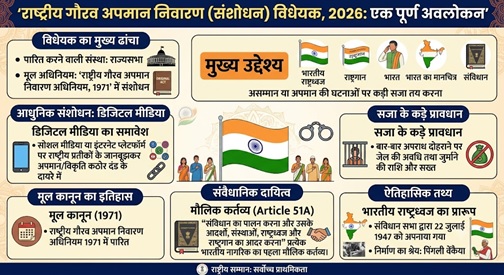
  • Rajya Sabha passed the Prevention of Insults to National Honour (Amendment) Bill, 2026 to protect national honour.

Key Points:

  • Main Objective: To provide statutory protection to the National Song 'Vande Mataram' equal to that of the National Anthem 'Jana Gana Mana'.
  •  
  • In the 'Prevention of Insults to National Honour Act, 1971'.
  • Offence: Intentionally preventing the singing of the National Song or causing disturbance to any assembly engaged in such singing shall be an offence.
  • Constituent Assembly Reference: It cites the Constituent Assembly meeting held on January 24, 1950.
  • In that meeting, the then President Dr. Rajendra Prasad highlighted the historical role of Vande Mataram in India's freedom struggle, stating that it should be honored equally and given equal status alongside Jana Gana Mana.
  • There was previously no specific statutory provision providing similar protection to the National Song.
  • Under this, it is proposed to include Vande Mataram within the scope of Section 3 of the 1971 Act.
  • Fundamental Duty (Article 51A): According to Article 51A(a) of the Constitution, it is the fundamental duty of every citizen of India "to abide by the Constitution and respect its ideals and institutions, the National Flag and the National Anthem."

Key Provisions of the 2026 Bill:

  • Amendment to Section 3: Clause 2 replaces the existing provision of Section 3 with a new provision that incorporates both the National Anthem (Jana Gana Mana) and the National Song (Vande Mataram).
  • Covered Conduct: The substituted Section 3 will apply to situations where any person intentionally—
  1. Prevents the singing of the National Anthem or National Song;
  2. Causes disturbance to any assembly engaged in such singing.
  • Short Title: Clause 1 provides that this law may be called the Prevention of Insults to National Honour (Amendment) Act, 2026.
Subject Original Act (1971) New Amendment of 2026
Scope of Protection Covers only the 'National Anthem' (Jana Gana Mana) Covers both the 'National Anthem' and the 'National Song' (Vande Mataram)
Definition of Offence Preventing singing or causing disturbance to an assembly Preventing singing or causing disturbance to an assembly during the National Anthem or National Song
Penalty Provision Imprisonment up to 3 years, or fine, or both Imprisonment up to 3 years, or fine, or both
Penalty on Recurrence Minimum 1 year for the second/subsequent conviction Minimum 1 year imprisonment upon second or subsequent conviction


Vande Mataram:

  • Meaning: "Mother, I bow to thee"
  • Original Tune: Its original tune was composed by Yadunath Bhattacharya.
  • Modern Tune: The famous ragam-based tune heard today was prepared by Pandit Vishnu Digambar Paluskar and later by Pandit Ravi Shankar for All India Radio.
  • Original Composition (1875): Bankim Chandra Chattopadhyay composed it on November 7, 1875. It was a strong Indian response against the imposition of 'God Save the Queen' by the British administration.
  • Inclusion in Anandamath (1882): The song first appeared in the literary magazine Bangadarshan and was later included in Bankim Chandra's famous novel Anandamath (1882). The novel is set against the backdrop of the Sannyasi Rebellion (1770s) and the Bengal famine.
  • Language: Its first two stanzas are predominantly in Sanskrit, while the remaining stanzas are in Bengali.
  • First Public Performance (1896): Rabindranath Tagore sang this song set to music for the first time at the Calcutta session of the Indian National Congress in 1896.
  • Swadeshi Movement (1905): During the Swadeshi Movement launched against the partition of Bengal, 'Vande Mataram' became the primary slogan of civil resistance against British rule and a mantra for nationalists.
  • International Platform (1907): Madam Bhikaiji Cama unfurled India's first tricolor flag in Stuttgart (Germany) in 1907, which featured 'Vande Mataram' inscribed in the Devanagari script at its center.
  • Newspaper (1906): Inspired by this song, Bipin Chandra Pal and Aurobindo Ghosh edited the English daily newspaper Bande Mataram.
  • Official Adoption (1937): The Congress Working Committee (CWC) in October 1937 officially adopted only the first two stanzas of the song as the National Song.
  • Constitutional Status:
    • January 24, 1950: On the final day of the Constituent Assembly, then-President Dr. Rajendra Prasad declared that 'Jana Gana Mana' would be the National Anthem of India, and 'Vande Mataram' would be granted equal status and honor due to its historical significance.
    • Mention in the Constitution: There is no explicit statutory mention of the term 'National Song' in the Constitution of India. However, under Article 51A(a) of the 'Fundamental Duties', citizens are required to respect only the National Flag and the National Anthem.

Prevention of Insults to National Honour Act, 1971:

  • Enactment: December 23, 1971
  • Objective: Respect and protection of the National Flag, Constitution, and National Anthem.
  • Constitutional Basis: Article 51A(a) (Fundamental Duties).
  • Section 2: Up to 3 years imprisonment, fine, or both for disrespecting the National Flag or the Constitution.
  • Section 3: Up to 3 years imprisonment, fine, or both for preventing or causing disturbance during the National Anthem.
  • Section 3A (2003): Mandatory imprisonment of at least 1 year upon repeated conviction.

National Anthem 'Jana Gana Mana':

  • Originally composed in Bengali by Gurudev Rabindranath Tagore as the first stanza of the poem Bharoto Bhagyo Bidhata, which was adopted in its Hindi version as the National Anthem by the Constituent Assembly on January 24, 1950.
  • First Public Singing: First sung on December 27, 1911, at the Calcutta session of the Indian National Congress (INC).
  • Original Composition: Originally written in Bengali with a heavy Sanskrit influence. The full song consists of 5 stanzas, but only the first stanza is officially recognized as the National Anthem.
  • Constituent Assembly Decision: The Constituent Assembly declared it as the National Anthem on January 24, 1950. On the same day, 'Vande Mataram' was accorded the status of the National Song.
  • Contribution of Subhash Chandra Bose: In 1941, under the direction of Netaji Subhash Chandra Bose, Captain Abid Ali prepared a translation (soldier version) called Subh Sukh Chain.
  • Full Version Duration: The official duration for playing or singing the full version of the National Anthem is specified as approximately 52 seconds.
  • Bijoe Emmanuel v. State of Kerala (1986): In this landmark case, the Supreme Court ruled that if a person refrains from singing the National Anthem due to genuine religious beliefs (e.g., Jehovah's Witnesses) but stands respectfully and quietly, it will not be considered disrespect. It is protected under Freedom of Speech and Expression (Article 19).


Latest Courses