GK Update
 
  • Mobile Menu
HOME BUY MAGAZINEnew course icon
LOG IN SIGN UP

Sign-Up IcanDon't Have an Account?


SIGN UP


Login Icon

Have an Account?


LOG IN
 

or
By clicking on Register, you are agreeing to our Terms & Conditions.


or


GK Update

Tue 28 Jul, 2026

Context:

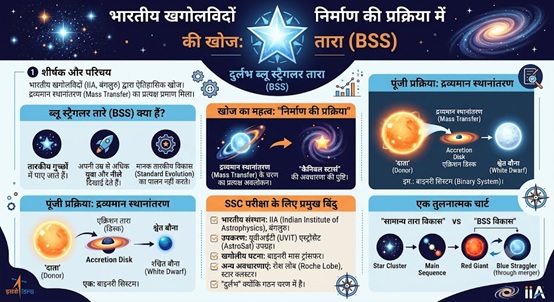
  • Indian astronomers have discovered a rare Blue Straggler Star (BSS) in the process of formation, providing direct evidence of mass transfer.

Key Highlights:

  • Star Cluster: The discovery was made in the old open star cluster Collinder 261, located about 9,500 light-years from Earth.
  • Binary System: The system is named TIC 327546480 and is a semi-detached binary system.
  • Mass Details: The newly forming BSS has a mass 1.67 times that of the Sun and is continuously accreting matter from its companion star, which has a mass of 0.32 solar masses.
  • Roche Lobe Overflow: The companion star has expanded beyond its gravitational boundary (the Roche lobe), allowing gas to flow onto the BSS.
  • Rotation & Orbital Period: Due to mass accretion, the BSS is rotating at a high speed of 69.55 km/s, and the two stars complete one orbit in 2.11 days.
  • X-ray Emission: Strong X-ray emissions from the system confirm that mass transfer is still ongoing.
  • Age Analysis: The star cluster is about 7 billion years old, while the mass transfer process began around 5.46 billion years ago and continues today.

Major Instruments and Institutions Used:

  • IIA (Indian Institute of Astrophysics): An autonomous institute under the Department of Science and Technology (DST), Bengaluru.
  • NASA's TESS Mission: High-precision light curves from NASA's Transiting Exoplanet Survey Satellite (TESS) were used in the study.
  • Very Large Telescope (VLT): Operated by the European Southern Observatory (ESO) in Chile, it was used to measure radial velocity.
  • Research Journal: The study was published in The Astrophysical Journal Letters.

Blue Straggler Star (BSS):

  • Definition: Blue Straggler Stars are unusual stars found in star clusters that appear hotter, brighter, and more massive than other stars in the same cluster.
  • A Cosmic Anomaly: According to normal stellar evolution, more massive stars should age and die earlier. However, these stars remain young and blue even in old star clusters, earning the name "Stragglers."
  • Discovery History: Blue Straggler Stars were first discovered in 1953 by Allan Sandage in the globular cluster M3.

Latest Courses