27 July, 2026
Ancient Buddhist Site of Sarnath Inscribed on the UNESCO World Heritage List
Sun 26 Jul, 2026
Context:
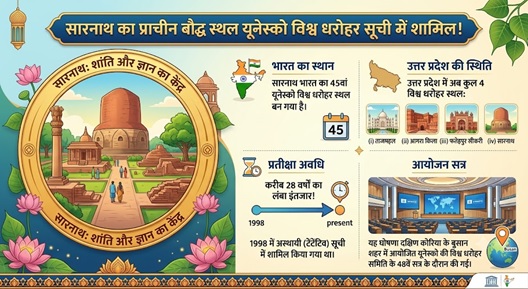
- At the 48th Session of the World Heritage Committee, held in Busan, South Korea, the Ancient Buddhist Site of Sarnath (Varanasi, Uttar Pradesh) was inscribed on the UNESCO World Heritage List.
Key Highlights:
- India's Position: Sarnath has become India's 45th UNESCO World Heritage Site.
- Uttar Pradesh's Status: With Sarnath's inscription, Uttar Pradesh now has 4 UNESCO World Heritage Sites – Taj Mahal, Agra Fort, Fatehpur Sikri, and Sarnath.
- Waiting Period: Sarnath received the recognition after a 28-year wait, having been placed on UNESCO's Tentative List in 1998.
- Session: The announcement was made during the 48th Session of the UNESCO World Heritage Committee in Busan, South Korea.
- Nomination Cycle: Sarnath was submitted as India's official nomination for the 2025–26 cycle.
UNESCO Nomination Criteria:
- Criterion (iii): Represents a unique or exceptional testimony to a living or extinct cultural tradition or civilization. Sarnath is a living testimony to Buddhist monasticism, philosophy, and the Sangha tradition from the 6th century BCE to the present.
- Criterion (vi): Directly associated with events, living traditions, ideas, beliefs, or artistic and literary works of outstanding universal significance. Sarnath is directly linked to Buddha's First Sermon (Dharmachakra Pravartana), the Noble Eightfold Path, and the establishment of the Buddhist Sangha.
Site Components:
- Chaukhandi Stupa: Marks the meeting of Lord Buddha and his first five disciples. It combines a Mauryan–Gupta period mound with an octagonal Mughal tower, built to commemorate Emperor Humayun's visit, symbolizing India's composite culture.
- Archaeological Remains of Sarnath: Include the Dhamek Stupa, Dharmarajika Stupa (built by Emperor Ashoka), Mulagandhakuti Vihara, and the Ashokan Pillar. The complex reflects the architectural evolution of the Maurya, Shunga, Kushan, and Gupta dynasties.
Ancient Names and Cultural Geography:
- Rishipattana / Isipatana: Meaning the place where sages or enlightened beings lived or descended.
- Mrigadava (Deer Park): A protected sanctuary for deer maintained by ancient kings, reflecting India's early tradition of wildlife conservation.
Global Buddhist Heritage:
Four Major Pilgrimage Sites Associated with Buddha:
- Lumbini (Nepal) – Birth – World Heritage Site
- Bodh Gaya (Bihar, India) – Enlightenment – World Heritage Site
- Sarnath (Uttar Pradesh, India) – First Sermon – World Heritage Site
- Kushinagar (Uttar Pradesh, India) – Mahaparinirvana – On the Tentative List / Under Consideration
Other Major Buddhist World Heritage Sites:
- India: Sanchi (Madhya Pradesh), Nalanda (Bihar), Ajanta (Maharashtra)
- Sri Lanka: Anuradhapura
- Bangladesh: Paharpur (Somapura Mahavihara)
- Pakistan: Taxila and Takht-i-Bahi
India's Cultural Diplomacy Timeline (2021–2026):
- 2021–2025: India served as an elected member of the UNESCO World Heritage Committee.
- July 2024: India hosted the UNESCO World Heritage Committee meeting for the first time in New Delhi.
- 25 July 2026: At the Busan Session, Sarnath was finally inscribed on the World Heritage List after remaining on the Tentative List since 1998, marking a major achievement in India's long-term cultural diplomacy.
UNESCO – General Information :
- Full Name: United Nations Educational, Scientific and Cultural Organization (UNESCO)
- Established: 1945
- Headquarters: Paris, France
- Objective: To promote peace and sustainable development through education, science, culture, and communication.
- World Heritage Convention: Adopted by UNESCO in 1972.
- As of October 2024: There are 1,223 World Heritage Sites in 196 countries:
-
- 952 Cultural
- 231 Natural
- 40 Mixed
India has 45 World Heritage Sites:
-
- 37 Cultural
- 7 Natural
- 1 Mixed
- Latest Addition (before Sarnath): Moidams (Ahom Dynasty Burial Mounds), Assam, inscribed in July 2024.
- World Heritage Day: Observed annually on 18 April.
- Theme (2025): "Heritage under Threat from Disasters and Conflicts: Preparedness and Learning from 60 Years of ICOMOS Actions."
- Government of India Initiatives: Various initiatives are being undertaken to promote and preserve India's rich cultural heritage.