GK Update
 
  • Mobile Menu
HOME BUY MAGAZINEnew course icon
LOG IN SIGN UP

Sign-Up IcanDon't Have an Account?


SIGN UP


Login Icon

Have an Account?


LOG IN
 

or
By clicking on Register, you are agreeing to our Terms & Conditions.


or


GK Update

Sun 26 Jul, 2026

National News

136th Episode of the Radio Programme 'Mann Ki Baat'
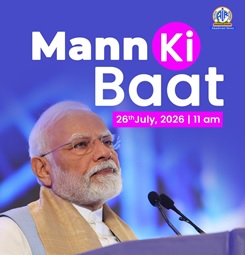
  • Prime Minister Narendra Modi shared his thoughts with people across the country and abroad today (July 26, 2026) at 11:00 AM through his popular monthly radio programme, 'Mann Ki Baat'. This was the 136th episode of the programme.

Related Facts:

  • It is broadcast live across all networks of All India Radio (AIR) and Doordarshan.
  • It can also be heard live on the AIR News website and the 'NewsOnAir' mobile app.
  • A live video broadcast is available on the official YouTube channels of DD News, the Prime Minister's Office (PMO), and the Ministry of Information and Broadcasting.
  • 'Mann Ki Baat' Programme:
  • Launch: October 3, 2014
  • Second Broadcast: November 2, 2014
  • US President Barack Obama also joined him in the programme in January 2015.
  • 100th Episode Broadcast: April 30, 2023

Important Day

Kargil Vijay Diwas (Kargil Victory Day)
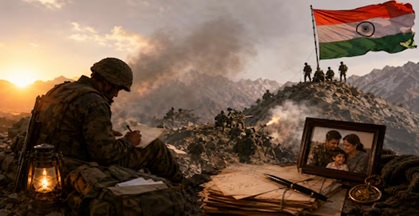
  • 'Kargil Vijay Diwas' is observed annually on July 26 to commemorate India's victory in the 1999 Kargil War.

Related Facts:

  • Kargil Conflict: An armed conflict fought between India and Pakistan in the high-altitude Kargil district of Ladakh between May and July 1999.
  • Date: July 26 ('Kargil Vijay Diwas' is observed annually).
  • Year: 1999 (The Kargil War was fought in this year).
  • Duration: The war lasted for approximately 60 days and concluded on July 26, 1999.
  • Significance in 2026: This year (2026), India is celebrating the 27th anniversary of its victory.

Military Operations:

  • Operation Vijay: The Indian Army's main ground campaign.
  • Operation Safed Sagar: The Indian Air Force's (IAF) aerial offensive campaign.
  • Operation Talwar: An offensive blockade carried out by the Indian Navy in the Arabian Sea.
  • Operation Badr: A covert operation launched by the Pakistan Army to infiltrate Indian territory.
  • War Heroes and Awards:
  • Captain Vikram Batra: 13 JAK Rifles (Codename: Sher Shah; Slogan: "Yeh Dil Maange More") – Posthumous.
  • Lieutenant Manoj Kumar Pandey: 1/11 Gorkha Rifles – Posthumous.
  • Grenadier Yogendra Singh Yadav: 18 Grenadiers (Youngest soldier to receive the Param Vir Chakra).
  • Rifleman Sanjay Kumar: 13 JAK Rifles.

Important Geographical Locations:

  • Kargil War Memorial: Located in the Drass sector of Ladakh. Drass is also known as the "Gateway to Ladakh" and is the coldest place in India.
  • Key Peaks: Tiger Hill, Tololing, Point 4875 (now known as Batra Top), and Point 5140. Highway: The enemy's objective was to block NH 1A (Srinagar to Leh)

Political Leadership:

  • India's then Prime Minister: Atal Bihari Vajpayee
  • India's then Defence Minister: George Fernandes
  • Indian Army Chief: General Ved Prakash Malik
  • Pakistan's Prime Minister: Nawaz Sharif
  • Pakistan's Army Chief: Pervez Musharraf

World Mangrove Day

  • The International Day for the Conservation of the Mangrove Ecosystem is observed annually on July 26.
  • It was adopted by UNESCO in 2015. Its primary objective is to raise awareness about the importance of mangrove forests and to promote their sustainable management and conservation.

Key Facts:

  • Date: Observed annually on July 26.
  • Inception: Declared by UNESCO in 2015.
  • Plant Type: Known as halophytes (plants capable of surviving in saline water).
  • Respiratory Roots: Due to the lack of oxygen in marshy soil, their roots emerge above ground into the air; these are called 'pneumatophores'.
  • Viviparity: The seeds of these plants germinate while still attached to the parent tree, ensuring the plant's survival without falling into the swamp.

Top 3 States/UTs:

  • West Bengal (Sundarbans – home to approximately 42% of the country's mangroves)
  • Gujarat
  • Andaman and Nicobar Islands
  • World's Largest Mangrove Forest: Sundarbans; it spans across India and Bangladesh. It holds the status of a UNESCO World Heritage Site. [1]

Sports News

World Junior Championship 2026

  • Indian squash player Anahat Singh won the 'Girls' Singles' title at the 'World Junior Championship 2026' by defeating Egypt's Ruqayya Salem.

Key Facts:

  • Winner's Name: Anahat Singh (Age: 18 years; from Delhi)
  • Title/Competition: World Junior Squash Championship 2026 (Girls' Singles)
  • Venue: Ontario / Niagara-on-the-Lake, Canada
  • Runner-up: Ruqayya Salem (Egypt)
  • Scoreline: A one-sided victory with a 3-0 score (11-3, 11-7, 11-9)
  • First Indian Record: Anahat Singh has become the first Indian player to win a gold medal at the World Junior Squash Championship.
  • Breaking Egypt's Monopoly: Players from Egypt had been winning the girls' category consecutively since 2011 (spanning 13 editions); Anahat ended this dominance. She became the first non-Egyptian player to win this title since American player Amanda Sobhy in 2010.
  • Joshna Chinappa's Record: India's previous best performance was in 2005, when veteran player Joshna Chinappa finished as the runner-up (winning the silver medal). Anahat surpassed that 21-year-old record. Anahat's previous record: She won a bronze medal in this same competition last year (in 2025, in Cairo, Egypt).

Squash:

  • A racket sport played on a four-walled court using a small, hollow rubber ball.
  • Origin: The sport originated in the 19th century (around 1830) at Harrow School in England. It is a modified version of the game 'Rackets'.
  • Governing bodies and headquarters:
  • WSF (World Squash Federation): Established in 1967; headquartered in Hastings, United Kingdom (UK).
  • SRFI (Squash Rackets Federation of India): The apex body for the sport in India; headquartered in Chennai, Tamil Nadu.
  • Court type: Squash is always played on a four-walled court resembling an enclosed room.
  • Court dimensions: Length is 9.75 meters (32 feet) and width is 6.40 meters (21 feet).
  • Tin height: The height of the metal strip at the bottom of the front wall (above which the ball must be hit) is 43 cm (17 inches).
  • Points: Each game consists of 11 points.
  • Match format: At the international level, matches are typically 'Best of 5' (best of 5 games), where the player who wins 3 games emerges victorious.

Key terminology:

  • Let: When a point is replayed due to an interruption in play.
  • Stroke: A penalty point awarded to the opponent due to interference or obstruction.
  • Nick: The corner where the wall meets the floor; if the ball lands here, it does not bounce at all. Drive, Boast, Lob, Drop Shot: These are the names of various types of shots played in squash.

Famous Indian players:

  • Male players: Saurav Ghosal, Harinder Pal Sandhu, Mahesh Mangaonkar, Abhay Singh.
  • Female players: Dipika Pallikal, Joshna Chinappa, Anahat Singh, Tanvi Khanna.

Economy and Banking

A Major Step Towards Becoming a Global Shipbuilding Hub
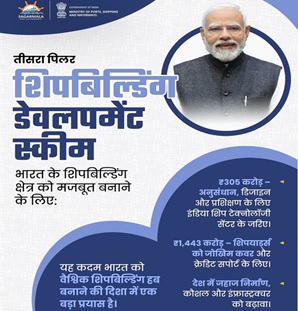
  • The Central Government has approved a comprehensive package worth ₹69,725 crore aimed at giving new momentum to the country's shipbuilding industry.
  • This policy is based on a four-pillar approach: financial assistance, capacity expansion, technological development, and policy reforms.

Related Facts:

  • Total Package Amount: ₹69,725 crore
  • Maritime Development Fund (MDF): ₹25,000 crore has been allocated for this.
  • MDF Fund Manager: 'SBI Ventures Limited' has been appointed as the fund manager.
  • Extension of SBFAS: The Shipbuilding Financial Assistance Scheme (SBFAS) has been extended until March 31, 2036.
  • Greenfield Shipbuilding Clusters: The government has approved the creation of new clusters in three states: Gujarat, Andhra Pradesh, and Tamil Nadu.
  • Institution: The 'India Ship Technology Centre' (ISTC) will be established for ship design and research.
  • International Cooperation: India's Ministry of Ports, Shipping and Waterways has signed an agreement with the Korea International Cooperation Agency (KOICA) for skill development and technical cooperation. (South Korea is one of the world's top shipbuilders.)
  • Vision: This package has been introduced to fulfill the goals of the Government of India's 'Maritime India Vision 2030' and 'Maritime Amrit Kaal Vision 2047'.
  • Capacity Target: The aim is to increase the country's annual shipbuilding capacity to 4.5 million Gross Tonnage (GT).
  • Employment Target: This scheme is estimated to generate approximately 30 lakh (3 million) new jobs in the maritime sector.
  • The government has also approved a Shipbuilding Development Scheme (SBDS) worth ₹19,989 crore.
  • Under this scheme, greenfield clusters will be developed, and brownfield expansion of existing shipyards will be undertaken. Its goal is to increase the country's shipbuilding capacity to 4.5 million gross tonnage per year.

International News

Spain Declares National Emergency for the First Time Due to Wildfires
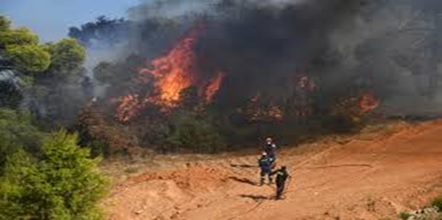
  • The Spanish government declared a national emergency for the first time in its history due to uncontrollable wildfires spreading across the Madrid and Ávila regions.

Key Facts:

  • Cause: Wildfires spiraled out of control in the outskirts of the Spanish capital, Madrid, and the neighboring province of Ávila due to severe heatwaves and drought. Two major fires merged to form a massive "convective fire."
  • Impact: More than 10,000 people were evacuated to safety, and over 100,000 hectares of land have burned so far this year.
  • Legal Framework: This emergency was declared under Spain's 'National Civil Protection System Law,' placing control directly in the hands of the Ministry of the Interior and the Military Emergency Unit (UME) to enable the mobilization of resources from across the country.

Art and Culture

Sarnath: An Ancient Buddhist Site in Varanasi
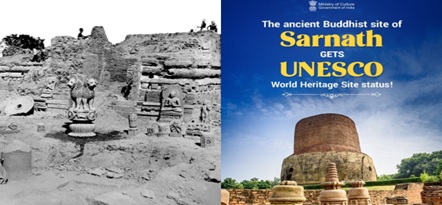
  • Sarnath, an ancient Buddhist site located in Varanasi, Uttar Pradesh, has been officially included in the UNESCO World Heritage List. This historic announcement was made on July 25, 2026, during the 48th session of the UNESCO World Heritage Committee held in Busan, South Korea.
  • Sarnath has attained this global status after a long wait of nearly 28 years (having been on the tentative list since 1998).
  • Sarnath has become India's 45th UNESCO World Heritage Site.
  • It is the fourth World Heritage Site in Uttar Pradesh, following the Taj Mahal, Agra Fort, and Fatehpur Sikri. With its inclusion, three of the four major pilgrimage sites of Buddhism—Lumbini (Nepal), Mahabodhi Temple (Bodh Gaya), and Sarnath—are now part of the UNESCO list.

Related Facts:

Sarnath:

  • Location: Varanasi, Uttar Pradesh
  • Historical Significance: Sarnath is the sacred site where Gautama Buddha delivered his first sermon—known as "Dharmachakra Pravartana" (Turning of the Wheel of Dharma)—around 528 BCE after attaining enlightenment. This marked the beginning of the spread of Buddhism.
  • Key Sites:
  • Sarnath Archaeological Museum: Managed by the Archaeological Survey of India (ASI); it houses the original Lion Capital of the Ashoka Pillar and numerous Buddhist artifacts.
  • Mulagandha Kuti Vihara Complex: A modern Buddhist temple, a Bodhi tree, and a major hub for pilgrims from across the world.
  • Jain and Hindu Temples: A pilgrimage site associated with Shreyanshanath (the 11th Tirthankara of Jainism) and Hindu ruins are also located nearby.
  • Excavation Site: An area excavated by the ASI, yielding numerous archaeological remains dating from the Mauryan to the Gupta periods.

UNESCO:

  • Full Name: United Nations Educational, Scientific and Cultural Organization
  • Established: 1945
  • Headquarters: Paris, France
  • Main Objective: To promote peace, cooperation, and sustainable development globally through education, science, culture, and communication.
  • World Heritage Convention: An international agreement adopted by UNESCO in 1972, aimed at the preservation of cultural and natural heritage.
  • As of October 2024: There are 1,223 World Heritage Sites listed across 196 countries, comprising 952 cultural, 231 natural, and 40 mixed sites.
  • World Heritage Sites in India: Currently, India has 43 UNESCO World Heritage Sites. Among these, Agra Fort, the Taj Mahal, and the Ajanta and Ellora Caves were the first to be listed in 1983.
  • India's Latest World Heritage Site: The Moidams of Assam (the mound-burial system of the Ahom Dynasty), which was added to the UNESCO World Heritage List in July 2024.
  • World Heritage Day: Observed annually on April 18. The theme for 2025 was—"Heritage at Risk from Disasters and Conflicts: Preparedness and Lessons from 60 Years of ICOMOS Action."

Person in the News

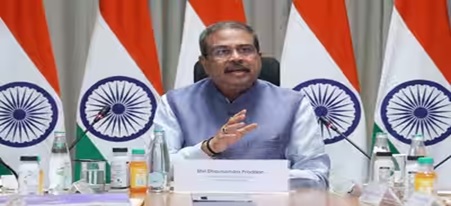
Dharmendra Pradhan

  • Union Education Minister Dharmendra Pradhan resigned from his post on July 25, 2026, amidst the NEET exam paper leak controversy and massive protests by students across the country (particularly by the 'Cockroach Janata Party' or CJP at Jantar Mantar).

Related Facts:

  • New Education Minister: Following Dharmendra Pradhan's resignation on July 25, 2026, Pralhad Joshi was appointed as the new Union Education Minister. (SSC exams often directly ask about the portfolios of new ministers.)
  • Reason for Controversy: This resignation followed the NEET-UG 2026 exam paper leak controversy and nationwide student protests.
  • Notable Movement: The protest at Delhi's Jantar Mantar was led by a youth organization named 'Cockroach Janata Party' (CJP) and renowned social activist Sonam Wangchuk (who had undertaken a 26-day hunger strike).

General Information on Ministers' Resignation:

  • Article 74: There shall be a Council of Ministers with the Prime Minister at the head to aid and advise the President.
  • Article 75(2) – Individual Responsibility: Under this, Union Ministers hold office during the 'pleasure of the President.' This means the President can remove any minister or accept their resignation based on the Prime Minister's advice.
  • Article 75(3) – Collective Responsibility: The Council of Ministers is collectively responsible to the Lok Sabha. If a 'No-Confidence Motion' is passed in the Lok Sabha, the entire government (including the Prime Minister) must resign.
  • Article 164 for States: At the state level, the appointment and resignation of the Chief Minister and ministers are handled through the Governor under Article 164.

Actual Resignation Process:

  • Submitting the letter to the Prime Minister: No Union Minister sends their resignation directly to the President; instead, they first submit their resignation letter to the Prime Minister. Presidential Approval: The Prime Minister forwards the recommendation for resignation to the President, who grants formal approval.
  • Gazette Notification: Following the President's approval, an official notification is issued in the Gazette of India by the Cabinet Secretariat. Only then is the minister's post legally considered vacant.
  • Resignation of the Prime Minister: If the Prime Minister resigns or passes away, the entire Council of Ministers automatically collapses.

History of resignations based on moral responsibility:

  • Lal Bahadur Shastri (1956): Resigned as Railway Minister, accepting moral responsibility following the Ariyalur train accident (India's first major instance).
  • T.T. Krishnamachari (1958): Resigned as Finance Minister following the LIC-Mundhra scandal.
  • V.K. Krishna Menon (1962): Resigned as Defence Minister following the failure in the India-China war.
  • Dharmendra Pradhan (2026): Recently resigned as Education Minister due to the NEET exam paper leak controversy.


Latest Courses