Approval of Bharat Audyogik Vikas Yojana – Rasayan (BHAVYA Rasayan)
 
  • Mobile Menu
HOME BUY MAGAZINEnew course icon
LOG IN SIGN UP

Sign-Up IcanDon't Have an Account?


SIGN UP


Login Icon

Have an Account?


LOG IN
 

or
By clicking on Register, you are agreeing to our Terms & Conditions.


or


Approval of Bharat Audyogik Vikas Yojana – Rasayan (BHAVYA Rasayan)

Sat 25 Jul, 2026

Context:

  • The Union Cabinet, chaired by the Prime Minister, has approved the Bharat Audyogik Vikas Yojana – Rasayan (BHAVYA Rasayan).

Key Information about the Scheme:

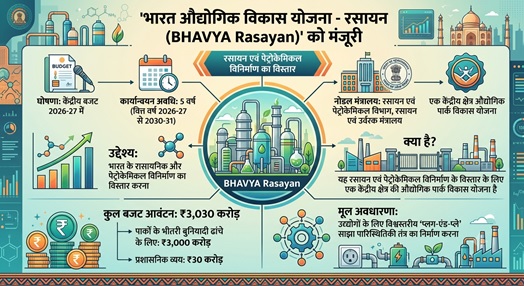
  • Full Name: Bharat Audyogik Vikas Yojana – Rasayan (BHAVYA - Bharat Audyogik Vikas Yojana Rasayan)
  • Announcement: The scheme was announced in the Union Budget 2026–27.
  • Implementation Period: The scheme will be implemented for 5 years (FY 2026–27 to FY 2030–31).
  • Nodal Ministry: Department of Chemicals and Petrochemicals, Ministry of Chemicals and Fertilizers.
  • It is a Central Sector Industrial Park Development Scheme.
  • Objective: To expand India's chemical and petrochemical manufacturing sector.
  • What is it? It is a Central Sector Industrial Park Development Scheme aimed at expanding chemical and petrochemical manufacturing in India.
  • Budget Allocation: Total outlay of ₹3,030 crore, including ₹3,000 crore for internal infrastructure development of parks and ₹30 crore for administrative expenses.
  • Implementation Period: FY 2026–27 to FY 2030–31 (5 years).
  • Core Concept: To develop a world-class "plug-and-play" shared industrial ecosystem for industries.

Key Features and Financial Framework:

  • Three Dedicated Parks: Three world-class dedicated chemical parks will be established under the scheme.
  • Challenge Route: States will be selected through a transparent, challenge-based competitive process.
  • Land Requirement: Participating states must provide a minimum of 8 square kilometres (approximately 2,000 acres) of contiguous and litigation-free land for each park.

Funding Pattern:

  • The Central Government will provide a grant of up to ₹1,000 crore for each park.
  • The grant will be available only if the concerned State Government contributes a minimum of ₹500 crore.

Shared Infrastructure Components:

  • Common Effluent Treatment Plants (CETPs) and Treatment, Storage & Disposal Facilities (TSDFs) for hazardous waste.
  • Continuous water supply, steam generation and distribution networks.
  • Solvent recovery and distillation facilities.
  • Integrated and interconnected industrial pipeline network.
  • Advanced logistics and warehousing facilities.

Strategic Importance and Benefits:

[Shared Infrastructure (CETP/Pipelines)] ➔ [Reduced Production & Logistics Costs] ➔ [Enhanced Global Competitiveness] ➔ [Export Promotion & Import Substitution]

  • Strengthening the Entire Value Chain: The scheme will bring upstream (raw materials), downstream (finished products), and ancillary industries together at one location, reducing transportation and handling costs.
  • Reducing Import Dependence: India currently depends on imports for several high-value chemicals. The scheme will increase domestic production and save foreign exchange.
  • Environmental Compliance: Centralized waste management will ensure better and more cost-effective compliance with pollution control regulations.
  • Multi-Sector Impact: The chemical industry serves as a backbone for sectors such as textiles, pharmaceuticals, agriculture (fertilizers), automobiles, and electronics. Strengthening the sector will benefit all these industries.
  • Investment and Employment: The scheme is expected to attract domestic and Foreign Direct Investment (FDI) and generate large-scale employment opportunities.

Important Facts about India's Chemical Sector

Global and Domestic Status:

  • Global Ranking: India is the 6th largest producer of chemicals in the world and the 3rd largest producer in Asia.
  • Contribution to GDP: The sector contributes over 7% of India's manufacturing GDP.
  • Position in Agrochemicals: India is the 3rd largest producer of agrochemicals globally, after the United States and China.
  • Hub for Dyes: India contributes 16–18% of the world's production of dyestuffs and dye intermediates.
  • Diversity and Market Size: The Indian chemical sector covers more than 80,000 commercial products. Its market size is estimated at US$250–300 billion by 2025–26, with expectations of reaching US$1 trillion by 2040.

Latest Courses