27 July, 2026
US–Saudi Arabia Nuclear Agreement
Fri 24 Jul, 2026
Context:
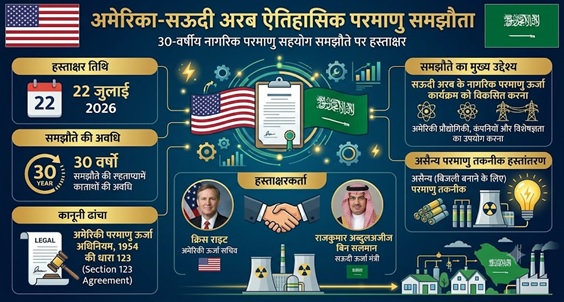
- The United States and Saudi Arabia signed a historic 30-year Civil Nuclear Cooperation Agreement.
Key Highlights:
- Main Objective: To develop Saudi Arabia's civilian nuclear energy programme using American technology, companies, and expertise.
- Date of Signing: 22 July 2026
- Duration of Agreement: 30 years
- Under the agreement, the United States will provide Saudi Arabia with civilian nuclear technology for electricity generation.
- Legal Framework: Section 123 of the U.S. Atomic Energy Act, 1954 (123 Agreement).
- Signatories: Chris Wright (U.S. Secretary of Energy) and Prince Abdulaziz bin Salman (Saudi Minister of Energy).
- Condition Linked to the Abraham Accords: U.S. President Donald Trump and the White House stated that the agreement will ultimately depend on Saudi Arabia's willingness to normalize diplomatic relations with Israel by joining the Abraham Accords.
Major Provisions of the Agreement:
- Transfer of Technology and Materials: The United States will provide Saudi Arabia with nuclear reactor technology, equipment, and technical expertise required for the construction of nuclear power plants.
- Uranium Enrichment: The agreement includes studies on establishing a uranium enrichment facility in Saudi Arabia with U.S. cooperation.
- Legal Requirement under Section 123: Under U.S. law, any transfer or sale of nuclear technology to another country requires a Section 123 Agreement.
Strategic and Geopolitical Significance:
- Energy Diversification (Vision 2030): Saudi Arabia aims to reduce its dependence on oil under its Vision 2030 programme. Nuclear power will reduce domestic oil consumption, allowing more crude oil exports.
- Keeping China and Russia Out: Without U.S. cooperation, Saudi Arabia could have turned to Russia (Rosatom) or China (CNNC). The agreement helps maintain U.S. strategic influence in West Asia.
- Regional Balance of Power: The deal may help counter Iran's nuclear influence in the region, though it has also raised concerns regarding regional strategic stability.
- Connection with the Abraham Accords: The U.S. administration views this agreement as part of broader efforts to normalize diplomatic relations between Saudi Arabia and Israel.
Major Concerns and Controversies:
- The United States has signed similar Section 123 Agreements with 26 countries. The India–U.S. Civil Nuclear Agreement was signed in 2008.
- • Traditionally, the U.S. requires non-nuclear weapon states to forgo uranium enrichment under such agreements, but this condition is absent in the Saudi agreement.
- • Saudi Arabia possesses uranium reserves. If permitted to enrich uranium, it could eventually produce nuclear fuel domestically.
- • Saudi Arabia aims to generate a significant share of its electricity from nuclear energy by 2030, reducing dependence on oil.
- • In 2009, the United States signed a Section 123 Agreement with the United Arab Emirates (UAE), under which the UAE permanently renounced uranium enrichment and spent fuel reprocessing rights. This became known as the "Gold Standard."
- • Unlike the UAE agreement, the Saudi agreement does not impose a complete prohibition on uranium enrichment, raising concerns among nuclear non-proliferation experts.
International Atomic Energy Agency (IAEA):
- Established: 29 July 1957 (following U.S. President Dwight D. Eisenhower's "Atoms for Peace" initiative).
- Headquarters: Vienna, Austria.
- Member States: More than 178 member countries (India is a founding member).
- Motto: "Atoms for Peace and Development."
- Award: Nobel Peace Prize (2005).
Relationship with the United Nations (UN):
- The IAEA is an autonomous international organization associated with the United Nations.
- It is not a regular UN specialized agency but operates under its own founding treaty (the IAEA Statute).
- It reports directly to both the United Nations General Assembly (UNGA) and the United Nations Security Council (UNSC).
India and the IAEA:
- Founding Member: India has been an active member since 1957.
- NPT and Safeguards: India has not signed the Nuclear Non-Proliferation Treaty (NPT); therefore, not all Indian nuclear facilities are under IAEA safeguards.
- India–U.S. Civil Nuclear Agreement (2008): Following this agreement, India concluded an India-specific Safeguards Agreement with the IAEA. Under this arrangement, India voluntarily places its civilian nuclear reactors under IAEA inspection, while military nuclear facilities remain outside its scope.
Nuclear Non-Proliferation Treaty (NPT):
- Opened for Signature: 1 July 1968.
- Entered into Force: 5 March 1970.
- Membership: Currently 191 States Parties.
- Duration: Extended indefinitely in 1995.
- Verification Authority: The IAEA monitors compliance with the treaty.
- India, Pakistan, Israel, and North Korea are not parties to the NPT, whereas Saudi Arabia is a member.