GK Update
 
  • Mobile Menu
HOME BUY MAGAZINEnew course icon
LOG IN SIGN UP

Sign-Up IcanDon't Have an Account?


SIGN UP


Login Icon

Have an Account?


LOG IN
 

or
By clicking on Register, you are agreeing to our Terms & Conditions.


or


GK Update

Wed 22 Jul, 2026

National News

Three-day meeting of BRICS Health Ministers
  • A three-day meeting of BRICS health ministers is being held in Chandigarh, hosted by India, starting from July 22.
  • The meeting will primarily focus on discussions regarding health security, digital health, pandemic preparedness, and universal access to quality healthcare.

Key Facts:

  • Edition: This is the 16th BRICS Health Ministers' Meeting
  • Venue: Chandigarh, India
  • Dates: July 22 to 24, 2026
  • Chaired by: Union Minister of Health and Family Welfare, Jagat Prakash Nadda
  • Main Theme: "Building for Resilience, Innovation, Cooperation and Sustainability"

Two new priority areas added by India:

  • BRICS Mission for Healthy Lifestyle
  • Mental Health Promotion

BRICS Organization:

  • Formation: In 2006 (initially it was 'BRIC')
  • First Summit: In 2009 (in Yekaterinburg, Russia)
  • When did South Africa join?: In 2010 (it then became BRICS)
  • India's Presidency: India is holding the BRICS presidency for the fourth time in 2026 (previously held in 2012, 2016, and 2021)
  • New expansion of BRICS: It now has a total of 11 member countries (Brazil, Russia, India, China, South Africa, Egypt, Ethiopia, Iran, Saudi Arabia, United Arab Emirates, and Indonesia)
  • BRICS Bank (NDB): The headquarters of the New Development Bank is in Shanghai, China.

Agreement between AAI and Steel Authority of India
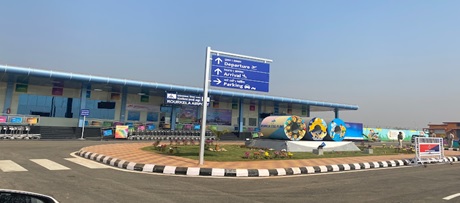
  • The Airports Authority of India (AAI) and Steel Authority of India Limited (SAIL) signed an expanded agreement for the operation and management of Rourkela Airport.
  • Concluded in New Delhi, this agreement marks a significant step towards enhancing regional air connectivity and accelerating socio-economic development in this industrial region of Odisha.

Key Facts:

  • Parties to the agreement: Airports Authority of India (AAI) and Steel Authority of India Limited (SAIL).
  • Objective: To expand the operation and management of Rourkela Airport in Odisha.
  • Additional Land: SAIL has approved the transfer of 140 acres of additional land to AAI for this expansion.
  • Scheme Name: This initiative has been undertaken under the Central Government's UDAN (RCS-UDAN) scheme, i.e., 'Ude Desh ka Aam Nagrik' (Let the common citizen of the country fly).

Airports Authority of India (AAI):

  • Establishment: April 1, 1995
  • Headquarters: New Delhi
  • It is a statutory body under the Ministry of Civil Aviation.

Steel Authority of India Limited (SAIL):

  • It is a 'Maharatna' public sector company of India.
  • Establishment: 1973
  • Headquarters: New Delhi

Rourkela Steel Plant (RSP):

  • It is India's first public sector integrated steel plant.
  • It was established with the collaboration of Germany.
  • State: Rourkela Airport is located in the Sundargarh district of Odisha.
  • Nickname: Rourkela is also known as the 'Steel Capital of Odisha'.
  • River: The city of Rourkela is situated on the banks of the Brahmani River (formed by the confluence of the Koel and Sankh rivers).

NCB Signs Bilateral Agreements with 27 Countries
  • The Government of India has signed bilateral agreements with 27 countries and Memorandums of Understanding (MoUs) with 19 countries to curb the illicit trafficking of narcotics at the international level.
  • According to information provided by the Minister of State for Home Affairs in Parliament (Lok Sabha), the Narcotics Control Bureau (NCB) is working to dismantle cross-border drug trafficking networks through these agreements.

Narcotics Control Bureau (NCB):

  • Establishment: 17 March 1986
  • Headquarters: New Delhi
  • Nodal Ministry: Ministry of Home Affairs
  • Relevant Law: NDPS Act (Narcotic Drugs and Psychotropic Substances Act), 1985
  • Constitutional Article: Article 47 of the Indian Constitution deals with the prohibition of the consumption of intoxicating drugs (it falls under the Directive Principles of State Policy - DPSP).
  • National Goal: The goal is to make India 'Drug-Free' by the year 2047.

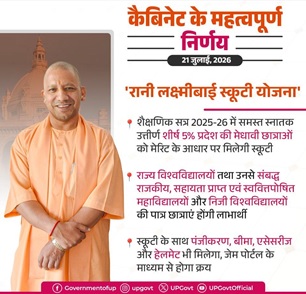
‘Rani Laxmibai Scooty Scheme’

  • The Uttar Pradesh government has approved the guidelines for implementing the ‘Rani Laxmibai Scooty Scheme’.

Key Facts:

  • Scheme Name: Rani Laxmibai Scooty Scheme
  • State Launching the Scheme: Uttar Pradesh (UP)
  • Announcement/Approval: Approved by the UP Cabinet in July 2026
  • Total Allocated Budget: ₹400 crore
  • Target: Approximately 50,000 meritorious female students in the first phase
  • Nodal Department: Department of Higher Education, Uttar Pradesh
  • Academic Qualification: Female students graduating in the 2025-26 academic session
  • Merit: Top 5% of female students from each institution (college/university)
  • Family Income Limit: Annual income must be less than ₹12 lakh

Uttar Pradesh:

  • Governor: Anandiben Patel
  • Legislative Assembly Constituencies: 403
  • Foundation Day: January 24, 1950
  • Legislative Council Constituencies: 100
  • Major Cottage Industries of Uttar Pradesh and Associated Districts:
  • Varanasi: Silk sarees and textile manufacturing, handicrafts, and wood carving
  • Moradabad: Brass and copper utensils, metal handicrafts
  • Agra: Leather shoes, marble carving, and handicrafts
  • Bhadohi: Carpet manufacturing
  • Lucknow: Chikan-kari (embroidery), Zari-Zardosi work
  • Farrukhabad: Block printing, dyeing, and printing work

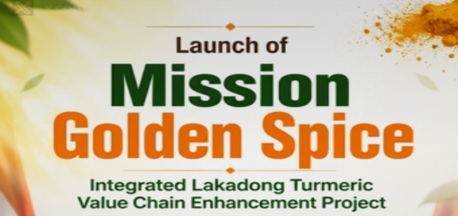
Launch of ‘Mission Golden Spice’

  • Union Minister for Development of North Eastern Region (DoNER) Jyotiraditya Scindia, along with Meghalaya Chief Minister Conrad Sangma, launched the 'Mission Golden Spice' for Lakadong turmeric.

Key Facts:

  • Name of the Mission: 'Mission Golden Spice' or 'Integrated Lakadong Turmeric Value Chain Enhancement Project'
  • Key Figures Launching the Mission: Union Minister for Development of North Eastern Region (DoNER) Jyotiraditya Scindia and Meghalaya Chief Minister Conrad Sangma
  • Total Budget/Cost: ₹175.45 crore
  • Timeframe: A 5-year roadmap (2026 to 2030) to be implemented in two phases.
  • Key Initiative: It falls under the Ministry of DoNER’s 'Unlock the Economic Potential of India’s Northeast' (USP) initiative.
  • Nodal Ministry & Implementation: This project has been developed under the Ministry of Development of North Eastern Region (MDoNER)’s 'Unlock the Economic Potential of India’s Northeast' (USP) initiative. It will be implemented in collaboration with the North Eastern Council (NEC) and the Government of Meghalaya.

National Turmeric Board:

  • Establishment: Notified by the Government of India in 2023
  • Associated Ministry: Ministry of Commerce and Industry
  • Objective of Establishment: To make India a leader in the global turmeric market.

International News

Total ban on social media for children under 15 in France

  • The French Parliament has approved a strict law imposing a total ban on social media use for children under the age of 15.
  • With the passage of this strict law, France has become the first country in the European Union (EU) to take such a step.
  • As part of this major policy initiative by President Emmanuel Macron, a complete ban has also been imposed on the use of mobile phones in high schools.

Related Facts:

  • Which country imposed the ban?: France has imposed a complete ban on social media usage by minors under the age of 15.
  • First EU country: France has become the first country in the European Union to enact such a strict law.
  • Which was the world's first country?: Note that Australia is the first country in the world to ban social media for children (for those under 16, effective December 2025). France is the next major country on this list.
  • Regulatory body: The body responsible for enforcing this law in France is Arcom (the audiovisual and digital communication regulator).
  • France:
  • Capital: Paris
  • Currency: Euro and CFP Franc
  • President: Emmanuel Macron
  • Name of Parliament: The French parliament is known as 'Parliament' and consists of two houses: the National Assembly (Lower House) and the Senate (Upper House).

Defence News

INS Malvan inducted into the Indian Navy
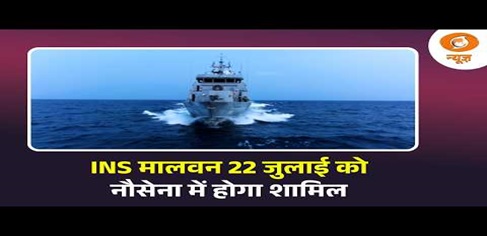
  • On July 22, the Indian Navy inducted INS Malvan—the second Mahe-class Anti-Submarine Warfare (ASW) Shallow Water Craft—into its fleet at Karwar, Karnataka.

Key Facts:

  • Name: INS Malvan
  • Type: Anti-Submarine Warfare Shallow Water Craft (ASW SWC)
  • Class: Mahe Class (this is the second ship of this class)
  • Induction Date: July 22, 2026
  • Location of Induction: Karwar Naval Base, Karnataka
  • Manufacturer: Cochin Shipyard Limited (CSL), Kochi (Kerala)
  • Indigenous Content: Over 80% (under the 'Make in India' initiative)
  • Primary Role: Hunting enemy submarines in coastal areas and shallow waters.
  • Chief Guest: Air Force Chief, Air Chief Marshal A.P. Singh

Other ships in the Mahe Class:

  • INS Malvan is part of the Indian Navy's 'Mahe Class'.
  • A total of 8 warships are being constructed under this project by Cochin Shipyard Limited (CSL).

List of all 8 Mahe-class ships:

  • INS Mahe (P80): The lead ship of the class; inducted into the Navy on November 24, 2025.
  • INS Malvan (P81): The second ship of the class; commissioned on July 22, 2026.
  • INS Mangrol: The third ship of the class. INS Malpe
  • INS Mulki
  • INS Munro
  • INS Makka
  • INS Mandvi

Indian Navy:

  • Established: 26 January 1950
  • Navy Day: 4 December
  • Motto: "Sham No Varunah"
  • Chief: Admiral Krishna Swaminathan; assumed charge as the 27th Chief of the Indian Navy on 31 May 2026

Naval Commands:

  • Western Naval Command (Mumbai)
  • Southern Naval Command (Kochi)
  • Eastern Naval Command (Visakhapatnam)

Science and Technology

Discovery of Five New Species of Lichen-Forming Fungi
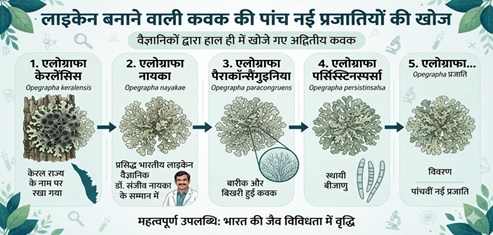
  • Scientists from the Pune-based Agharkar Research Institute have discovered five new species of lichen belonging to the genus Allographa in the Western Ghats.

Related Facts:

Five newly discovered species:

  • Allographa keralensis: Named after the state of Kerala.
  • Allographa nayackae: Named in honor of the renowned Indian lichenologist Dr. Sanjeeva Nayaka.
  • Allographa paraconsanguinea
  • Allographa persistinsparsa
  • What was discovered?: 5 new species of lichen-forming fungi.
  • Genus: Allographa
  • Discovering Institute: MACS-Agharkar Research Institute (ARI), Pune (an autonomous institute under the Department of Science and Technology - DST).
  • Location of discovery: Western Ghats – Kerala and Maharashtra regions.
  • Research Journal: Published in Mycological Progress.
  • What is a lichen?: It is a symbiotic relationship between fungi and algae.
  • Litmus paper: Litmus paper, used to identify acids and bases, is derived from a lichen called Roccella.
  • Indicator of air pollution: Lichens are highly sensitive to sulfur dioxide (SO₂). They do not grow in areas with high pollution. (This is a favorite question for SSC exams).
  • What is the study of fungi called?: Mycology.

Appointments

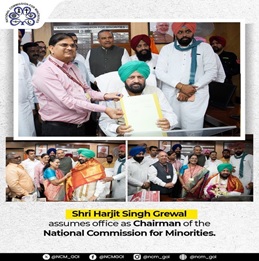
Harjit Singh Grewal

  • Senior leader Harjit Singh Grewal assumed office as the new Chairperson of the National Commission for Minorities (NCM) in New Delhi on July 21, 2026.
  • The Ministry of Minority Affairs issued the notification regarding his appointment on July 16, 2026.
  • The post had been vacant since April 2025, following the completion of the tenure of the then Chairperson, Iqbal Singh Lalpura.
  • As Chairperson, Grewal will hold the rank of a Union Cabinet Minister.

Related Facts:

  • New Chairperson: Harjit Singh Grewal assumed charge as the new Chairperson of the National Commission for Minorities (NCM) on July 21, 2026.
  • Succeeded: He has succeeded Iqbal Singh Lalpura (the post had been vacant since April 2025).
  • New Vice-Chairperson: Smt. S. Munwari Begum has been appointed as the new Vice-Chairperson of the Commission.
  • New Member: Glenn E. Souza Ticlo (former MLA from Goa) has been appointed as a member representing the Christian community.
  • Ministry: This appointment was made by the Ministry of Minority Affairs.

National Commission for Minorities:

  • Type of Body: It is a statutory body (it is not a constitutional body).
  • Establishment Act: It was established under the National Commission for Minorities Act, 1992.
  • Year of Establishment: The first commission under this Act was constituted on May 17, 1993.
  • Headquarters: Its headquarters is located in New Delhi.
  • Tenure: The tenure of the Chairperson and members is three years. Total number of members: The sanctioned strength of this commission is 7 (1 Chairperson, 1 Vice-Chairperson, and 5 members).

India's notified minority communities (chronology and number):

  • The Central Government has currently notified 6 communities as minorities at the national level under Section 2(c) of the Act:
  • Muslims (included in 1993)
  • Christians (included in 1993)
  • Sikhs (included in 1993)
  • Buddhists (included in 1993)
  • Parsis (included in 1993)
  • Jains (included most recently in 2014)

Important Articles of the Indian Constitution:

  • Article 29: Protection of the interests of minorities (right to conserve language, script, and culture).
  • Article 30: Right of minority communities to establish and administer educational institutions.
  • Article 350B: Provision for the appointment of a Special Officer for linguistic minorities (added by the 7th Constitutional Amendment, 1956).

Awards and Honors

'Lokmanya Tilak National Award 2026'

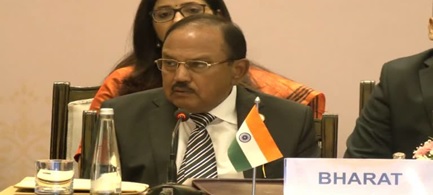
  • National Security Advisor (NSA) Ajit Doval has been selected for the 'Lokmanya Tilak National Award 2026'.

Related Facts:

  • Inception: This award was instituted in 1983 by the Lokmanya Tilak Smarak Trust.
  • Objective: This honor is conferred annually upon individuals who have made unique and remarkable contributions to the nation's progress, development, and nation-building.
  • Date: The award is presented every year on August 1st, the death anniversary of freedom fighter Lokmanya Bal Gangadhar Tilak.
  • Award Components: The recipient receives a memento, a citation, and a cash prize of ₹1 lakh.
  • Notable Past Recipients: Previous recipients include eminent personalities such as Prime Minister Narendra Modi (2023), Union Minister Nitin Gadkari (2025), former Prime Ministers Atal Bihari Vajpayee and Dr. Manmohan Singh, and former President Pranab Mukherjee.

Key Reasons for Ajit Doval's Selection:

  • Top Strategist: He has been selected for his role in strengthening India's national security policy, counter-terrorism operations, and modernizing the intelligence apparatus.
  • Operation Black Thunder (1988): During this operation against Khalistani militants at the Golden Temple in Amritsar, Doval gathered crucial intelligence by going undercover as a rickshaw puller and a Pakistani agent. For this, he was awarded the 'Kirti Chakra' (becoming the first police officer to receive this military honor).
  • Crisis Management: He played a pivotal role in suppressing insurgency and establishing peace talks in highly sensitive regions such as Mizoram, Sikkim, Punjab, and Jammu & Kashmir.
  • Doklam Standoff and Border Disputes: He played a key role as India's Special Representative in resolving the 2017 Doklam standoff with China through diplomatic negotiations.

Important Day

'National Flag Adoption Day'

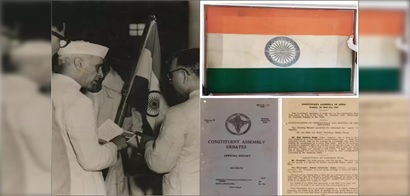
  • 'National Flag Adoption Day' is observed annually on July 22nd to commemorate the adoption of the national flag by the Constituent Assembly in 1947.

Related facts:

  • Date of Adoption: July 22, 1947
  • Designer: Pingali Venkayya
  • First Hoisting: Officially hoisted for the first time at the Red Fort on August 15, 1947.

Dimensions and Ratio:

  • Length-to-width ratio: 3:2 (Note: If the question asks for the ratio of width to length, it would be 2:3).

Ashoka Chakra:

  • Color of the Chakra: Navy blue
  • Number of spokes: 24 spokes (representing the 24 hours of the day and continuous progress)
  • Source: The Ashoka Lion Capital at Sarnath (it replaced the 'Charkha' from the old Congress flag).

Colors and their Meanings:

  • Saffron: Valor, courage, and sacrifice
  • White: Peace and truth
  • Green: Faith, fertility, and prosperity
  • Year of Implementation: The Flag Code of India came into effect in 2002.
  • Fabric: Originally, the flag was required to be made only of hand-spun Khadi, cotton, or silk.
  • Key Amendment of 2022: Machine-made and polyester flags are now also valid. Additionally, the flag is now permitted to be flown day and night (24 hours), provided it is displayed in an open space or at a citizen's residence.


Latest Courses