22 July, 2026
Discovery of Five New Lichen Species of the Allographa Genus
Wed 22 Jul, 2026
Context:
- Scientists from MACS–Agharkar Research Institute (ARI), Pune have discovered five new lichen species belonging to the Allographa genus from the biodiversity-rich Western Ghats.
Key Points:
- The study has been published in the scientific journal Mycological Progress and represents the first comprehensive molecular phylogenetic study of the genus Allographa from the Western Ghats.
- Allographa is a genus of script lichens or lichen-forming fungi belonging to the Graphidaceae family, characterized by elongated fruiting structures.
- The genus contains more than 200 species.
- Molecular knowledge of Allographa species in India is still limited, especially in the Western Ghats, where many species had previously been identified mainly on the basis of morphology.
- This research represents the first comprehensive molecular phylogenetic investigation of Allographa species from the Western Ghats.
- The research team, led by Rajeshkumar KC (PI), doctoral student Ansil PA (CSIR-SRF), and Technical Officer Dr. Bharti Sharma (Co-PI), conducted extensive field surveys across the Western Ghats and collected numerous specimens from tropical forest habitats for detailed examination.
- The team integrated detailed morphological and chemical analyses with multi-locus DNA sequencing using three genetic markers—mtSSU, nrLSU, and RPB2—to evaluate species boundaries and reconstruct evolutionary relationships within the genus.
Five Newly Discovered Species:
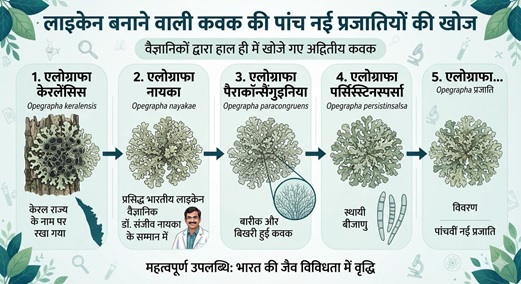
- Allographa keralensis — named after the state of Kerala.
- Allographa nayakae — named in honor of renowned Indian lichenologist Dr. Sanjeeva Nayaka.
- Allographa paraconsanguinia.
- Allographa persistinspersa.
- Allographa semicarbonisata.
Lichens
- Symbiotic relationship: Lichens are not single organisms; they are a mutualistic association between a fungus and a photosynthetic alga or cyanobacterium.
- Division of roles: The fungal partner provides structure, protection, and moisture retention, while the algal partner produces food through photosynthesis.
- Allographa genus: It is a group of script lichens under the Graphidaceae family, whose fruiting bodies appear as long, script-like markings.
Western Ghats
- Extent: The Western Ghats extend for about 1,600 km from the Tapti River valley in Gujarat in the north to Kanyakumari in Tamil Nadu in the south.
- States covered: The range passes through six states—Gujarat, Maharashtra, Goa, Karnataka, Kerala, and Tamil Nadu.
- Physical characteristics: Compared with the Eastern Ghats, the Western Ghats are higher, more continuous, and less eroded. They can be crossed only through a few major passes.
- Highest peak: Anamudi (2,695 m) in Kerala is the highest peak of the Western Ghats.
Regional Classification and Major Passes
- Northern Sahyadri (Tapti to Goa): Dominated by basaltic lava formations (Deccan Trap). Major peaks include Kalsubai and Mahabaleshwar.
- Central Sahyadri (Goa to Nilgiris): Characterized by granite rocks and dense forests. The Baba Budan Hills and Mullayanagiri in Karnataka fall within this region.
- Southern Western Ghats (Nilgiris to Kanyakumari): The Western Ghats and Eastern Ghats meet in the Nilgiri Hills.
Major Passes
- Thal Ghat: Connects Mumbai with Nashik.
- Bhor Ghat: Connects Mumbai with Pune.
- Pal Ghat (Palakkad Gap): Connects Palakkad in Kerala with Coimbatore in Tamil Nadu.
- Sengottai Pass: Connects Thiruvananthapuram with Madurai.