22 July, 2026
UCC Bill, 2026: Madhya Pradesh
Tue 21 Jul, 2026
Reference:
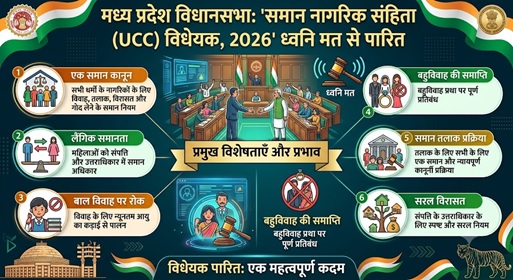
- The Madhya Pradesh Legislative Assembly passed the Uniform Civil Code (UCC) Bill, 2026 by a voice vote.
Key Highlights:
- Committee Formation: The draft of the Bill has been prepared based on the recommendations of a committee headed by Justice (Retd.) Ranjana Prakash Desai, former Judge of the Supreme Court of India.
- Public Participation: Before preparing the draft, an extensive public consultation was conducted, receiving over 9.5 lakh suggestions.
- The Bill prohibits practices such as polygamy and Nikah Halala, and introduces stringent provisions regarding live-in relationships.
Major Provisions of the Bill:
- Complete Ban on Polygamy: No person in the state will be allowed to have more than one spouse.
- Mandatory Registration of Marriage and Divorce: Registration of all marriages and divorces will be compulsory for people of all religions, down to the village level.
- Equal Inheritance Rights: Men and women (including daughters) will have equal rights in both ancestral and self-acquired property.
- Regulation of Live-in Relationships: Couples living in a live-in relationship must register their relationship within one month.
- Exemption for Tribal Communities: Tribal communities have been kept outside the purview of the law to protect their unique customs and traditions.
- Drafting Committee: The Bill was drafted by a committee headed by Justice (Retd.) Ranjana Prakash Desai, former Judge of the Supreme Court.
- Ban on Harmful Practices: Practices such as Triple Talaq and Nikah Halala have been prohibited and made punishable offences.
- Minimum Marriage Age: The minimum marriage age is 21 years for men and 18 years for women.
Inheritance and Property Rights:
- Gender Equality: Sons and daughters will enjoy equal inheritance rights in ancestral property.
- Removal of the Term 'Illegitimate Child': The term "illegitimacy" has been removed from the legal framework. Children born through biological birth, adoption, surrogacy, or Assisted Reproductive Technology (ART) will enjoy equal legal and property rights.
Special Exemption for Scheduled Tribes (STs):
- Protection of Tribal Culture: Scheduled Tribes of Madhya Pradesh notified under Articles 342 and 366 (such as Bhil, Gond, Korku, Baiga, Sahariya, and Bharia) have been exempted from the law to preserve their distinct customs and traditions.
- In addition, communities protected under Part XXI of the Constitution have also been granted exemption for their traditional rights.
Uniform Civil Code (UCC):
- The Uniform Civil Code (UCC) refers to a common set of civil laws applicable to all citizens irrespective of religion in matters such as marriage, divorce, inheritance, adoption, and succession.
Constitutional Provision:
- Article 44 (Part IV): It is included under the Directive Principles of State Policy (DPSPs). It states that "The State shall endeavour to secure for the citizens a Uniform Civil Code throughout the territory of India."
- Nature: Being a Directive Principle, it is not legally enforceable by courts but serves as a guiding principle for governance.
Other Related Articles:
- Article 14: Equality before law.
- Article 15: Prohibits discrimination on grounds of religion, race, caste, sex, or place of birth.
- Article 21: Right to life with dignity.
- Articles 25–28: Right to Freedom of Religion (the principal constitutional basis cited by opponents of the UCC).
- Article 342: Empowers the President to notify Scheduled Tribes.
- Article 366(25): Provides the constitutional definition of Scheduled Tribes.
Current Status in India:
- Goa: The only state in India where a common civil law has been in force since the Portuguese era under the Goa Civil Code, 1867, and it continued after Independence.
- Uttarakhand: The first state after Independence to enact and implement a UCC through legislation. The law came fully into force on 27 January 2025.
- Gujarat: Became the second state to pass the Uniform Civil Code Bill, 2026 in its Legislative Assembly on 24–25 March 2026.
- Assam: Became the third state and the first in Northeast India to pass the UCC Bill in May 2026.
- Madhya Pradesh: Became the fourth state to pass the UCC Bill by voice vote in its Legislative Assembly on 21 July 2026.
- Law Commission's Stand: The 21st Law Commission (2018) stated that a UCC was "neither necessary nor desirable" at that stage, while the 22nd Law Commission has invited fresh views from the public and religious organizations.
Major Supreme Court Judgments:
- Shah Bano Case (1985): The Supreme Court observed that a Uniform Civil Code would promote national integration and gender justice.
- Sarla Mudgal Case (1995): The Court held that conversion of religion solely for contracting a second marriage amounts to misuse of personal laws and emphasized the need for a UCC.
- John Vallamattom Case (2003): The Supreme Court observed that the absence of a UCC leads to inequalities in civil matters and hampers national integration.
- Shayara Bano Case (2017): The Constitution Bench declared Instant Triple Talaq (Talaq-e-Biddat) unconstitutional.
- Joseph Shine Case (2018): The Supreme Court reaffirmed the constitutional principles of equality, dignity, and individual autonomy in marital relationships.