International Conference on the Postal Ballot System
 
  • Mobile Menu
HOME BUY MAGAZINEnew course icon
LOG IN SIGN UP

Sign-Up IcanDon't Have an Account?


SIGN UP


Login Icon

Have an Account?


LOG IN
 

or
By clicking on Register, you are agreeing to our Terms & Conditions.


or


International Conference on the Postal Ballot System

Sun 19 Jul, 2026

Reference:

  • The Election Commission of India organized an international conference in Kolkata to make the postal ballot system more inclusive, secure, and accessible.

Key Highlights:

  • Organizers: The conference was jointly organized by the Election Commission of India's India International Institute of Democracy and Election Management (IIIDEM) and International IDEA.
  • Main Objective: To hold global discussions on making the postal ballot system more inclusive, secure, and accessible.

Categories Eligible for Postal Ballot:

  • Service Voters: Members of the Armed Forces and government employees posted outside India.
  • Personnel on Election Duty: Police personnel and polling officials deployed away from their own constituencies.
  • Preventive Detention: Persons kept in preventive custody (Note: Ordinary prisoners in India are not entitled to vote).
  • Special Category (Amended Rules): Senior citizens aged above 85 years and Persons with Disabilities (PwDs) with more than 40% disability.
  • What is ETPBS? It stands for Electronically Transmitted Postal Ballot System, which is used exclusively for service voters.

Statutory Provisions and Rules:

  • The Representation of the People Acts, 1950 and 1951 form the legal basis for electoral processes and voter eligibility in India.
  • The entire postal ballot process is governed under the Conduct of Elections Rules, 1961.
  • On the day of counting, postal ballots are counted first.

Election Commission of India (ECI):

  • Established: 25 January 1950
  • Constitutional Provision: Part XV (Articles 324–329) of the Constitution of India
  • Composition: Became a multi-member body after the Election Commissioner (Amendment) Act, 1989.
  • Chief Election Commissioner (CEC): Gyanesh Kumar
  • Appointment: By the President of India
  • Tenure: Fixed term of 6 years or until attaining the age of 65 years, whichever is earlier.
  • National Voters' Day: 25 January

Election Commission – Constitutional Provisions:

  • Part of the Constitution: Elections are covered under Part XV (15).
  • Article 324: Empowers the Election Commission with the superintendence, direction, and control of elections.
  • Article 325: No person can be excluded from the electoral roll on grounds of religion, race, caste, sex, etc.
  • Article 326: Elections to the Lok Sabha and State Legislative Assemblies shall be based on universal adult suffrage.
  • Article 327: Parliament may make laws relating to elections.
  • Article 328: State Legislatures may make provisions regarding elections to their respective legislatures.
  • Article 329: Courts cannot interfere in electoral matters except through an election petition.
  • Voting Age: The 61st Constitutional Amendment Act, 1989 reduced the minimum voting age from 21 years to 18 years.

India International Institute of Democracy and Election Management (IIIDEM):

  • It is the advanced training, research, and capacity-building arm of the Election Commission of India (ECI).
  • Established: June 2011 by the Election Commission of India. (It completed 15 years in June 2026.)
  • Major Functions: Electoral training, global capacity building, research, and innovation.

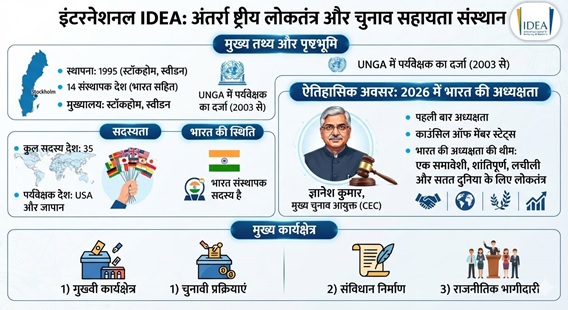
International IDEA:

  • Full Form: International Institute for Democracy and Electoral Assistance
  • Established: 1995 in Stockholm, Sweden, by 14 founding countries, including India.
  • Headquarters: Stockholm, Sweden
  • Since 2003, it has held Observer Status in the United Nations General Assembly (UNGA).
  • Member Countries: Currently has 35 member states.
  • Observer Countries: The United States (USA) and Japan are its official observer countries.
  • India's Status: India is a founding member of the organization.
  • Historic Milestone: For the first time, India assumed the Chairmanship of the International IDEA Council of Member States for the year 2026.
  • India's Representative: Chief Election Commissioner Gyanesh Kumar is serving as the Chair of the Council on behalf of India.
  • Theme of India's Chairmanship: "Democracy for an Inclusive, Peaceful, Resilient and Sustainable World."

Latest Courses