17 July, 2026
'WHO and UNICEF Estimates of National Immunization Coverage (WUENIC) 2026'
Fri 17 Jul, 2026
Context:
- The World Health Organization (WHO) and United Nations Children's Fund (UNICEF) released the WHO and UNICEF Estimates of National Immunization Coverage (WUENIC) 2026 report.
Key Highlights:
- Full Form: WHO and UNICEF Estimates of National Immunization Coverage (WUENIC)
- Published by: World Health Organization (WHO) and United Nations Children's Fund (UNICEF)
- Significance: It provides the world's most comprehensive dataset on routine immunization coverage against 13 vaccine-preventable diseases, including diphtheria, pertussis, tetanus, measles, and polio.
- Methodology: Estimates are based on administrative data reported by countries, population-based surveys (such as India's NFHS), and expert consultation.
Global Scenario:
- Global health systems are recovering from the disruptions caused by the COVID-19 pandemic, but immunization levels in many regions remain below pre-pandemic levels.
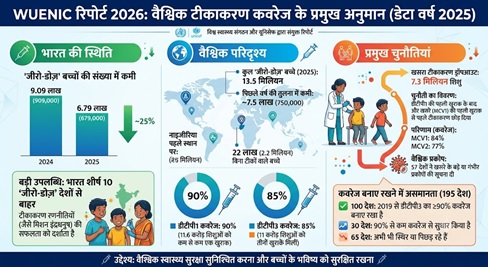
- Overall Progress: In 2025, around 90% of infants worldwide received at least the first dose of the DTP (Diphtheria, Tetanus and Pertussis) vaccine. However, coverage for all three doses (85%) remained slightly below the 2019 level (86%).
- Zero-dose Children: Children who did not receive even a single routine vaccine (such as DTP1) during their first year of life. Their global number declined to 13.5 million.
- Measles Risk: A minimum 95% vaccination coverage is required for measles elimination. Globally, coverage reached 84% for the first dose (MCV1) and 77% for the second dose (MCV2), leaving many children vulnerable to outbreaks.
- Regional Trends: The South-East Asia Region (including India) not only recovered but surpassed pre-pandemic immunization levels, while the Western Pacific Region recorded a decline.
- Nigeria ranked first with 2.2 million zero-dose children.
- Globally, 90% (116 million) infants received at least one dose of the DTP vaccine, while 85% (110 million) completed all three doses.
- The number of unvaccinated children declined by about 750,000 compared to the previous year.
- Around 7.3 million infants dropped out after receiving the first DTP dose before receiving the first measles vaccine (MCV1), resulting in only 84% MCV1 and 77% MCV2 coverage.
- 57 countries reported large or disruptive measles outbreaks in 2025.
- According to data from 195 countries, 100 countries maintained 90% or higher DTP3 coverage since 2019. Among countries with below 90% coverage in 2019, 30 countries improved, while 65 countries remained stagnant or declined.
India's Performance:
Sharp Decline in Zero-dose Children:
- India strengthened its routine immunization services.
- The number of zero-dose children declined from 1.59 million in 2023 to 909,000 in 2024 and further to 679,000 in 2025, reflecting the success of India's intensive immunization strategies.
Historic Improvement in Measles Immunization:
- For the first time since the report's launch in 2001, India is no longer among the top 10 countries with the highest number of unvaccinated children against measles.
- India's estimated MCV1 coverage reached 98%, while MCV2 coverage reached 95%.
High Coverage of Key Vaccines:
- DTP3 and MCV2: 95% coverage.
- DTP1: 97% coverage.
- Rubella (First Dose): 98% coverage.
- Pneumococcal Conjugate Vaccine (PCV3): 97% coverage.
- Polio (IPV1) and Hepatitis B (Third Dose): 95% coverage.
Major Government Initiatives:
- Mission Indradhanush: Launched in December 2014 to vaccinate missed children and pregnant women. More than 54.6 million children have been vaccinated under the programme.
- U-WIN Portal: A digital platform for registration and tracking of vaccination for pregnant women and children, developed on the lines of CoWIN.
- Intensified Mission Indradhanush (IMI): Focuses on districts and urban areas with low routine immunization coverage.
World Health Organization (WHO):
- Nature: A specialized agency of the United Nations (UN) responsible for international public health.
- Headquarters: Geneva, Switzerland.
- Members: 194 Member States.
- Functions: Provides global health leadership, sets research priorities, establishes standards, and offers evidence-based policy guidance.
- India and WHO: India is a member of the WHO South-East Asia Region (SEARO), whose regional headquarters is located in New Delhi.
- World Mental Health Day: Observed annually on 10 October.
United Nations Children's Fund (UNICEF):
- Established: 11 December 1946 by the United Nations General Assembly as the International Children's Emergency Fund.
- Permanent Status: Became a permanent part of the UN system in 1953. The words "International" and "Emergency" were removed from its name, while the acronym UNICEF was retained.
- Headquarters: New York, United States.
- Parent Organization: Functions under the United Nations Economic and Social Council (ECOSOC).