India–UK CETA Comes into Force
 
  • Mobile Menu
HOME BUY MAGAZINEnew course icon
LOG IN SIGN UP

Sign-Up IcanDon't Have an Account?


SIGN UP


Login Icon

Have an Account?


LOG IN
 

or
By clicking on Register, you are agreeing to our Terms & Conditions.


or


India–UK CETA Comes into Force

Thu 16 Jul, 2026

Context:

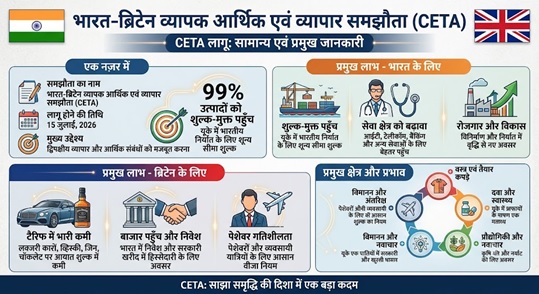
  • The Comprehensive Economic and Trade Agreement (CETA) between India and the United Kingdom (UK) came into full effect on 15 July 2026.

Key Points:

  • What is it: A Free Trade Agreement (FTA) between India and the United Kingdom.
  • Date of Signing: 24 July 2025
  • Effective Date: 15 July 2026
  • Rounds of Negotiations: 14
  • Total Chapters: 30
  • Target: To double bilateral trade to US$100 billion by 2030.

Major Benefits of the India–UK CETA:

  • Employment Generation: It will boost employment and investment in the textile, leather, and MSME sectors.
  • Boost to the Services Sector: Through the Double Contribution Convention (DCC), Indian IT, financial, and other professionals will gain better access to the UK market.
  • Stronger Strategic Partnership: It will further strengthen economic and strategic ties between India and the UK in the post-Brexit era.
  • Support to Make in India: It will promote PLI-supported industries and domestic manufacturing, enhancing India's global competitiveness.

Trade Objectives and Impact:

  • Duty-Free Market Access: Under the agreement, 99.5% of India's export value (98.8% of tariff lines) will enjoy zero customs duty in the UK market. Earlier, these products attracted import duties ranging from 2% to 16%.
  • Reciprocal Concessions: India has also offered tariff concessions on 89.4% of its tariff lines, making British products such as Scotch whisky, premium cars, and chocolates more affordable in the Indian market.
  • Protection of Sensitive Sectors: India has excluded agriculture, dairy, cereals, pulses, and edible oils from the agreement to safeguard its sensitive domestic sectors.
  • Digital Certificate of Origin (eCoO 2.0): For the first time, digital certificates based on self-certification have been introduced to reduce transaction costs and paperwork.
  • Exemption from Dual Social Security Contributions: Indian professionals temporarily working in the UK for up to 60 months (5 years) will not be required to pay social security contributions in both countries.
  • Who Benefits: Around 75,000 Indian IT and financial professionals and more than 900 companies are expected to receive direct financial benefits.
  • Professional Mobility: India and the UK have agreed to conclude Mutual Recognition Agreements (MRAs) within one year in the fields of nursing, architecture, and accountancy.

Sensitive Sectors Protected by India:

  • India has strategically used the Negative List and Tariff Rate Quotas (TRQs) to safeguard its domestic economy.
  • Protection of Agriculture and Dairy: India has completely excluded dairy products, cereals, millets, pulses, apples, and selected vegetables from tariff reductions to protect farmers' interests.
  • Sensitive Manufacturing Sectors: Gold, jewellery, lab-grown diamonds, smartphones, and industries covered under the Make in India and PLI schemes have been provided with a phased protection period.

Balanced Approach on Automobiles and Alcohol:

  • Scotch Whisky: Import duty on UK Scotch whisky has been reduced from 150% to 75% immediately, and it will be gradually lowered to 40% over the next 10 years.
  • British Automobiles: India has fixed an annual Tariff Rate Quota (TRQ) (e.g., 20,000 units in the first year) under which British cars will attract concessional customs duties of around 30–50%, ensuring that domestic automobile manufacturers remain protected.

Latest Courses