GK Update
 
  • Mobile Menu
HOME BUY MAGAZINEnew course icon
LOG IN SIGN UP

Sign-Up IcanDon't Have an Account?


SIGN UP


Login Icon

Have an Account?


LOG IN
 

or
By clicking on Register, you are agreeing to our Terms & Conditions.


or


GK Update

Thu 16 Jul, 2026

National News

Approval for Two Elevated Road Projects in Uttar Pradesh
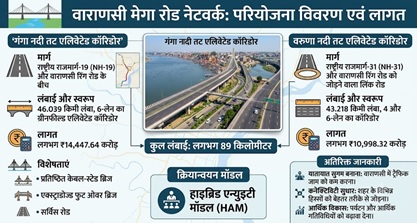
  • The Union Cabinet has approved two elevated road projects for Varanasi, worth over ₹25,000 crore.
  • This decision was taken under the 'Varanasi Decongestion Plan,' with the primary objective of easing traffic congestion in the city and reducing travel time.

Details of the two elevated projects:


Ganga River Corridor Project:

  • Total Cost: ₹14,447.64 crore
  • Length: 46.039 km
  • Structure: It will primarily be a 6-lane greenfield elevated corridor connecting National Highway-19 (NH-19) to the Varanasi Ring Road.
  • Features: It includes the construction of a 910-meter-long cable-stayed bridge over the Ganga River and a 1.32 km-long foot over-bridge (FOB) equipped with travelators (automated walkways) for pedestrians heading to Kashi Vishwanath Dham.

Varuna River Corridor Project:

  • Total Cost: ₹10,998.32 crore
  • Length: 43.218 km
  • Structure: This is a 6-lane and 4-lane elevated corridor to be constructed along the banks of the Varuna River, connecting National Highway-31 (NH-31) to the Varanasi Ring Road.
  • Hybrid Annuity Model (HAM): Both projects will be implemented by the National Highways Authority of India (NHAI) under the Hybrid Annuity Model (HAM).
  • PM Gati Shakti National Master Plan: This infrastructure development will strengthen logistics efficiency and multi-modal connectivity in alignment with the PM Gati Shakti National Master Plan.

India-UK CETA Comes into Effect

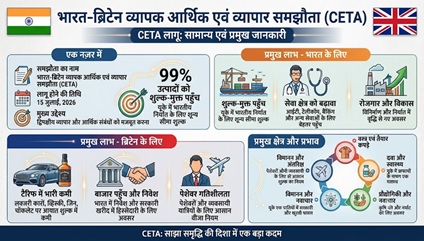
  • The Comprehensive Economic and Trade Agreement (CETA) between India and the United Kingdom (UK) has come into full effect as of July 15, 2026.
  • Signed in July 2025, this agreement aims to double bilateral trade to $100 billion by 2030.
  • On the very first day, Indian exporters shipped goods worth over $140 million to the UK at zero duty from more than 20 of the country's ports, airports, and Special Economic Zones (SEZs).

Key features of the India-UK CETA:


  • Date of Signing: July 24, 2025
  • Effective Date: July 15, 2026
  • Rounds of Negotiation: 14
  • Total Chapters: 30
  • What it is: A Free Trade Agreement (FTA) between India and the United Kingdom.
  • Zero-duty market access: Under the agreement, approximately 99.5% of India's export value (98.8% of tariff lines) will benefit from zero customs duty in the British market. Previously, these goods were subject to import duties ranging from 2% to 16%.
  • Reciprocal concessions: India has also granted concessions to the UK on 89.4% of its tariff lines, making British products such as Scotch whisky, premium cars, and chocolates cheaper in the Indian market.
  • Protection of sensitive sectors: India has safeguarded sensitive domestic sectors—such as agriculture, dairy, grains, pulses, and edible oils—by excluding them from this agreement.
  • Digital Certificate of Origin (eCoO 2.0): Digital certificates are being issued based on self-certification for the first time to reduce transaction costs and paperwork.
  • Exemption from double contribution: Under this provision, Indian professionals traveling to the UK for a temporary period of up to 60 months (5 years) will not be required to pay social security taxes in both countries.
  • Who benefits: Approximately 75,000 Indian IT and financial professionals, along with over 900 companies, will derive direct financial benefits from this.
  • Professional mobility: India and the UK have agreed to enter into 'Mutual Recognition Agreements' (MRAs) within one year in the fields of nursing, architecture, and accountancy.

Approval for 'Semicon 2.0'

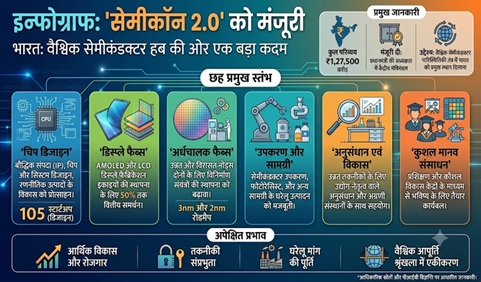
  • Chaired by Prime Minister Narendra Modi, the Union Cabinet approved the second phase of the India Semiconductor Mission—'Semicon 2.0'—with a total budgetary allocation of ₹1,27,500 crore (₹1.27 lakh crore).

6 Key Pillars of Semicon 2.0:


  • Chip Design: Establishing India as a global hub for semiconductor chip design IP (Intellectual Property) and providing design resources to startups.
  • Machines & Materials: Strengthening the domestic supply chain for equipment, specialized chemicals, gases, and raw materials required for semiconductor manufacturing.
  • Setting up more Fab units: Attracting global companies to establish additional silicon fabs, compound semiconductor fabs, and display fabs in India.
  • Strengthening the ATMP/OSAT industry: Promoting Assembly, Testing, Marking, and Packaging (ATMP) and Outsourced Semiconductor Assembly and Test (OSAT) units by incorporating modern technologies.
  • Research & Development (R&D): Collaborating with leading global research centers to work on advanced nodes and future semiconductor technologies.
  • Talent Development: Creating a workforce of skilled engineers—trained at the college level through universities—specializing in chip design, cleanroom operations, and fab construction.

Approval for Mobile Phone Manufacturing Scheme (MPMS)
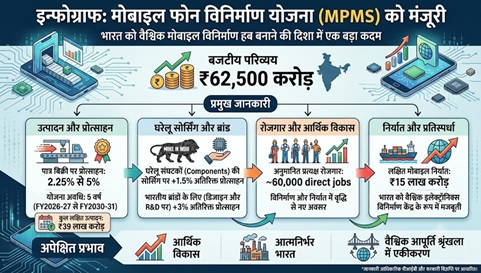
  • The Union Cabinet, chaired by Prime Minister Narendra Modi, has approved the Mobile Phone Manufacturing Scheme (MPMS) with a budgetary outlay of ₹62,500 crore.
  • This scheme is a successor to the earlier Production Linked Incentive (PLI) scheme (which concluded on March 31, 2026).

Key Facts:


  • Tenure: The scheme is for a period of 5 years, effective from the 2026-27 financial year to the 2030-31 financial year.
  • Base Incentive: Incentives ranging from 2.25% to 5% will be provided on eligible sales of mobile phones manufactured in India.
  • Domestic Sourcing Bonus: An additional incentive of up to 1.5% will be provided for the domestic sourcing of key components or sub-assemblies.
  • Promotion of Indigenous Brands: An additional incentive at a rate of 3% on eligible sales will be provided for product design and R&D.
  • Cumulative Production: Mobile phone production worth approximately ₹39 lakh crore is projected within the country over the 5-year period.
  • Employment Generation: The scheme is expected to generate approximately 60,000 direct jobs in the electronics sector.
  • Export Growth: Smartphones have already become India's largest single export product category (based on 2025 data); this scheme will further boost exports.

Approval of National Investment Policy for Urea-2026 (NIPU-2026)
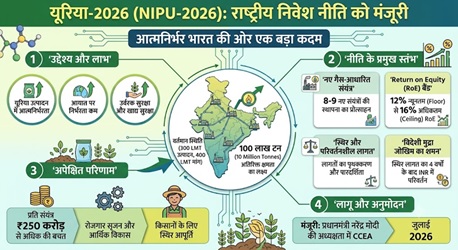
  • Chaired by Prime Minister Narendra Modi, the Cabinet Committee on Economic Affairs (CCEA) officially approved the 'National Investment Policy for Urea-2026 (NIPU-2026) for an Atmanirbhar Bharat' (Self-Reliant India) on July 15, 2026.
  • This is a major policy step towards making the country self-reliant in the fertilizer sector, boosting domestic production, and reducing dependence on imports.

Key Facts:


  • Reducing Import Dependence: NIPU-2026 aims to create an additional domestic urea production capacity of 10 million tonnes (1 crore tonnes) to reduce reliance on imports.
  • Equal Incentives and Returns: The policy applies equally to the private, public (PSUs), and cooperative sectors, setting a Return on Equity (RoE) band of 12% to 16% on investment.
  • Cost Transparency: Fixed and variable costs have been segregated to ensure financial stability.
  • Economic Efficiency: The policy projects savings of over ₹250 crore per new plant compared to the previous NIP-2012.
  • Why is this policy needed? India currently produces approximately 3 crore tonnes of urea annually, while the total demand is around 4 crore tonnes. This policy has been introduced to bridge this gap of 1 crore tonnes (import dependence).
  • Current Infrastructure: There are currently 33 operational urea manufacturing units in the country, with a total installed capacity of 269.42 lakh metric tonnes (LMT).
  • History of the Previous Policy: Previously, the 'New Investment Policy (NIP)-2012' was in effect, under which 6 new plants were established. Its investment period expired in October 2019.

Expansion of 'Pink E-Rickshaw Scheme': Maharashtra
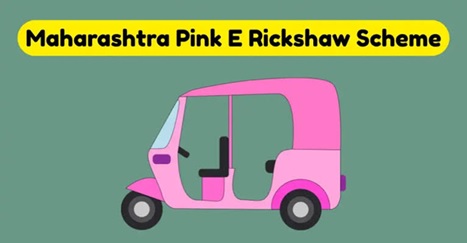
  • The Maharashtra government has expanded the 'Pink E-Rickshaw Scheme' and increased the subsidy for female beneficiaries from 20% to 40% of the vehicle's total cost.

Related Facts:


  • Subsidy and Loan: The subsidy on the vehicle cost has been raised from 20% to 40%. The remaining 50% of the amount will be arranged through bank loans (nationalized, private, or urban/district cooperative banks) or via interest-free deferred payments provided by the supplier. The beneficiary's contribution will be at least 10%.
  • Retrospective Benefit: Previously registered beneficiaries will also receive the benefit of the increased 40% subsidy.
  • Administrative Changes: To ensure transparency, the process has been centralized under the Office of the Commissioner for Women and Child Development, Pune.
  • Safety and Accessibility: A GPS-enabled tracking system is mandatory, and free driver training will be provided. Additionally, the scheme's geographical scope has been expanded to cover more districts.

Maharashtra:

  • Capital: Mumbai
  • Sub-capital: Nagpur (Winter Session)
  • Foundation Day: 1 May 1960 (Maharashtra Day)
  • State Song: Jai Jai Maharashtra Majha
  • Major Rivers: Godavari, Krishna, Bhima, Tapi, Painganga
  • Folk Dances: Lavani, Tamasha
  • Major Festivals: Ganesh Chaturthi, Gudi Padwa, Diwali
  • Traditional Food: Puran Poli, Vada Pav, Misal Pav
  • Mumbai is the financial capital of India.

5th BIMSTEC NSA Meeting

  • The 5th BIMSTEC National Security Advisor (NSA) meeting was held in New Delhi.

Key Facts:


  • Chairmanship and Hosting: India
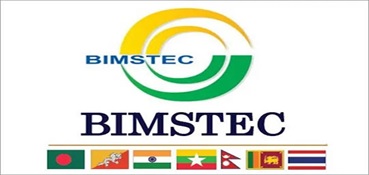
  • Member Countries: India, Bangladesh, Bhutan, Myanmar, Nepal, Sri Lanka, and Thailand

Key Focus Areas:

  • Cybersecurity: Enhancing cooperation to tackle threats posed by modern technology.
  • Maritime Security: Strengthening security cooperation in the Bay of Bengal region.
  • Trans-border Crime: Shared strategies against human trafficking and international crimes.
  • India's Diplomacy: This meeting serves as a key platform to promote India's 'Neighbourhood First' and 'Act East' policies.

BIMSTEC:

  • Full Name: Bay of Bengal Initiative for Multi-Sectoral Technical and Economic Cooperation.
  • Establishment: It was established on June 6, 1997, through the Bangkok Declaration.
  • Secretariat: Its permanent secretariat is located in Dhaka (Bangladesh).
  • BIMSTEC comprises a total of 7 member countries, geographically divided into two groups:
  • South Asia (5 countries): India, Bangladesh, Bhutan, Nepal, and Sri Lanka.
  • Southeast Asia (2 countries): Myanmar and Thailand.
  • Initially, it was formed in June 1997 as BIST-EC (Bangladesh, India, Sri Lanka, Thailand).
  • It became BIMST-EC after Myanmar joined in December 1997.
  • It was renamed to its current name (BIMSTEC) after Nepal and Bhutan joined in 2004.

31st 'Divya Kala Mela'

  • The 31st 'Divya Kala Mela' was inaugurated in Kolkata.

Key Facts:


  • Organizing Ministry: This fair is organized by the Department of Empowerment of Persons with Disabilities (DEPwD) under the Union Ministry of Social Justice and Empowerment.
  • Significant Milestone: This is the first 'Divya Kala Mela' to be held as a joint initiative between the Government of India and the Government of West Bengal.
  • Inaugurated by: It was inaugurated by Dr. Virendra Kumar, Union Minister for Social Justice and Empowerment.
  • Duration and Participation: This is an 8-day event (July 14 to July 22, 2026), featuring approximately 40 stalls for artisans with disabilities from across the country (particularly from West Bengal).

Announcement of 'Seafarer-First' Emergency Maritime Security Plan
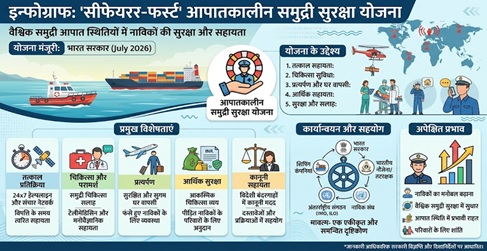
  • The Government of India has announced the 'Seafarer-First' emergency maritime security plan to ensure the safety of Indian seafarers.
  • Union Minister for Ports, Shipping and Waterways, Sarbananda Sonowal, launched this far-reaching initiative.

Related Facts:


  • Concerned Ministry: Union Ministry of Ports, Shipping and Waterways
  • Union Minister: The plan was announced by Union Minister Sarbananda Sonowal.
  • Reason for Launch: It was launched following missile attacks on two cargo vessels (MT Al Bahiyah and MT Mombasa) in the Strait of Hormuz (West Asia), which resulted in casualties and injuries to Indian seafarers.

Key Features and Institutional Framework:

  • Real-time Tracking: A real-time dashboard will be set up by the Directorate General of Shipping for round-the-clock monitoring of Indian seafarers.
  • Nodal Liaison Officers: Dedicated liaison officers will be appointed to assist Indian seafarers stranded or facing distress in affected regions and to provide medical, legal, or financial aid to their families.
  • Whole-of-Government Approach: The Indian Navy, the Ministry of External Affairs (MEA), and Indian embassies in Iran, Oman, and the UAE will work together to strengthen the security mechanism.
  • 24×7 Support System: A round-the-clock grievance redressal system—accessible via WhatsApp, a toll-free helpline, and email—has been activated for seafarers and their families during times of crisis.

Approval for Two Railway Multi-Tracking Projects
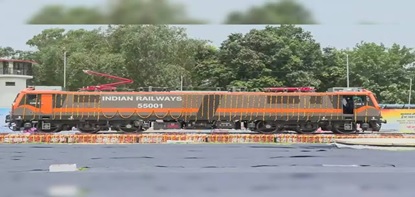
  • Chaired by Prime Minister Narendra Modi, the Cabinet Committee on Economic Affairs (CCEA) approved two railway multi-tracking projects in Odisha and Jharkhand with an estimated cost of ₹3,907 crore.

Key Facts:


  • Total approved projects: 2 multi-tracking rail projects
  • Total estimated cost: ₹3,907 crore
  • Target year (Deadline): These projects are targeted for completion by the 2030-31 financial year.
  • Network expansion: This will expand the existing Indian Railways network by approximately 145 kilometers.
  • Districts covered: These projects will cover 4 districts across Odisha and Jharkhand.
  • Paradip-Haridaspur line (Odisha): This rail section will undergo doubling.
  • Rajkharsawan-Dangoaposi section (Odisha and Jharkhand): A fourth railway line will be constructed on this route.
  • Basis of the plan: Both projects have been formulated under the PM Gati Shakti National Master Plan.
  • Connectivity: This will directly benefit 14 lakh people across approximately 1,526 villages.
  • Boosting tourism: This route will facilitate access to major tourist destinations such as the Lalitgiri Buddhist complex, the Shri Baladevjew Temple, and the Meghahatuburu Hills.
  • Freight traffic: These routes will ease the transportation of coal, iron ore, limestone, and dolomite, adding an incremental freight capacity of 44 million tonnes per annum (MTPA).
  • Environmental benefits: This infrastructure will save approximately 6 crore liters of oil imports and reduce carbon dioxide (CO2) emissions by 29 crore kilograms.

Art and Culture

Commencement of Jagannath Rath Yatra 2026
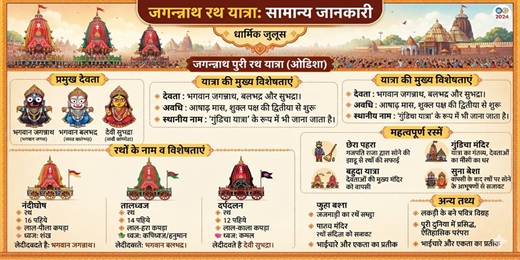
  • The grand commencement of the world-famous Jagannath Rath Yatra 2026 took place today, July 16 (Ashadha Shukla Dwitiya), in Puri, Odisha; the return journey (Bahuda Yatra) is scheduled for July 24, 2026.

Jagannath Rath Yatra:


  • An annual Hindu festival
  • Venue: Puri, Odisha
  • Principal Temple: Shri Jagannath Temple, Puri
  • Deities: Lord Jagannath (an avatar of Lord Vishnu/Krishna), his elder brother Balabhadra, and sister Subhadra
  • Date of Event: Ashadha Shukla Dwitiya (between June and July)
  • Names of Chariots: Lord Jagannath’s chariot – Nandighosa; Lord Balabhadra’s chariot – Taladhwaja; Goddess Subhadra’s chariot – Darpadalan
  • Departure: From Jagannath Temple
  • Destination: Gundicha Temple (the deity's aunt's abode)
  • Return (Bahuda Yatra): After a seven-day sojourn at the Gundicha Temple, the deities return to their main temple on Ashadha Shukla Dashami.

Jagannath Temple:

  • Temple Architecture: An exquisite example of the Kalinga style of architecture, which is a sub-style of the Nagara style.
  • Builders: Construction was initiated in the 12th century by King Anantavarman Chodaganga Deva of the Ganga Dynasty and completed by King Anangabhima Deva.

Books and Authors

Book: 'The Voice of Justice: Justice Gavai Speaks'
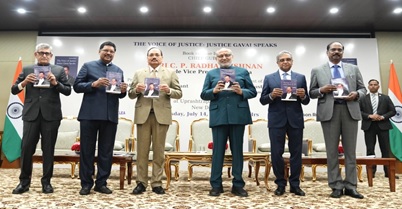
  • Vice President C.P. Radhakrishnan formally launched the book 'The Voice of Justice: Justice Gavai Speaks' at the Vice President's Enclave in New Delhi.

Related Facts:


  • Launched by: Hon'ble Vice President of India, Shri C.P. Radhakrishnan
  • Venue: Vice President's Enclave (Vice President's House), New Delhi
  • Chief Guests/Dignitaries: The event was presided over by Justice Surya Kant (Judge, Supreme Court of India). Additionally, Supreme Court Judge Justice Vikram Nath was also present.
  • Central Figure: This book is a compilation of the speeches, lectures, and thoughts of Justice B.R. Gavai (Bhushan Ramkrishna Gavai).
  • Editor: The book has been edited by Prof. (Dr.) S. Sivakumar.
  • Publisher: It has been published by Thomson Reuters in collaboration with the Commonwealth Legal Education Association (CLEA).
  • Key Themes: The book primarily compiles judicial perspectives on significant topics such as constitutionalism, the rule of law, social justice, and democratic governance.


Latest Courses