India's Sixth Fully Literate State under the 'ULLAS' Programme
 
  • Mobile Menu
HOME BUY MAGAZINEnew course icon
LOG IN SIGN UP

Sign-Up IcanDon't Have an Account?


SIGN UP


Login Icon

Have an Account?


LOG IN
 

or
By clicking on Register, you are agreeing to our Terms & Conditions.


or


India's Sixth Fully Literate State under the 'ULLAS' Programme

Sun 12 Jul, 2026

Reference:

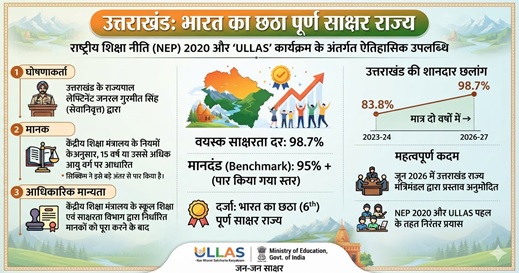
  • Under the National Education Policy (NEP) 2020 and the ULLAS Programme, Uttarakhand has been declared India's sixth fully literate state with an adult literacy rate of 98.7%.

Key Highlights:

  • Announcement: Declared by the Governor of Uttarakhand, Lieutenant General Gurmit Singh (Retd.).
  • Prescribed Criterion: According to the Ministry of Education, a State/Union Territory can be declared 'Fully Literate' if its adult literacy rate crosses 95%.
  • Standard: As per the Ministry of Education norms, when the adult literacy rate (15 years and above) of a State/UT reaches 95% or more, it is declared 'Fully Literate'. Uttarakhand has comfortably crossed this benchmark.
  • Status & Rank: Uttarakhand has become the 6th Fully Literate State in India.
  • Uttarakhand's Achievement: The State's literacy rate increased from 83.8% in 2023-24 to 98.7% within just two years.
  • Earlier Approval: The proposal was approved by the Uttarakhand State Cabinet in June 2026.
  • Official Recognition: The recognition was granted after the State fulfilled the literacy standards prescribed by the Department of School Education & Literacy, Ministry of Education.

Other Fully Literate States:

State/Union Territory Year of Declaration Literacy Rate Special Features
Mizoram 2025 98.2% Community participation and emphasis on women's education
Goa 2025 96% Administrative efficiency and high investment in education
Tripura 2025 95.6% Cyber literacy campaign and tribal outreach
Himachal Pradesh 2025 99.3% Literacy increased from 7% after Independence to near-universal literacy
Ladakh (UT) 2024 97% First Union Territory to achieve functional literacy
Sikkim 2026 99.82% Inclusive outreach in remote Himalayan regions
Chandigarh 2026 99.93%  
Uttarakhand 2026 98.7% India's 6th Fully Literate State

ULLAS Initiative:

  • Full Form: Understanding Lifelong Learning for All in Society (ULLAS) – New India Literacy Programme.
  • Nature: A Centrally Sponsored Scheme, launched in 2022 in line with the recommendations of the National Education Policy (NEP) 2020.
  • Nodal Ministry: Ministry of Education.
  • Target Group: Non-literate citizens aged 15 years and above who missed the opportunity of formal schooling.
  • Tagline: "Jan Jan Sakshar" (Education for All).
  • National Target: To cover 5 crore non-literate adults during 2022–2027 (around 1 crore every year).
  • Benchmark for Full Literacy: According to the Ministry of Education, a State/UT can be declared Fully Literate when the adult literacy rate (15 years and above) reaches 95% or above.

Five Key Components of ULLAS:

  1. Foundational Literacy and Numeracy (FLN): Basic reading, writing and arithmetic.
  2. Critical Life Skills: Financial literacy, digital literacy, legal literacy, electoral literacy, environmental literacy and health awareness.
  3. Vocational Skills Development: Skill training for local employment and livelihood opportunities.
  4. Basic Education: Providing equivalency at elementary, middle and secondary levels.
  5. Continuing Education: Lifelong learning opportunities in arts, science, culture, technology and recreation.

National Education Policy 2020 (NEP 2020):

Introduction:

  • The National Education Policy (NEP) 2020 was announced by the Government of India on 29 July 2020.
  • It is the first major education policy reform since the 1986 National Policy on Education.
  • The policy aims to make India a global knowledge superpower by making education inclusive, holistic, flexible and aligned with the needs of the 21st century.

Main Objectives:

  • Achieve 100% Gross Enrolment Ratio (GER) by 2030.
  • Increase public expenditure on education to 6% of GDP.
  • Ensure quality, inclusive and equitable education for all.
  • Promote the holistic development of students (physical, mental, social and ethical).
  • Strengthen technical, vocational and skill-based education.

Key Features:

Area Features
School Education
  • 5+3+3+4 curricular structure (for children aged 3–18 years)
  • Mother tongue/local language as the medium of instruction up to Class 5
  • Emphasis on Early Childhood Care and Education (ECCE)
  • Reducing dropout rates and ensuring universal access to education
Higher Education
  • Multiple Entry and Exit System
  • Three or Four-year undergraduate programmes with certificate/diploma options
  • Higher Education Commission of India (HECI) as a single regulator
  • Promotion of research and innovation
Language Policy
  • Three-language formula
  • At least two Indian languages
  • Priority to mother tongue/local language
Teacher Education
  • Improved teacher training and evaluation system
  • Focus on teacher competency and capacity building
Other Initiatives


  • Digital education, virtual laboratories and technology integration
  • Introduction of vocational education at the school level
  • Special provisions for inclusive and equitable education

Structure (5+3+3+4):

  • 5 Years: Foundational Stage (3 years of pre-primary + Classes 1–2).
  • 3 Years: Preparatory Stage (Classes 3–5).
  • 3 Years: Middle Stage (Cla
  • sses 6–8).
  • 4 Years: Secondary Stage (Classes 9–12).

Literacy Rate in India (Census 2011):

  • Overall Literacy Rate: 74.04%
  • Male Literacy Rate: 82.14%
  • Female Literacy Rate: 65.46%
  • State with the Highest Literacy Rate: Kerala – 93.91% (Mizoram – 91.58%)
  • Union Territory with the Highest Literacy Rate: Lakshadweep – 92.28%
  • State with the Lowest Literacy Rate: Bihar – 63.82%
  • Highest Male Literacy: Kerala – 96.11% (Lakshadweep – 95.56%)
  • Highest Female Literacy: Kerala – 91.98% (Mizoram – 89.40%)

Latest Courses