26 May, 2026
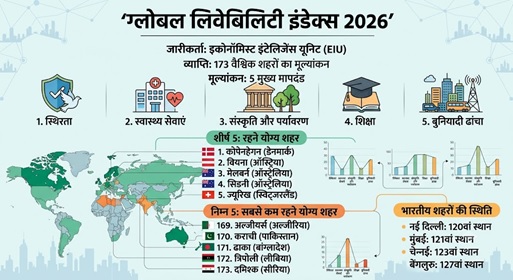
Global Liveability Index 2026 Report: EIU
Fri 10 Jul, 2026
Context:
- The Economist Intelligence Unit (EIU) has released the Global Liveability Index 2026 report.
Key Highlights:
- Organization: Economist Intelligence Unit (EIU), part of The Economist Group.
- Coverage: Assessment of 173 cities.
- Evaluation: Based on five parameters—Stability, Healthcare, Culture & Environment, Education, and Infrastructure.
Five Main Pillars of Assessment:
- The index measures cities on a scale of 1 to 100 using more than 30 qualitative and quantitative indicators, divided into five categories:
- Stability (25% Weight): Crime rate, civil unrest, terrorism threat, and military conflict.
- Healthcare (20% Weight): Quality and availability of public and private healthcare facilities and medicines.
- Culture & Environment (25% Weight): Climate, corruption levels, social and cultural restrictions, and recreational facilities.
- Education (10% Weight): Quality and accessibility of public and private education.
- Infrastructure (20% Weight): Public transport, road network, energy, water supply, telecommunications, and housing quality.
Global Scenario 2026:
- Average Global Score: The global liveability score remained stable at 76.1/100, unchanged from last year.
- Contrasting Trends: Global stability declined due to conflicts in the Middle East, while improvements in healthcare and education in Asia (especially China and Japan) offset the decline.
- Western Europe's Dominance: Western Europe remained the world's most liveable region with an average score of 91.7, despite a slight decline.
- Rise of Asia: Asia's average score increased by 0.3 points, with 9 Asian cities now featuring among the global top 20.
Top 10 Most Liveable Cities:
- Copenhagen (Denmark): Ranked 1st for the second consecutive year (Overall Score: 98; perfect 100/100 in Stability, Education, and Infrastructure).
- Vienna (Austria)
- Melbourne (Australia)
- Sydney (Australia)
- Zurich (Switzerland)
- Geneva (Switzerland)
- Osaka (Japan)
- Adelaide (Australia)
- Vancouver (Canada)
- Tokyo (Japan)
Five Least Liveable Cities:
- Damascus (Syria) – Ranked last globally.
- Tripoli (Libya)
- Dhaka (Bangladesh)
- Karachi (Pakistan) – Ranked 170th globally (4th least liveable).
- Algiers (Algeria)
Performance of Indian Cities:
| City | Global Rank (2026) | Key Strengths | Key Weaknesses |
| New Delhi | 120th (Score: 48.1) | Education (66.7) and Infrastructure (58.9) | Healthcare (41.7) and Culture & Environment (35.4) |
| Mumbai | 121st | Economic opportunities and Education | Traffic congestion and pressure on civic infrastructure |
| Chennai | 123rd | Stable social structure | Weak healthcare infrastructure |
| Bengaluru | 127th | IT sector and economic growth | Water shortage, unplanned urbanization, and poor infrastructure |
Major Reasons Behind the Poor Performance of Indian Cities:
Very Low Score in Culture & Environment (33–35):
- Air pollution and environmental degradation: Dangerous levels of PM2.5 and PM10 in Delhi-NCR contribute to respiratory diseases.
- Waste management: Landfill mountains and untreated sewage flowing into rivers have created severe environmental challenges.
Heavy Pressure on the Healthcare System (Score: 41.7):
- Inadequate infrastructure and overcrowding in government hospitals.
- High cost of tertiary healthcare, leading to increased out-of-pocket expenditure.
Urbanization and Infrastructure Deficiencies:
- Waterlogging during the monsoon, with cities like Mumbai and Delhi facing flood-like situations even after normal rainfall.
- Limited public transport and rising private vehicle ownership causing severe traffic congestion.
- Rapid growth of slums due to the shortage of affordable housing.