India's 21st Designated Repository
 
  • Mobile Menu
HOME BUY MAGAZINEnew course icon
LOG IN SIGN UP

Sign-Up IcanDon't Have an Account?


SIGN UP


Login Icon

Have an Account?


LOG IN
 

or
By clicking on Register, you are agreeing to our Terms & Conditions.


or


India's 21st Designated Repository

Tue 07 Jul, 2026

Context:

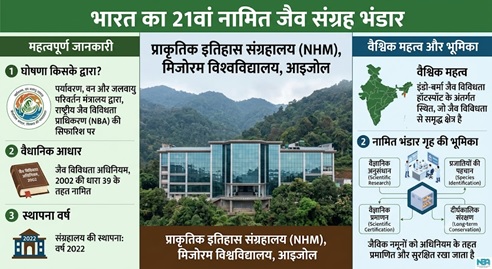
  • The Ministry of Environment, Forest and Climate Change (MoEFCC) has declared the Natural History Museum (NHM), Mizoram University, Aizawl, as the 21st Designated Repository of India.

Key Highlights:

  • Declared by: Ministry of Environment, Forest and Climate Change on the recommendation of the National Biodiversity Authority (NBA).
  • Legal Provision: Notified under Section 39 of the Biological Diversity Act, 2002.
  • Established: The museum was established in 2022.
  • Global Significance: The region falls under the Indo-Burma Biodiversity Hotspot.

Designated Repository:

  • Under the Biological Diversity Act, 2002, the Central Government notifies selected institutions as Designated Repositories. These repositories preserve authenticated biological specimens collected or deposited under the Act for scientific research, species identification, and long-term conservation.

Features of the Museum and Protected Specimens:

  • Species Preserved: The repository will primarily house authenticated specimens of pteridophytes, macrofungi, reptiles, amphibians, fishes, moths, beetles, and butterflies.
  • Example of an Endemic Species: It will also preserve Leptobrachium tamdil, a unique amphibian recently discovered in the forests of Mizoram.
  • Scientific Capacity: The institution already possesses more than 500 biological specimens, including herbarium sheets and wet-preserved collections.

Significance of the Decision:

  • Local Conservation: Biological specimens can now be preserved closer to their original source, reducing logistical challenges.
  • Achieving National Targets: The move supports National Biodiversity Target 4 under India's National Biodiversity Strategy and Action Plan (2024–2030) and strengthens the Kunming–Montreal Global Biodiversity Framework.
  • Collaboration: The institution will complement the existing national network of the Botanical Survey of India (BSI) and the Zoological Survey of India (ZSI).

National Biodiversity Authority (NBA):

  • Established: 2003
  • Headquarters: Chennai, Tamil Nadu
  • Nature: Statutory and autonomous body
  • Established under: Biological Diversity Act, 2002
  • Chairperson: A distinguished environmentalist or expert appointed by the Central Government
  • Ex-officio Members: 10 officials representing various Central Ministries (such as Agriculture, Tribal Affairs, Sc
  • ientific & Industrial Research, etc.)
  • Non-official Members: 5 experts in biodiversity conservation, sustainable use, and related fields

Three-tier Institutional Framework:

  • National Level: National Biodiversity Authority (NBA) – Chennai
  • State Level: State Biodiversity Boards (SBBs) – In all States
  • Local Level: Biodiversity Management Committees (BMCs) – At local bodies (Panchayats and Municipalities)

Zoological Survey of India (ZSI):

  • The Zoological Survey of India (ZSI) is India's premier zoological research institution under the Ministry of Environment, Forest and Climate Change.
  • Established: Formally established on 1 July 1916; originated from the Zoological Section of the Indian Museum, Kolkata (1875).
  • Headquarters: Kolkata, West Bengal
  • Regional Centres: 16 regional centres across different biogeographic zones of India
  • Leadership: Dr. Dhriti Banerjee is the first woman Director in the history of ZSI.

Botanical Survey of India (BSI):

  • The Botanical Survey of India (BSI) is the premier research organization under the Ministry of Environment, Forest and Climate Change (MoEFCC) for taxonomic and botanical studies of India's wild plant resources.
  • Established: 13 February 1890 under the leadership of Sir George King during the British period.
  • Reorganized: 1954, after Independence, with expanded functions.
  • Headquarters: Kolkata, West Bengal
  • Regional Centres: 11 regional centres across the country
  • Major Publications: Plant Discoveries and Red Data Book

Forest Survey of India (FSI):

  • Established: 1981
  • Headquarters: Dehradun, Uttarakhand
  • Main Function: Assessment of forest cover using satellite data
  • Major Report: India State of Forest Report (ISFR) – Published biennially (every two years)


Latest Courses