National News
Approval for 'Uttar Pradesh Data Center Policy-2026'
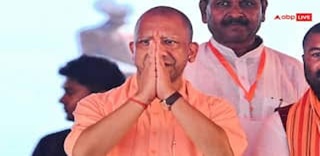
- The Uttar Pradesh government has approved the 'Uttar Pradesh Data Center Policy-2026'.
- The policy aims to attract investments exceeding ₹2 lakh crore and create a data center capacity of 2 GW (Gigawatts).
Related Facts:
- Its primary objective is to establish UP as a global AI (Artificial Intelligence) and green data center hub. This policy is highly significant for competitive examinations.
- Investment Target: Attracting investments worth over ₹2 lakh crore into the state.
- Additional Capacity: Developing an additional data center capacity of 2 Gigawatts (GW).
- Job Creation: Generating approximately 50,000 temporary jobs (during the construction phase) and 7,500 direct long-term jobs.
- Theme/Focus: Transforming Uttar Pradesh into a green, AI-ready (Artificial Intelligence-based), and globally competitive data center hub.
- First Data Center: 'Yotta D1' is the first hyper-scale data center in Uttar Pradesh and North India; it was inaugurated in Greater Noida in October 2022.
|
Approval of Uttar Pradesh Startup Policy 2026
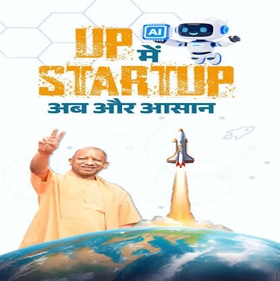
- The Uttar Pradesh Cabinet has approved the Uttar Pradesh Startup Policy 2026.
- Under the revised policy, the monthly sustenance allowance for startups has been increased from ₹17,500 to ₹20,000.
Key Facts:
- Goal of a $1 trillion economy: This policy is aligned with the vision of transforming Uttar Pradesh into a $1 trillion economy by 2030.
- Concept of 'Job Creators': The core philosophy of the policy is to transform the youth from 'job seekers' into 'job creators'.
- Current Status: As of June 2026, the number of registered startups in Uttar Pradesh has exceeded 17,000, and the state is home to 8 unicorns.
Key Financial Incentives:
- Sustenance Allowance: Increased from ₹17,500 per month (for 1 year) to ₹20,000 per month (for 2 years).
- Prototype Grant: Increased from ₹5 lakh to ₹10 lakh (up to ₹50 lakh in special cases).
- Seed Funding: Initial funding support has been doubled from ₹7.5 lakh to ₹15 lakh.
- Patent and Quality Certification: A provision of up to ₹2 crore exists for reimbursement of these costs.
- Long-term Investment: Includes incentives for investments (patient capital) of up to ₹100 crore for frontier technology and deep-tech startups.
|
Renaming of Jalalabad Town and Tehsil
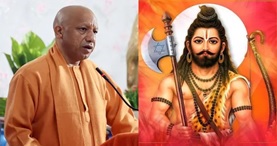
- The Uttar Pradesh government has approved renaming the Jalalabad town and tehsil in Shahjahanpur district to 'Parashurampuri'.
Related Facts:
- This town falls under the Shahjahanpur district of Uttar Pradesh.
- With the name change, the local municipal body will now be known as the 'Parashurampuri Nagar Palika Parishad' (Municipal Council).
- According to Hindu beliefs and mythological texts, Jalalabad is considered the birthplace of Lord Parashurama, the sixth avatar of Lord Vishnu.
- An ancient temple dedicated to Lord Parashurama and Mother Renuka is also situated here.
- The town was established around 1560 AD (during the Mughal era).
- It was originally named 'Jalalabad' after the Mughal Emperor Jalaluddin Muhammad Akbar.
- Prerogative of States: According to the Constitution of India, the final authority to rename a city, town, village, or district, or to create new districts, rests with the respective state government. The central government does not have a direct role in this process.
|
Economy and Banking
Exports from the Leather and Footwear Industry
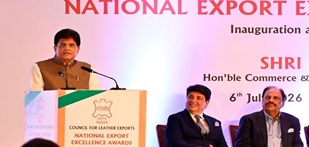
- Union Minister of Commerce and Industry Piyush Goyal stated at the Council for Leather Exports (CLE) National Export Excellence Awards 2024-25 ceremony in New Delhi that India's leather and footwear industry exports stand at approximately $4.5 billion.
Related Facts:
- Free Trade Agreements (FTAs): 38 developed nations—including the UK, Oman, and the United Arab Emirates (UAE)—have opened their markets to India.
- Export Target: Piyush Goyal has called upon the leather and footwear industry to achieve an export target of at least $15 billion over the next 5 to 6 years.
- Market Diversification: Currently, 77 percent of India's total leather exports go to just 15 countries; therefore, diversifying export destinations is essential.
Key National Institutions Related to the Leather Industry:
- Council for Leather Exports (CLE): Headquartered in Chennai, Tamil Nadu.
- Central Leather Research Institute (CLRI): The world's largest leather research institute, located in Chennai, Tamil Nadu.
- Footwear Design and Development Institute (FDDI): Its main campus is in Noida, Uttar Pradesh.
- Leading States: Tamil Nadu, Uttar Pradesh, West Bengal, and Punjab are at the forefront of leather and leather product production in India.
Major Cities (Leather Hubs):
- Kanpur (Uttar Pradesh): Known as the "Manchester of the East," it is famous for its massive leather industry.
- Agra (Uttar Pradesh): A major hub for footwear production.
- Vaniyambadi and Ambur (Tamil Nadu): Key leather processing centers in South India.
- Kolkata (Bantala): A major leather complex in Eastern India.
|
ADB Assistance of ₹2,000 Crore for Karnataka Schools
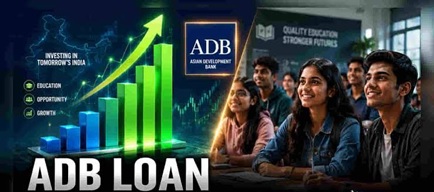
- The Asian Development Bank (ADB) has approved a loan of $182.89 million (approximately ₹2,000 crore) to strengthen the public education system in Karnataka.
- This initiative aligns with the National Education Policy (NEP) 2020 and aims to improve learning outcomes for over 1 million (10 lakh) students.
Key Facts:
- Objective: To establish 500 integrated Karnataka Public School (KPS) clusters in the state.
- Coverage: These schools will provide seamless education from the pre-primary to the secondary level.
- Focus Areas: It will facilitate infrastructure development, improve teacher qualifications, enhance assessment systems, and promote education in Science, Technology, Engineering, Arts, and Mathematics (STEAM).
- Financial Assistance: Funded under ADB’s Results-Based Lending mechanism; it also includes additional grants and guarantees from the International Finance Facility for Education (IFFEd).
Asian Development Bank (ADB):
- Full Name: Asian Development Bank (ADB)
- Type: Multilateral development bank
- Establishment: December 19, 1966
- Headquarters: Mandaluyong City, Metro Manila, Philippines
- Member Countries: 68 member countries
- Current President: Masato Kanda (11th President)
- Governance: Managed by a Board of Governors, representing all member countries.
- Operations: Provides financial assistance through loans, technical assistance, grants, guarantees, and equity investments.
- Area of Operation: Promoting sustainable, inclusive, and resilient development in the Asia-Pacific region.
- Major Shareholders: Japan (15.6%), USA (15.6%), China (6.4%), India (6.3%), and Australia (5.8%).
- India's Status: Founding member country.
- Role in India: Provides financial and technical assistance for various development projects.
|
Person In News
Mountaineer Chering Choden
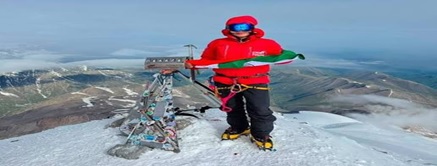
- Sikkim mountaineer Chering Choden successfully unfurled the Indian national flag atop Mount Elbrus (5,642 m), the highest peak in Europe.
Key Facts:
- Mountaineer: Chering Choden
- Home State: Sikkim (37-year-old from Chongay, Gangtok)
- Achievement: Successfully unfurled the Indian flag on Mount Elbrus (5,642 m) on 5 July 2026.
- Mission: She is on a mission to complete the Seven Summits Challenge. Mount Elbrus is her second successful summit in this challenge.
- Previous Achievement: She summited Mount Kilimanjaro, the highest peak in Africa, in August 2025.
- Training Institute: She completed her Basic Mountaineering Course at the Indian Himalayan Centre for Adventure and Eco-Tourism (IHCAE), Chemchey, South Sikkim.
Mount Elbrus :
- Location: Russia, near the Georgia border.
- Mountain Range: Part of the Caucasus Mountains.
- Nature: A dormant volcano with two summits; the western summit (5,642 m) is the higher one.
- Significance: The Caucasus Mountains are widely regarded as the boundary between Europe and Asia. Therefore, Mount Elbrus is recognized as the highest peak in Europe. (The highest peak in the Alps is Mont Blanc, at 4,810 m.)
What is the Seven Summits Challenge? :
|
1. Asia
- Highest Peak: Mount Everest
- Height: 8,848.86 m
- Country/Location: Nepal / China
2. South America
- Highest Peak: Mount Aconcagua
- Height: 6,961 m
- Country/Location: Argentina
3. North America
- Highest Peak: Mount Denali (Mount McKinley)
- Height: 6,190 m
- Country/Location: Alaska, USA
4. Africa
- Highest Peak: Mount Kilimanjaro
- Height: 5,895 m
- Country/Location: Tanzania
|
5. Europe
- Highest Peak: Mount Elbrus
- Height: 5,642 m
- Country/Location: Russia
6. Antarctica
- Highest Peak: Mount Vinson Massif
- Height: 4,892 m
- Country/Location: Antarctica
7. Oceania/Australia
- Highest Peak: Puncak Jaya (Carstensz Pyramid) / Mount Kosciuszko
- Height: 4,884 m / 2,228 m
- Country/Location: Indonesia / Australia
|
|
Cricketer Vaibhav Suryavanshi
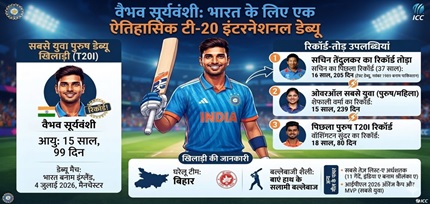
- Vaibhav Suryavanshi became the youngest cricketer to make his international T20 debut for India at the age of 15 years and 99 days.
Key Points:
- Record: He broke the Indian records held by Sachin Tendulkar (16 years 205 days, Test, 1989) and Washington Sundar (18 years 80 days, T20I).
- Global Achievement: He is the youngest T20I player in the world to play for any ICC Full Member nation.
- Other Young Indian Players: Following Sachin Tendulkar are Piyush Chawla (17 years 75 days) and Laxman Sivaramakrishnan (17 years 118 days).
- Other Records: He is the player who played Ranji Trophy at the age of 12, won the Orange Cap and Emerging Player award for Rajasthan Royals in IPL 2026, and scored the fastest half-century in List-A cricket off just 11 balls.
|
Footballer Neymar Jr.
- Legendary Brazilian footballer Neymar Jr. announced his retirement from international football.
- He made this emotional decision immediately after Brazil's 2-1 defeat by Norway in the Round of 16 of the 2026 FIFA World Cup, which resulted in their elimination from the tournament.
Key Facts:
- Final Match: Neymar's last international match was against Norway on July 5, 2026 (July 6, Indian Standard Time), at MetLife Stadium in New Jersey.
- Final Goal: In this match, Neymar scored Brazil's only goal via a penalty in the 10th minute of stoppage time; this proved to be the 80th international goal of his career.
- Interesting Coincidence: Neymar made his international debut against the USA at this very stadium (MetLife Stadium) in 2010, and his farewell match also took place on the same ground.
- Total Matches and Goals: He scored a record 80 goals and provided 59 assists in 130 matches for Brazil (*Seleção*).
- Brazil's All-Time Top Scorer: He holds the record for the most international goals in Brazil's history, having surpassed the legendary footballer Pelé (77 goals). They won the FIFA Confederations Cup in 2013.
FIFA World Cup 2026:
- It is the biggest and grandest tournament in football history to date, scheduled to be held from June 11 to July 19, 2026.
- Hosting: For the first time, three countries are co-hosting the event (USA, Mexico, and Canada).
- Note: Previously, only two countries—Japan and South Korea—had co-hosted the tournament in 2002.
- 48 Teams: A record 48 teams are participating in the tournament this time, whereas previously only 32 teams competed.
- 12 Groups: All teams have been divided into 12 groups of four teams each.
- Total Matches: The total number of matches has increased from 64 to 104, spanning 39 days.
- Host Cities: Matches are being played across 16 cities in North America (11 in the USA, 3 in Mexico, and 2 in Canada).
- Opening Match: Played on June 11 at Mexico's historic Estadio Azteca.
- Official Football: The ball, manufactured by Adidas, is named 'Trionda'. In Spanish, this means "three waves," symbolizing the unity and culture of the three host nations.
- Mascots: Three official mascots have been unveiled: Maple™ the Moose (symbolizing Canada), Zayu™ the Jaguar (symbolizing Mexico), and Clutch™ the Bald Eagle (symbolizing the USA).
- The Indian football team failed to qualify for this World Cup. The team was eliminated after finishing third in Group A during the second round of the AFC qualifiers. FIFA:
- Full Name: Fédération Internationale de Football Association
- Founded: 21 May 1904 (in Paris, France)
- Headquarters: Zurich, Switzerland
- Current President: Gianni Infantino
- Regional Confederations: 6 regional continental confederations
- AFC - Asian Football Confederation (India is a member)
- UEFA - Union of European Football Associations
- CONMEBOL - South American Football Confederation
- CAF - Confederation of African Football
- CONCACAF - Confederation of North, Central American and Caribbean Association Football
- OFC - Oceania Football Confederation
Major Tournaments Organized by FIFA:
- FIFA Men's World Cup: This is the biggest football event, held every 4 years. The first World Cup was played in Uruguay in 1930.
- FIFA Women's World Cup: It was inaugurated in 1991.
India and FIFA:
- All India Football Federation (AIFF): The AIFF governs football in India. It was established in 1937.
- FIFA Membership: India (AIFF) received official FIFA membership in 1948.
- Historic Moments: India successfully hosted the FIFA U-17 Men's World Cup in 2017 and the FIFA U-17 Women's World Cup in 2022.
|
Defence News
'Rim of the Pacific' (RIMPAC) 2026 Exercise
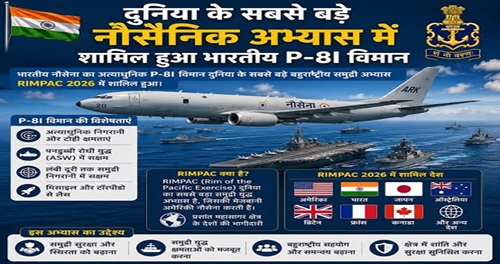
- The Indian Navy's P-8I long-range maritime reconnaissance and anti-submarine warfare (LRMR-ASW) aircraft has arrived at Joint Base Pearl Harbor-Hickam in Hawaii, USA, to participate in 'Rim of the Pacific' (RIMPAC) 2026—the world's largest international naval exercise.
Key Facts:
|
Exercise RIMPAC 2026:
- Host: US Navy (Pacific Fleet), Hawaii.
- Edition & Duration: 30th edition; June 24 to July 31, 2026.
- Scale: 30 nations, 30+ warships, 200+ aircraft, 30,000 personnel.
- Indian Participation: Continuous since 2014; includes INS Shivalik and the P-8I aircraft this time.
P-8I Aircraft (Boeing, USA):
- Platform: Based on the Boeing 737-800 (India was the first international customer).
- Role: Long-range maritime surveillance and anti-submarine warfare (ASW).
- Armament: Harpoon Block II missiles, Mk-54 torpedoes, and sonobuoys.
|
Sports News
India's First Asmita South Zone Women's Canoeing and Kayaking League
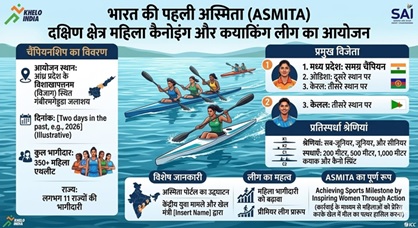
- India's first Asmita South Zone Women's Canoeing and Kayaking League was held at the Gambhiramgedda Reservoir in Visakhapatnam, Andhra Pradesh.
Key Facts:
- Organizers: The league was organized under the 'Khelo India' initiative of the Union Ministry of Youth Affairs and Sports. It was conducted in collaboration with the Sports Authority of Andhra Pradesh (SAAP) and the Canoeing and Kayaking Association of Andhra Pradesh (CKAAP).
- Overall Champion: Madhya Pradesh delivered an outstanding performance to clinch the overall championship title (securing a total of 38 medals).
- Runners-up: Odisha secured the second position, while Kerala finished third.
- Special Category Winner: The Telangana team emerged as the overall winner in the Sub-Junior Girls category.
- Full form of ASMITA: Achieving Sports Milestone by Inspiring Women Through Action.
- Nodal Ministry: Union Ministry of Youth Affairs and Sports, Government of India (in collaboration with the Sports Authority of India - SAI).
|
Women's T20 World Cup 2026
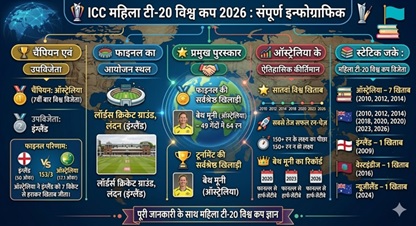
- The Australian women's cricket team won the Women's T20 World Cup title for the seventh time by defeating England by 7 wickets.
Related Facts:
- Edition: 10th edition
- Host Country: England and Wales
- Winner: Australia (won the title for a record 7th time by defeating hosts England by 7 wickets)
- Runner-up: England
- Participating Teams: For the first time in history, 12 teams participated instead of 10.
- Venue of the Final: Historic Lord's Cricket Ground, London
Tournament Format and Structure:
- Group Stage: The 12 teams were divided into two groups of six (Group A and Group B).
- Round-Robin: Each team played one match against the other five teams in its group.
- Knockout Stage: The top two teams from each group (4 teams in total) advanced to the semi-finals.
- Total Matches: A total of 33 matches were played over a period of 24 days.
- The Women's T20 World Cup was held for the first time in England in 2009. The tournament featured 8 teams.
- Hosts England became the inaugural champions.
- Eight teams competed in the first three World Cups.
- The number of teams increased to 10 starting in 2014.
- In 2026, 12 teams are participating for the first time.
- England is hosting the World Cup after 17 years.
Major Awards:
- Player of the Match: Australian opening batter Beth Mooney
- Player of the Tournament: Australian wicketkeeper-batter Beth Mooney (scored 238 runs in 7 innings across 7 matches at an average of 47.60 and a strike rate of 142.51)
- Most Successful Batter: England's Danni Wyatt (scored 302 runs in 7 innings across 7 matches—remaining unbeaten twice—at an average of 60.40 and a strike rate of 149.50)
|
Science and Technology
First Successful Test of ‘SOLVE’ Rocket Motor
- The Indian Space Research Organisation (ISRO) conducted the first successful ground test of the 'SOLVE' solid motor at the Static Test Facility of the Satish Dhawan Space Centre (SDSC), Sriharikota.
- This test marks a major and significant achievement towards ensuring the reliability of the safety systems for India's first human spaceflight mission, Gaganyaan.
Related Facts:
|
SOLVE:
- Full Name: Sub-Orbital Launch Vehicle for Experiments
- Nature: It is a specially developed small sub-orbital test vehicle/platform. It is used for conducting various tests rather than for placing actual satellites into space.
- Technical Basis: The solid stage of SOLVE is derived from the strap-on booster motor (PS0) of the PSLV (Polar Satellite Launch Vehicle), with necessary modifications made to suit the specific requirements of the Gaganyaan mission.
Gaganyaan Mission:
- It is the Indian Space Research Organisation's (ISRO) first human spaceflight program.
- Under this mission, three astronauts will be sent to a Low Earth Orbit (LEO) at an altitude of 400 km for three days and brought back safely.
- The LVM3 (GSLV Mk-3) rocket will be used for this mission.
- Astronauts: Group Captain Prasanth Balakrishnan Nair, Group Captain Angad Pratap, Group Captain Ajit Krishnan, and Group Captain Shubhanshu Shukla.
- Space Station Goal: The scope of the Gaganyaan mission has now been expanded. India is preparing to establish its own space station (BAS – Bharatiya Antariksh Station) by 2035.
Test Flights:
- ISRO is conducting several uncrewed test flights before sending humans into space.
- A female robot named 'Vyommitra' will also be sent on these test flights to assess space conditions.
Indian Space Research Organisation (ISRO):
- India's national space agency; it operates under the Department of Space (DOS) and reports directly to the Prime Minister.
- Establishment: August 15, 1969
- Founder: Dr. Vikram Sarabhai (known as the father of the Indian space program)
- Headquarters: Bengaluru, Karnataka
- Predecessor: INCOSPAR (Indian National Committee for Space Research) was formed in 1962, prior to ISRO.
- First Indian satellite: Aryabhata (launched on April 19, 1975, using a Soviet Union rocket)
- First satellite launched from Indian soil: Rohini (RS-1) (launched in 1980 by India's first indigenous rocket, SLV-3)
- First Indian astronaut: Rakesh Sharma (went into space on April 3, 1984, aboard the Soviet Union's 'Soyuz T-11' mission)
|
Art and Culture
A rare 13th century Telugu inscription discovered
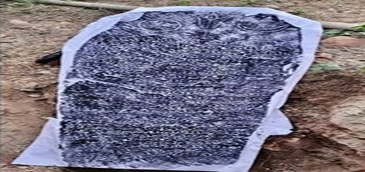
- A fragmentary Telugu inscription from the 13th century has been discovered by the Archaeological Survey of India (ASI) in the Nallamala Tiger Reserve (Yerragondapalem mandal) in Prakasam district of Andhra Pradesh.
- This inscription of 16 May 1285 AD is related to the period of Kakatiya queen Rudrama Devi.
Related facts:
- Location: This inscription was found in the Nallamala Tiger Reserve forest area near Ayyambholapalle village in Yerragondapalem mandal of Prakasam district
- Script and Language: This inscription is inscribed in the ancient Telugu language and script.
- Period: It is dated May 16, 1285 AD (Saka Samvat 1207), which belongs to the reign of the famous queen Rudramadevi of the Kakatiya dynasty.
- Structure of the inscription: It is inscribed on a fragmented boulder, on which are carved figures of Amaravati Stupa and Muchalinda Naga (Nagaraja protecting the Buddha).
Historical content of the inscription:
- Details of donation: It records that Bolayani Mallikarjuna Nayak, a commander (nayak) under Queen Rudramadevi, made a donation.
- Gift: The commander gifted/donated the village of Velmapalli to 'Buddhadev' of Sridhanyam (then Dhanyakatka/modern Amaravati).
Kakatiya Dynasty:
- was a prominent and powerful dynasty of South India, which ruled mainly modern Andhra Pradesh, Telangana and parts of Karnataka and Odisha during the 12th to 14th centuries.
- Capital: Initially their capital was Anumkonda, which was later changed to Orugallu, which is today known as Warangal.
- Origin: Initially, the Kakatiya rulers served as feudatories of the Western Chalukyas.
- Independence: This dynasty declared itself independent during the reign of Prola II and his son Pratapbhadra I (Rudradev).
- Coat of arms: Their royal symbol was Boar.
Queen Rudramadevi (1262–1289 AD):
- One of the very few female rulers to rule in the history of India. Being the daughter of Ganapati Dev, she assumed the name of 'Rudradev Maharaj' in male form and took over the rule.
- The famous Venetian traveler Marco Polo visited the Kakatiya Empire during his reign and highly praised their administrative efficiency and prosperity.
Art, Architecture and Culture:
- Ramappa Temple: Located in Palampet, this temple is dedicated to Lord Shiva. It was included in the UNESCO World Heritage Site in the year 2021. Its specialty is its floating bricks and the exquisite carvings of the sanctum sanctorum.
- Torana/Kirthi Torana: The gateways (Torana) of the Warangal Fort are symbols of the exquisite sculpture of this dynasty, which have now been incorporated by the Government of Telangana in its official state emblem.
- Literature: Sanskrit and Telugu literature developed immensely during this period. Jayapa Senani wrote the famous treatise on dance 'Nritya Ratnavali'.
Archaeological Survey of India (ASI):
- Establishment: It was established in the year 1861 during the British period.
- Founder: Its founder was Sir Alexander Cunningham, who also became its first Director General. Cunningham is called the 'Father of Indian Archaeology'.
- Contribution of Lord Curzon: In the year 1902, the then Viceroy Lord Curzon centralized and revived the ASI and appointed John Marshall as its Director General, under whose leadership the Indus Valley Civilization (Harappa and Mohenjodaro) were discovered in the 1920s.
- Headquarters: Its headquarters is located at 'Dharohar Bhawan', Tilak Marg, New Delhi.
|
Discovery of Two Gold Rings Dating Back Approximately 2,000 Years in Thailand
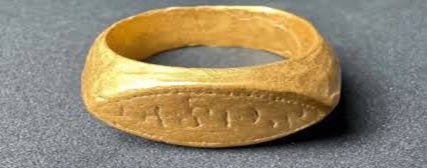
- Two gold rings, estimated to be around 2,000 years old, have been discovered at the 'Don Yai Thong' site in Thailand's Phetchaburi province.
- One of the rings bears an inscription in the ancient Indian 'Brahmi script' reading "Pusarakhitas."
- This serves as evidence of strong trade and cultural ties between ancient India and Southeast Asia.
Related Facts:
- Location of discovery: Don Yai Thong archaeological site, Phetchaburi province, western/central Thailand
- Age: Approximately 1,900 to 2,100 years old (Iron Age)
- Epigraphic evidence: Ancient Indian Brahmi script
- Inscribed word: "Pusarakhitas"
- Probable owner: A member of the Vaishya (merchant) community of ancient India
- Museum: Housed at the Phra Nakhon Khiri Museum, Ratchaburi province, for preservation
Other Important Facts:
- Brahmi Script: It is one of the oldest scripts of the Indian subcontinent. Modern Indian scripts (such as Devanagari, Bengali, Tamil, etc.) evolved from it. Most of Emperor Ashoka's inscriptions were written in the Brahmi script; they were first deciphered by James Prinsep in 1837.
- Vaishya Varna: In the ancient Indian Hindu Varna system, the responsibility for trade and commerce lay with the Vaishya community.
- Iron Age: This archaeological site in Thailand is attributed to the prehistoric Iron Age (approximately 1,500 to 2,500 years ago).
|
Important Day
'World Kiswahili Language Day'
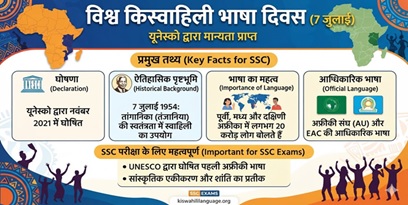
- 'World Kiswahili Language Day' is observed annually on July 7th with the aim of promoting African culture, peacebuilding, and regional integration.
Related Facts:
- Date: Observed annually on July 7th.
- Organization: UNESCO declared this day during its 41st session in 2021.
- First Observance: The first official World Kiswahili Language Day was celebrated on July 7, 2022.
- Objective: To promote African culture, peacebuilding, and regional integration.
- Significance: Kiswahili (or Swahili) is the first African language to be recognized by the United Nations (UN).
Kiswahili Language:
- Meaning of the word: The word 'Swahili' is derived from the Arabic word 'Sahil', which means 'coast'.
- 'Ki-' prefix: In this language, the prefix 'Ki-' denotes 'language'. Therefore, the local people call it 'Kiswahili' (coastal language).
- Native speakers: People who speak this language as their mother tongue are known as 'Waswahili'.
- Main region: It is primarily spoken in countries across East and Central Africa (Tanzania, Kenya, Uganda, Rwanda, Burundi, Congo, and Mozambique).
- Language family: It belongs to the Bantu branch of the Niger-Congo language family.
- Script evolution: Originally written in the Arabic script, it is now written using the Latin (Roman) alphabet.
- UNESCO official language: In November 2025, Kiswahili was recognized as the seventh official language of the UNESCO General Conference. It is the first language of African origin to achieve this distinction.
|


 Don't Have an Account?