


 Don't Have an Account?




SSC Foundation Eklavya - 2 Offline Cum Online Batch Lucknow Branch
10 September, 2026



Enter your Email ID and we'll send you a link to get back into your account.

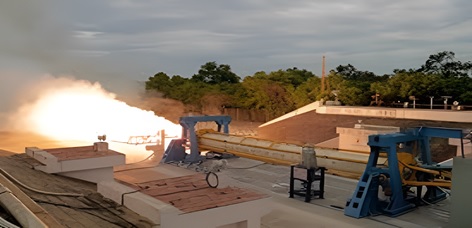

Sub-Orbital Launch Vehicle for Experiments (SOLVE)
Mon 06 Jul, 2026
The Indian Space Research Organisation (ISRO) successfully conducted the first static ground test of the solid motor for the Sub-Orbital Launch Vehicle for Experiments (SOLVE) on 3 July 2026 at the Static Test Facility of the Satish Dhawan Space Centre (SDSC), Sriharikota. The successful test marks a major milestone in validating the crew safety systems of India's Gaganyaan Human Spaceflight Mission.
What is SOLVE?
SOLVE (Sub-Orbital Launch Vehicle for Experiments) is a dedicated, cost-effective sub-orbital launch vehicle developed by ISRO to conduct Integrated Parachute Tests (IPT) for the Gaganyaan Crew Module.
Its primary objective is to validate the parachute-based deceleration and recovery system of the crew module under realistic high-altitude atmospheric conditions before the actual human spaceflight mission.
Key Features of SOLVE
1. Dedicated Test Vehicle
2. PSLV-Based Solid Motor
3. Indigenous Technological Improvements
ISRO introduced several modifications, including:
4. Flight Profile
5. Parachute Recovery Sequence
After reaching the designated altitude:
Significance for the Gaganyaan Mission
The safe return of astronauts is considered the most critical phase of any human spaceflight mission.
Earlier, ISRO validated the parachute system through:
However, SOLVE enables:
Thus, SOLVE significantly enhances the reliability and safety of the Gaganyaan mission.
Outcome of the Ground Test
According to ISRO:
About Gaganyaan Mission
About ISRO
10 September, 2026
24 August, 2026
06 August, 2026
28 July, 2026
27 July, 2026
22 July, 2026
20 July, 2026
26 May, 2026
08 May, 2026
20 April, 2026
