


 Don't Have an Account?




SSC Foundation Eklavya - 2 Offline Cum Online Batch Lucknow Branch
10 September, 2026



Enter your Email ID and we'll send you a link to get back into your account.

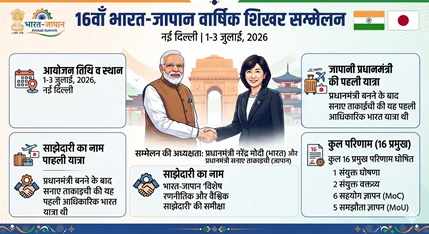

16th India–Japan Annual Summit
Sat 04 Jul, 2026
Context:
Key Highlights:
List of the 16 Major Outcomes:
| S. No. | Agreement/Declaration | Main Objective |
| 1 | India–Japan Joint Declaration on Economic Security | Promote project-based cooperation and strengthen supply chains in semiconductors, critical minerals, AI, ICT, clean energy, and pharmaceuticals. |
| 2 | Joint Statement on Cooperation in Artificial Intelligence (AI) | Enhance joint research, development, and technology cooperation for safe, secure, trustworthy, inclusive, and human-centric AI. |
| 3 | Joint Statement on Strengthening Energy Cooperation | Enhance cooperation in strategic petroleum reserves and maritime energy transportation. |
| 4 | 75th Anniversary of India–Japan Diplomatic Relations | Celebrate 2027 as the "India–Japan Year of Shared Horizons." |
| 5 | India–Japan Cooperative Biogas for Growth (CBG) Initiative | Support the establishment of 1,000 biogas and organic fertilizer plants across India. |
| 6 | MoC on Battery Cooperation | Promote battery projects and develop secure, resilient, and sustainable battery supply chains. |
| 7 | MoC on Pharmaceuticals and Medical Devices | Strengthen pharmaceutical supply chains, including APIs and KSMs, through investment and technical cooperation. |
| 8 | MoC on Geology and Mineral Exploration | Promote exploration of critical minerals and exchange geological expertise. |
| 9 | IndiaAI Mission–METI Agreement | Foster AI projects, B2B partnerships, webinars, and access to computing resources. |
| 10 | Next Generation Mobility Partnership (NGMP) | Promote cooperation in railways, roads, automobiles, aviation, shipbuilding, logistics, and urban development under the "Make in India for the World" initiative. |
| 11 | C-CAMP–RIKEN MoU | Promote deep-tech, life sciences, healthcare, agriculture, environmental research, and startup innovation. |
| 12 | NCBS-TIFR–RIKEN MoU | Strengthen collaboration in fundamental biology and neuroscience research. |
| 13 | IIT Bombay–BharatGen–NII MoU | Advance joint research on Large Language Models (LLMs) with enhanced scientific reasoning capabilities. |
| 14 | Sarvam AI–Preferred Networks MoU | Promote cooperation across the AI technology stack, including foundation models. |
| 15 | NIXI–JPNIC MoU | Strengthen cooperation in IPv6 adoption, internet security, capacity building, internet governance, and professional exchanges. |
| 16 | Exchange of Letters between IFSCA and JFSA | Establish cooperation in financial regulation, supervision, FinTech, RegTech, and exchange of best practices. |
Japan :
Main Islands (North to South):
Hiroshima and Nagasaki (World War II):
Evolution of India–Japan Diplomatic Relations:
10 September, 2026
24 August, 2026
06 August, 2026
28 July, 2026
27 July, 2026
22 July, 2026
20 July, 2026
26 May, 2026
08 May, 2026
20 April, 2026
