26 May, 2026
Sustainable Development Report 2026
Fri 03 Jul, 2026
Context:
- UN Sustainable Development Solutions Network (SDSN) has released the 'Sustainable Development Report 2026'.
According to the Report:
- Global Slowdown: The report warns that progress toward meeting the 2030 goals globally is substantially slow. Only 16.5% of individual SDG targets are on track.
- Globally Lagging Goals: Globally, SDG 2 (Zero Hunger), SDG 11 (Sustainable Cities), SDG 14 (Life Below Water), SDG 15 (Life on Land), and SDG 16 (Peace and Justice) are lagging the furthest behind.
India's Performance:
Progress and Ranking Trends:
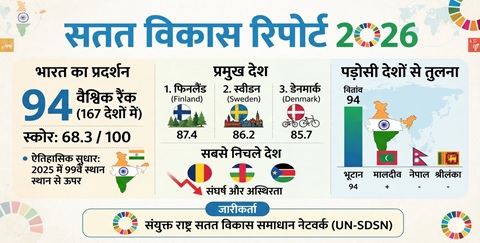
- Score: India has achieved an overall SDG score of 68.3 out of 100 (reflecting an improvement from a score of 67 in 2025 and its 109th rank in 2024).
- Historic Improvement: Since the adoption of SDGs in 2015, India has improved its ranking by 18 places (moving from 112th position to 94th position now). Along with China, India is one of the major economies globally to record the fastest rate of improvement.
- 2030 Projection: Only 33.3% of India's sustainable development targets are on track to be achieved by 2030, whereas progress is limited on 42.7% of targets, and the situation has worsened in 24% of the targets.
Regional Comparison:
- Although India has improved significantly, it remains behind several of its South Asian neighbors:
- Maldives: 53rd rank
- Bhutan: 74th rank
- Nepal: 85th rank
- Sri Lanka: 93rd rank
- (Note: India is in a better position than Bangladesh and Pakistan)
Key Areas of Success for India:
- SDG 7 (Affordable and Clean Energy): Massive expansion of electricity access (via rural electrification schemes).
- SDG 9 (Industry, Innovation, and Infrastructure): Exceptional improvement in mobile broadband and internet penetration, which has catalyzed Digital Inclusion.
- Reduction in Infant Mortality Rate (SDG 3): Due to institutional deliveries and immunization campaigns, a notable decline has been recorded in under-five and neonatal mortality rates.
Top Countries:
- Finland has secured the first position in this index, while Sweden stands second and Denmark third.
Bottom-most Countries:
- Grappling with conflict and instability, Chad, Central African Republic, and South Sudan are at the very bottom of the rankings.
Key Structural Challenges before India:
| Affected Goals (SDG) | Key Issues and Data Points |
| SDG 2: Zero Hunger | This is the most severe challenge. India's child wasting rate is 19% (the highest in the world), child stunting is 29.3%, and undernourishment has increased to 12%. |
| SDG 13: Climate Action | Carbon emissions are rising due to fossil fuel combustion and cement production. India's per capita $\text{CO}_2$ emissions have reached a record 2.21 tonnes. |
| SDG 16: Peace, Justice, and Strong Institutions | Governance indicators have declined. India's Press Freedom Index score has dropped from 59.51 in 2015 to 31.96 in 2026. |
| Other Weak Areas | SDG 3 (Mortality rate caused by air pollution), SDG 5 (Gender inequality), SDG 11 (Unsustainable urbanization), SDG 12 (Responsible consumption), and SDG 14 & 15 (Degradation of ecosystems). |
Highlights of the Global Scenario:
- Global Slowdown: At the global level, no country is on track to achieve all 17 goals. Only 16.5% of global targets are moving in the right direction.
- Top Countries: Nordic countries remain leaders — Finland (1st), Sweden (2nd), and Denmark (3rd).
- Bottom-most Countries: Chad, Central African Republic, and South Sudan (due to protracted conflict and financial shortages).
- Multilateralism Index (UN-Mi): This year, Barbados topped the chart for its commitment to multilateralism, whereas the USA ranked at the very bottom due to its opposition to the 2030 Agenda and withdrawal from more than 60 international organizations.
Sustainable Development Goals (SDG):
- It is a universal action plan adopted to end poverty globally, protect the environment, and ensure peace and prosperity for all.
- It is known by the United Nations (UN) as "Agenda 2030". Its core details for the Civil Services Examination (UPSC) and general understanding are provided below:
Basic Facts:
- Year of Adoption: September 2015 (at the 70th session of the UN General Assembly).
- Date of Enforcement: 1 January 2016.
- Target Year (Timeframe): 2030 (A 15-year plan).
- Total Targets: 17 Core Goals and 169 Sub-targets.
- Predecessor: They replaced the Millennium Development Goals (MDGs), which spanned from 2000 to 2015.
5 Pillars of Sustainable Development:
- People: Ending poverty and hunger; ensuring dignity and equality.
- Planet: Protecting the Earth's natural resources and climate for future generations.
- Prosperity: Ensuring prosperous and fulfilling lives in harmony with nature.
- Peace: Fostering peaceful, just, and inclusive societies free from fear and violence.
- Partnership: Implementing the agenda through global solidarity.
List of the 17 Sustainable Development Goals:
- SDG 1: No Poverty – End poverty in all its forms everywhere.
- SDG 2: Zero Hunger – End hunger, achieve food security, improved nutrition, and sustainable agriculture.
- SDG 3: Good Health and Well-being – Ensure healthy lives and promote well-being for all at all ages.
- SDG 4: Quality Education – Ensure inclusive and equitable quality education.
- SDG 5: Gender Equality – Achieve gender equality and empower all women and girls.
- SDG 6: Clean Water and Sanitation – Sustainable management of water and sanitation for all.
- SDG 7: Affordable and Clean Energy – Access to affordable, reliable, sustainable, and modern energy.
- SDG 8: Decent Work and Economic Growth – Sustained, inclusive economic growth and productive employment.
- SDG 9: Industry, Innovation, and Infrastructure – Build resilient infrastructure and foster innovation.
- SDG 10: Reduced Inequalities – Reduce inequality within and among countries.
- SDG 11: Sustainable Cities and Communities – Make cities safe, resilient, and sustainable.
- SDG 12: Responsible Consumption and Production – Ensure sustainable consumption and production patterns.
- SDG 13: Climate Action – Urgent action to combat climate change and its impacts.
- SDG 14: Life Below Water – Conserve oceans, seas, and marine resources.
- SDG 15: Life on Land – Sustainable management of forests, halt desertification, and halt biodiversity loss.
- SDG 16: Peace, Justice, and Strong Institutions – Access to justice and build accountable institutions.
- SDG 17: Partnerships for the Goals – Revitalize the global partnership.