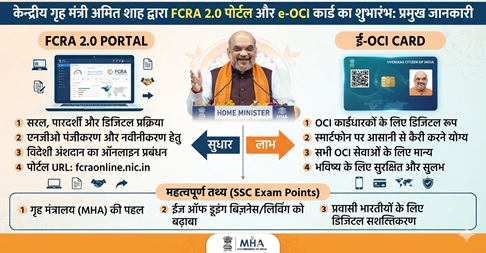
Launch of FCRA 2.0 Portal and e-OCI Card
 
  • Mobile Menu
HOME BUY MAGAZINEnew course icon
LOG IN SIGN UP

Sign-Up IcanDon't Have an Account?


SIGN UP


Login Icon

Have an Account?


LOG IN
 

or
By clicking on Register, you are agreeing to our Terms & Conditions.


or


Launch of FCRA 2.0 Portal and e-OCI Card

Thu 02 Jul, 2026

Reference:

  • Union Home Minister Amit Shah launched the FCRA 2.0 Portal and the e-OCI Card.

Key Highlights:

  • Main Objective: To strengthen digital governance, transparency, and citizen-centric service delivery.
  • Ministry: Both initiatives come under the Ministry of Home Affairs (MHA).
  • Principle: Based on the vision of "Minimum Government, Maximum Governance."
  • FCRA 1.0 Portal was launched in 2015 by the then Union Home Minister Rajnath Singh.
  • Foreign Contribution (Regulation) Act 2.0 (FCRA 2.0 Portal):
  • The FCRA 2.0 Portal is an upgraded digital platform developed for the administration of the Foreign Contribution (Regulation) Act, 2010.
  • Objective: To simplify compliance with foreign funding regulations and ensure strict monitoring of foreign funds received with malicious intent.
  • Nodal Ministry: Ministry of Home Affairs (MHA).
  • Hosted on: National Government Cloud (MeghRaj).

Key Features:

  • End-to-End Digitalization: Registration, renewal, annual return filing, and all statutory approvals are now completely online, eliminating the need for physical document submission.
  • Cloud Hosting: Hosted on the National Government Cloud (MeghRaj), ensuring enhanced cybersecurity and reducing the risk of data breaches.
  • Advanced Technologies: Aadhaar-based authentication, e-Sign facility, and OCR (Optical Character Recognition)-based document analysis.
  • Database Integration: Integrated with PAN, Aadhaar, OCI Database, NGO Darpan, and ICAI's UDIN (Unique Document Identification Number) system for real-time verification.
  • Upcoming Features: AI-powered chatbot, mobile application, and a dedicated online dashboard for banks.
  • All major services, including applications, renewals, annual returns, and approvals, are now fully digital (end-to-end).
  • Around 14,500 active FCRA organizations are currently functioning across India.
  • Every year, nearly 15,000–20,000 applications and around 17,000 annual returns are received.

FCRA 1.0 vs FCRA 2.0 (Comparison for Examination) :

Feature FCRA 1.0 Portal FCRA 2.0 Portal
System Type Partially digital (required scanned documents) Fully digital and paperless (end-to-end online)
Database Linkage Isolated system requiring manual verification Direct integration with PAN, Aadhaar, NGO Darpan, and ICAI
Verification Technology Traditional username-password login Aadhaar authentication, e-Sign, and OCR-enabled verification
Monitoring Periodic review based on quarterly/annual reports Real-time tracking with AI-enabled monitoring
     

Electronic Overseas Citizen of India Card (e-OCI Card):

  • A major citizen-centric digital initiative.
  • Objective: To provide completely digital OCI services for the global Indian diaspora.
  • Introduced for over 5 million OCI cardholders worldwide in accordance with the Citizenship (Amendment) Rules, 2026.

Key Features and Reforms:

  • Completely Paperless Process: Applicants can complete the entire application online, upload documents, and download the digitally generated e-OCI card after approval. It can be stored on mobile devices and shown at immigration checkpoints and airlines.
  • 20-Year Age Rule Removed (Major Relief): Earlier, OCI booklet re-issuance was mandatory after obtaining a new passport upon crossing the age of 20 years. This requirement has now been removed. Cardholders only need to update their passport details online.
  • No Risk of Document Loss: The digital OCI card eliminates the risk of losing or damaging the physical booklet and enables real-time digital verification.

Overseas Citizen of India (OCI):

  • An immigration facility provided by the Government of India to foreign citizens of Indian origin, often referred to as a "Lifetime Visa."
  • Launch: The OCI Scheme was launched on Pravasi Bharatiya Divas (9 January 2006) at Hyderabad through the Citizenship (Amendment) Act, 2005.
  • Recommendation: Based on the recommendations of the L.M. Singhvi Committee.
  • Merger of PIO: In 2015, the Government of India merged the Person of Indian Origin (PIO) Card Scheme with the OCI Scheme.

Eligibility Criteria:

  • A foreign citizen is eligible for an OCI Card if he/she:
  • Was eligible to become an Indian citizen on or after 26 January 1950.
  • Was an Indian citizen at any time on or after 26 January 1950.
  • Belongs to a territory that became part of India after 15 August 1947.
  • Is a child, grandchild, or great-grandchild of such a citizen.
  • Exception: A person is not eligible if he/she, or either parent or grandparent, has ever been a citizen of Pakistan or Bangladesh.

Restrictions on OCI Cardholders:

  • No Voting Rights: Cannot vote in Indian elections.
  • No Constitutional Posts: Cannot become the President, Vice-President, Judge of the Supreme Court/High Court, Member of Parliament, or Member of State Legislature.
  • No Government Employment: Not eligible for public employment unless specifically permitted by the Government.
  • Restriction on Agricultural Property: Cannot purchase agricultural land, plantation property, or farmhouses. They may purchase only residential and commercial properties.
  • Special Permission Required: Government approval is mandatory for mountaineering, research, journalism, missionary activities, and visits to protected/restricted areas (including certain North-Eastern States).

NRI vs OCI :

Feature Non-Resident Indian (NRI) Overseas Citizen of India (OCI)
Citizenship Indian citizen residing abroad Foreign citizen holding a foreign passport
Passport Indian passport holder Foreign passport holder
Voting Rights Yes, eligible to vote in India No voting rights
Taxation Taxed according to Indian tax laws on income earned in India Taxed on income earned in India as per rules applicable to foreign citizens/NRIs


Latest Courses