11 Years of the Digital India Programme
 
  • Mobile Menu
HOME BUY MAGAZINEnew course icon
LOG IN SIGN UP

Sign-Up IcanDon't Have an Account?


SIGN UP


Login Icon

Have an Account?


LOG IN
 

or
By clicking on Register, you are agreeing to our Terms & Conditions.


or


11 Years of the Digital India Programme

Wed 01 Jul, 2026

Context:

  • The Digital India Programme completed 11 years of its implementation on 1 July 2026.

Major Achievements:

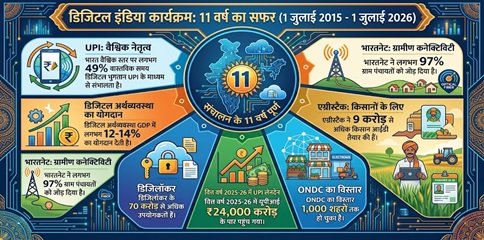
  • India handles nearly 49% of the world's real-time digital payment transactions through UPI.
  • The digital economy contributes about 12–14% to India's GDP.
  • BharatNet has connected nearly 97% of Gram Panchayats.
  • DigiLocker has more than 700 million users.
  • UPI transactions crossed 24,000 crore in FY 2025–26.
  • ONDC has expanded to 1,000 cities.
  • AgriStack has generated over 90 million Farmer IDs.

Digital India Programme:

  • Launch: 1 July 2015 (The programme completed 11 successful years on 1 July 2026.)
  • Nodal Ministry: Ministry of Electronics and Information Technology (MeitY), Government of India
  • Main Objective: To transform India into a digitally empowered society and a knowledge-based economy.
  • Motto: "Power to Empower"

Three Vision Areas of Digital India:

  • Digital Infrastructure as a Utility to Every Citizen: High-speed internet, unique digital identity (Aadhaar), and secure cyberspace.
  • Governance and Services on Demand: Online government services, digital financial transactions, and integrated government departments.
  • Digital Empowerment of Citizens: Universal digital literacy and easy access to digital resources.

Nine Pillars of Digital India:

Pillar 1: Broadband Highways

  • Objective & Progress: Focuses on three components—rural, urban, and the National Information Infrastructure.
  • BharatNet Project: Aimed to connect over 2.2 lakh Gram Panchayats across the country. By January 2026, nearly 97% of Gram Panchayats had been connected, with more than 7 lakh km of Optical Fibre Cable (OFC) laid.
  • Significance: It has laid the foundation for e-Governance, telemedicine, and online education in rural India.

Pillar 2: Universal Access to Mobile Connectivity

  • Progress: Broadband internet subscribers in India increased to 106.58 crore by March 2026.
  • Administrative Significance: Ensures that every citizen-centric government policy reaches the last mile without interruption.

Pillar 3: Public Internet Access Programme

  • Common Service Centres (CSCs): More than 6.5 lakh CSCs and 1.6 lakh post offices are functioning as digital hubs.
  • Significance: These centres promote digital inclusion by providing banking, e-Governance, and citizen services in rural areas.

Pillar 4: e-Governance – Reforming Government through Technology

  • Principle: "Minimum Government, Maximum Governance"
  • Major Platforms: DigiLocker and National Single Sign-On (NSSO)
  • Benefits: Simplified procedures, single-window clearance, and improved inter-departmental coordination.

Pillar 5: e-Kranti – Electronic Delivery of Services

  • Vision: Deliver government services electronically across all departments.
  • Key Sectors: e-Education, e-Health, e-Justice (e-Courts), and e-Planning.
  • Case Study – e-Courts Mission Mode Project: It has digitally transformed India's judicial system. More than 660 crore judicial pages have been digitised, and over 1.07 crore cases have been filed online, accelerating case disposal.

Pillar 6: Information for All

  • Principle: Transparency and citizen participation.
  • Platforms: MyGov (Citizen Engagement Portal) and the Open Government Data (OGD) Platform.
  • Benefit: Citizens can directly contribute suggestions for policymaking, making democracy more participatory.

Pillar 7: Electronics Manufacturing

  • Progress: Production increased from ₹1.9 lakh crore in FY 2014–15 to around ₹12 lakh crore by March 2026.
  • Global Position: India is now the world's second-largest mobile phone manufacturer.
  • Supporting Policies: The Production Linked Incentive (PLI) Scheme and Make in India have acted as key growth drivers.

Pillar 8: IT for Jobs

  • Employment Generation: According to NASSCOM, the IT-BPM industry generated US$283 billion in revenue in FY 2025.
  • Global Capability Centres (GCCs): India has more than 2,100 GCCs, employing around 2.6 million professionals in advanced sectors such as cybersecurity, AI, and analytics.

Pillar 9: Early Harvest Programmes

  • Quick-Impact Initiatives: Biometric attendance systems, secure government email, public Wi-Fi hotspots, and weather SMS alerts demonstrated the immediate impact of digital governance.

Major Digital Initiatives:

  • DigiLocker: 1 July 2015 (Launched along with the Digital India Programme.)
  • UMANG App: 23 November 2017 (Introduced to provide multiple government services through a single platform.)
  • UPI: 11 April 2016 (Launched by the National Payments Corporation of India (NPCI), transforming India's retail payment ecosystem.)
  • PM-WANI: 9 December 2020 (Approved by the Union Cabinet to expand public Wi-Fi networks across the country.)
  • Bhashini: 4 July 2022 (Launched by the Prime Minister during Digital India Week 2022 as an AI-based language translation platform.)

Latest Courses