National News
Approval for the construction of a 6-lane road tunnel on National Highway-148AE
- The Union Cabinet has approved the construction of a 6-lane road tunnel on National Highway-148AE (NH-148AE), connecting the Dwarka Expressway (NH-248BB) in Delhi to Nelson Mandela Marg in Vasant Kunj.
Related Facts:
- Total Length and Configuration: The total length of the project is 8.1 kilometers. It includes a 3.14 km long twin-tube tunnel, with each tube featuring three lanes.
- Financial Cost: The total estimated capital cost of this ambitious project is ₹6,969.67 crore.
- Implementation Model: It will be developed under the Hybrid Annuity Model (HAM) as part of the National Highways (O) scheme.
- Timeline: The Central Government has set a target to complete this project within 5 years.
- Route Alignment: The tunnel will commence at the Shiv Murti Interchange on the Delhi-Gurgaon Expressway (NH-48) and terminate before the intersection of Nelson Mandela Marg and Mehrauli-Mahipalpur Road in Vasant Kunj.
- Conservation of Southern Ridge Forest: A 1.98 km stretch of this tunnel will pass beneath the Southern Ridge area, known as the 'lungs' of Delhi.
- The project will generate approximately 75 lakh man-days of direct employment and 98 lakh person-days of indirect employment.
|
Approval for Construction of Kanpur-Kabrae Section
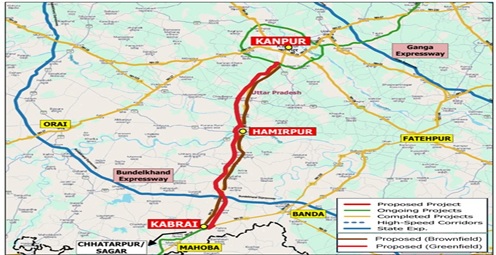
- The government has approved the construction of the 117.7 km long, 4-6 lane Kanpur-Kabrae section in Uttar Pradesh.
- This project is part of NH-34 and will be constructed under the Build-Operate-Transfer (BOT) model at a cost of approximately ₹7,145.14 crore.
Key Facts:
- Project Name: Kanpur-Kabrae Greenfield Highway (Kanpur to Mahoba)
- Highway Name: Part of National Highway NH-34
- Length: Approximately 117.7 kilometers
- Cost: Total expenditure of ₹7,145 crore
- Lanes: Initially constructed as a 4-lane highway, with a design that allows for future expansion to 6 lanes
- Travel Time: Travel time will be reduced from 3.5 hours to just 1.5 hours
- Model: To be constructed under the 'Build-Operate-Transfer' (BOT) mode
- Economic Corridor: A crucial component of the Bhopal-Kanpur Economic Corridor
- Gati Shakti: The project aligns with the objectives of the PM Gati Shakti National Master Plan.
|
Introduction of MLFF-based Tolling System
- The National Highways Authority of India (NHAI) has introduced a Multi-Lane Free Flow (MLFF) based tolling system at the Manoharpura toll plaza, located on the Delhi-Jaipur section of National Highway-48 (NH-48) in Rajasthan.
Related Facts:
|
Multi-Lane Free Flow (MLFF) Technology:
- This is a barrier-less, automated toll collection system. Under this system, vehicles do not need to stop or slow down at the toll plaza to pay the toll tax.
- Mechanism: This technology integrates Automatic Number Plate Recognition (ANPR) cameras and smart sensors with the existing FASTag-based electronic toll collection system.
- Sensors and Gantry: Special gantries installed over the road and high-resolution cameras read the moving vehicle's FASTag and registration details, and the fee is deducted directly from the linked account.
National Highways Authority of India (NHAI):
- Establishment: Under the NHAI Act, 1988
- Operations Commenced: February 1995
- Headquarters: New Delhi
- Ministry: Ministry of Road Transport and Highways (MoRTH)
- Current Chairman: Santosh Kumar Yadav
|
VB-G RAM G Act Comes into Effect
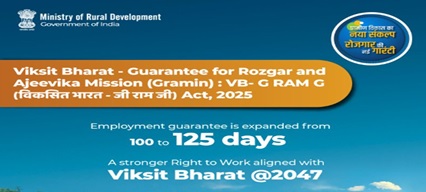
- The 'Viksit Bharat G Ram G' Act has come into force today (July 1, 2026), replacing MGNREGA.
'Viksit Bharat Guarantee for Employment and Livelihood Mission - Rural' (VB-G RAM G) Scheme:
- Replaced: Mahatma Gandhi National Rural Employment Guarantee Act (MGNREGA)
- Legislative Journey: The bill was introduced in the Lok Sabha on December 16, 2025, and became law after receiving the assent of President Droupadi Murmu on December 21, 2025.
- Objective: To align the rural economy and employment with the long-term goal of 'Viksit Bharat @2047'.
- Employment Guarantee: Minimum of 125 days per year.
- Legal provision for a maximum 60-day agricultural break during peak farming seasons.
- Financial Burden: 60:40 ratio for general states; 90:10 ratio for Northeastern and Himalayan states.
- Wage Increase: The national average wage has risen from ₹298.8 to ₹327.4 per day. Additionally, the Minimum Base Wage has been fixed at ₹300 per day.
- Financial Provision: The Central Government has released an interim allocation of ₹95,692 crore to the states for the current financial year.
|
Completion of 11 Years of the Digital India Programme

- The Digital India programme completed 11 years of operation on July 1, 2026.
Digital India Programme:
- Launch: July 1, 2015 (Today, July 1, 2026, marks the successful completion of 11 years of this historic programme)
- Nodal Ministry: Ministry of Electronics and Information Technology, Government of India
- Main Objective: To transform India into a digitally empowered society and a knowledge-based economy
- Motto: 'Power to Empower'
3 Key Vision Areas of Digital India:
- Infrastructure as a utility for every citizen: High-speed internet, unique digital identity (Aadhaar), and secure cyberspace
- Governance and services on demand: Online government services, digital financial transactions, and inter-departmental connectivity
- Digital empowerment of citizens: Universal digital literacy and easy access to digital resources for all
9 Key Pillars of Digital India:
- Broadband Highways: Connecting the entire country (especially Gram Panchayats) with high-speed internet
- Universal access to mobile connectivity: Extending mobile networks to every corner of the country
- Public Internet Access Programme: Transforming post offices and Common Service Centres (CSCs) into digital service centres
- e-Governance (Reforming government through technology): Making government operations online and transparent
- e-Kranti (Electronic delivery of services): Delivering online technology for education (e-Basta), health (e-Hospital), and farmers
- Information for All: Making government data and documents available online to the public
- Electronics Manufacturing: Promoting the production of mobile phones, chips, and other electronic goods within the country (aiming for zero imports)
- IT for Jobs: Training youth from rural areas and small towns for employment in the Information Technology sector
- Early Harvest Programme: Implementing biometric attendance, Wi-Fi, and... in government offices Immediate implementation of e-documents.
Key digital initiatives and achievements:
- DigiLocker: 1 July 2015 (Launched alongside the inception of the Digital India program).
- UMANG App: 23 November 2017 (Launched to provide citizens with access to all government services in a single place).
- UPI: 11 April 2016 (Launched by the National Payments Corporation of India; it transformed the landscape of retail payments in the country).
- PM-WANI: 9 December 2020 (The Union Cabinet approved this scheme for the expansion of public Wi-Fi networks across the country).
- Bhashini: 4 July 2022 (This AI-based language translation platform was launched by the Prime Minister during Digital India Week 2022).
|
Launch of FCRA 2.0 Portal and e-OCI Card
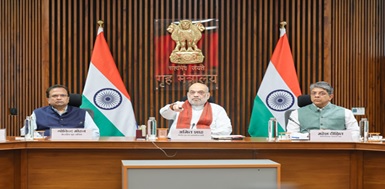
- Union Home Minister Amit Shah launched the FCRA 2.0 portal and the e-OCI card.
Key Facts:
|
FCRA 2.0 Portal:
- Full Name: Foreign Contribution (Regulation) Act 2.0 Portal.
- Objective: To make the processes of registration, renewal, and filing of annual returns for foreign contributions/donations completely digital and transparent.
- Hosting: The portal is securely hosted on the national government cloud 'MeghRaj', minimizing the risk of data theft.
- Technical Features: It includes e-Sign-based authentication, OCR-based document analysis, and integration with the NGO Darpan bank account system.
Electronic e-OCI Card:
- Full Name: Electronic Overseas Citizen of India Card.
- Beneficiaries: Over 5 million OCI cardholders across the globe.
- Change: This makes OCI services completely paperless and digital. Applicants can now handle the entire process online—from submitting applications to downloading the digitally generated card.
|
Appointments
Lieutenant General Sandeep Jain

- Lieutenant General Sandeep Jain assumed the office of Vice Chief of the Army Staff (VCOAS) on July 1, 2026.
Related Facts:
- Post: Vice Chief of the Army Staff (VCOAS)
- Succeeded: He succeeded Lieutenant General Dhiraj Seth, who has been appointed as the new Chief of the Army Staff (COAS).
- Regiment: He was commissioned into the Mahar Regiment in June 1988 and has been the Colonel of the Regiment since August 1, 2024.
- Military Honors: He has been awarded the Ati Vishisht Seva Medal (AVSM) and the Sena Medal (SM) for distinguished service.
Other Key Appointments:
- Chief of Defence Staff (CDS): General N.S. Raja Subramani (Assumed office on May 31, 2026)
- Chief of the Army Staff (COAS): General Dhiraj Seth (Assumed office on June 30, 2026)
|
Air Marshal Tejinder Singh
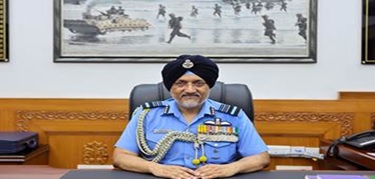
- Air Marshal Tejinder Singh assumed offic
- e as the Chief of Integrated Defence Staff to the Chairman, Chiefs of Staff Committee (CISC), on July 1, 2026.
Related Facts:
|
Integrated Defence Staff (IDS) :
- Formation: October 1, 2001 (based on the recommendations of the Kargil Review Committee, 1999)
- Headquarters: New Delhi
- Motto: 'Victory through Jointness'
- Primary Objective: To establish better coordination and jointness among the Army, Navy, and Air Force.
- Nodal Department: It works in conjunction with the Department of Military Affairs (DMA) under the Ministry of Defence.
Chief of Integrated Defence Staff (CISC):
- Designation: Chief of Integrated Defence Staff to the Chairman, Chiefs of Staff Committee (CISC)
- Latest Appointment: Air Marshal Tejinder Singh (Assumed office: July 1, 2026)
- Status of the Post: It is a three-star rank position, equivalent to the Vice Chiefs of the three armed services (Army, Navy, Air Force).
- Rank Rotation: Officers from the Army, Navy, and Air Force are appointed to this post on a rotational basis.
- Executive Role: The officer heads the secretariat and serves as the Secretary to the Chiefs of Staff Committee (CoSC) under the Chief of Defence Staff (CDS).
|
Helen McEntee

- Ireland's Minister for Justice, Helen McEntee, assumed the Presidency of the Council of the European Union.
Related Facts:
- Presidency of the Council of the European Union (2026):
- Country holding the Presidency: Ireland has assumed the rotating Presidency of the Council of the European Union for a six-month term starting 1 July 2026.
- Duration: The Presidency runs from 1 July 2026 to 31 December 2026.
- Helen McEntee's Role: As the Minister for Justice in the Irish government, she will chair and lead meetings of the EU Justice and Home Affairs Council during this Presidency.
- Previous Presidency: Immediately prior to Ireland (January to June 2026), Austria held the Presidency.
European Union (EU):
- A unique economic and political organization comprising 27 member states located in Europe.
- Establishment: 1 November 1993, under the Maastricht Treaty.
- Headquarters: Brussels (Belgium).
- Shared Currency: Euro (€) — currently used by 20 of the 27 member states, collectively known as the 'Eurozone'.
|
Economy and Banking
India's Gross GST Collection in June 2026

- India's gross GST collection reached ₹1.94 lakh crore in June 2026, marking a year-on-year growth of 13.9%.
Related Facts:
|
June 2026 GST Collection:
- Total Gross Collection: ₹1.94 lakh crore (Exact figure: ₹1,93,964 crore)
- Year-on-Year Growth Rate: A robust growth of 13.9% was recorded compared to June 2025.
- Growth in Domestic Transactions: Tax collection from domestic economic activities and transactions increased by 14.2% compared to the same period last year.
- Growth in Tax on Goods Imports: GST collection on imported goods saw an increase of 12.1%. Component-wise breakdown of collections:
- Central GST (CGST): ₹34,250 crore
- State GST (SGST): ₹42,850 crore
- Integrated GST (IGST): ₹1,02,450 crore (includes ₹48,200 crore collected on the import of goods)
- Cess: ₹14,414 crore (includes ₹1,215 crore collected on the import of goods)
- Gross GST:
- It is an indirect tax applicable across the entire country.
- Date of implementation: 1 July 2017 (101st Constitutional Amendment Act, 2016)
- Meaning of Gross GST collection: It refers to the total tax collected by the government during a specific month or period, without deducting refunds.
Tax rates:
- 0% (Tax-free): Essential items such as milk, salt, unpackaged grains, etc.
- 5%: Common use items such as sugar, tea, edible oil, etc.
- 12%: Butter, mobile phones, processed foods, etc.
- 18%: Hair oil, soap, electronic goods, and most services.
- 28% (Highest rate): Cars, cement, cigarettes, and luxury goods.
GST Council:
- Constitutional Article: Constituted under Article 279A.
- Chairperson: The Union Finance Minister (currently Nirmala Sitharaman) serves as the chairperson.
- Members: The Union Minister of State for Finance and the Finance/Tax Ministers of all states are members.
- Key functions: Determining GST rates, setting tax exemption thresholds, and resolving tax-related disputes.
|
India's Net Foreign Liabilities

- According to the RBI, India's net foreign liabilities declined by US$52.4 billion to US$209.9 billion during the January–March quarter (Q4) of FY2025–26.
- This reflects a decline in foreign-owned assets in India and an increase in foreign financial assets held by Indian residents.
- The decline in net claims of non-residents on India was mainly due to a US$40 billion decrease in foreign liabilities and a US$12 billion increase in foreign financial assets held by Indian residents.
Key Figures:
| Component / Parameter |
Status (End-March 2026) |
Quarterly Change (Q4) |
Key Reason / Impact |
| Net Foreign Liabilities |
US$209.9 billion |
Declined by US$52.4 billion |
Strengthening of India's external financial position |
| Foreign Liabilities |
US$1,420.3 billion |
Declined by US$40.1 billion |
Decline in portfolio and direct investment valuations |
| Foreign Financial Assets |
US$1,210.4 billion |
Increased by US$12.3 billion |
Overseas investments and reserve assets held by Indian residents |
| Asset–Liability Ratio |
85.2% (82% in December) |
Improved by 3.2 percentage points |
Reduced vulnerability to external financial shocks |
| Net Claims-to-GDP Ratio |
–5.9% (–9.0% in the previous year) |
Improved by 3.1 percentage points |
Positive for India's sovereign credit profile |
Important Day
Chartered Accountants Day

- Chartered Accountants Day is celebrated annually on July 1st to commemorate the establishment of the Institute of Chartered Accountants of India (ICAI).
Chartered Accountants (CA) Day:
- Date: Celebrated annually on July 1st (Today, July 1, 2026, marks the completion of 77 years since the establishment of this prestigious institute).
- Commemorating: The establishment of the Institute of Chartered Accountants of India (ICAI).
- Year of Establishment: Established on July 1, 1949, under an Act of Parliament (The Chartered Accountants Act, 1949).
- Headquarters: New Delhi.
Institute of Chartered Accountants of India (ICAI):
- Nature: It is a statutory body for the regulation of the financial audit and accounting profession in India.
- Status: It is the second-largest accounting body in the world in terms of economy and financial management.
- Administrative Ministry: It operates under the administrative control of the Ministry of Corporate Affairs, Government of India.
|
Awards and Honors
Country's First 'Eat Right Campus' Airport
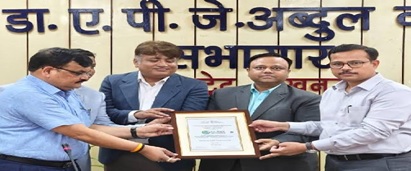
- Chaudhary Charan Singh International Airport in Lucknow, Uttar Pradesh, has become the first airport in the country to receive the 'Eat Right Campus' certification from the Food Safety and Standards Authority of India (FSSAI).
Country's First 'Eat Right Campus' Airport:
- Location: Chaudhary Charan Singh International Airport (Amausi Airport), Lucknow, Uttar Pradesh
- Certification: 'Eat Right Campus'
- Issuing Body: Food Safety and Standards Authority of India (FSSAI)
- Achievement: It has become the first airport in the country to achieve this distinction.
- Rating: The airport has been awarded a '5-Star' (Excellent) rating by FSSAI.
- Food Safety and Standards Authority of India (FSSAI):
- Establishment: Established under the Food Safety and Standards Act, 2006
- Effective Date: August 5, 2011
- Headquarters: New Delhi
- Jurisdiction: Pan-India
- Parent Ministry: Ministry of Health and Family Welfare, Government of India
|


 Don't Have an Account?