Discovery of the New Millisecond Pulsar PSR J0125-5854
 
  • Mobile Menu
HOME BUY MAGAZINEnew course icon
LOG IN SIGN UP

Sign-Up IcanDon't Have an Account?


SIGN UP


Login Icon

Have an Account?


LOG IN
 

or
By clicking on Register, you are agreeing to our Terms & Conditions.


or


Discovery of the New Millisecond Pulsar PSR J0125-5854

Tue 30 Jun, 2026

Context:

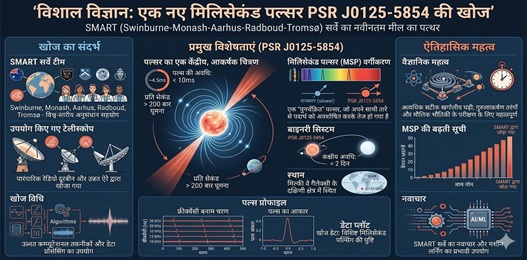
  • Astronomers have discovered a new millisecond pulsar, PSR J0125-5854, during the SMART (Survey for Pulsars and Extragalactic Radio Bursts) survey of the southern sky.

Key Points:

  • The research was published as a preprint on 17 June 2026 and has since been accepted for publication in a leading scientific journal.
  • The discovery marks a significant advancement in radio astronomy and the study of neutron stars.
  • Technical Instruments: The discovery was made using the combined capabilities of South Africa's MeerKAT Radio Telescope and Australia's Australia Telescope Compact Array (ATCA).
  • Rotation Rate: The pulsar rotates about 40 times per second, with a rotation period of 24.6 milliseconds.
  • Binary System: Follow-up observations revealed that it is part of a wide binary system, orbiting its companion star (likely a helium white dwarf) every 833 days.
  • Distance and Location: It is located about 1,600–3,200 light-years from Earth at a high Galactic latitude (-57°), away from the Milky Way's disk.
  • Neutron Star and Pulsar: When a massive star (about 8–20 times the Sun's mass) ends its life in a supernova explosion, it leaves behind an extremely dense core called a neutron star. If this neutron star rotates rapidly and emits beams of radio waves from its magnetic poles, it is known as a pulsar.
  • Millisecond Pulsars (MSPs) and "Recycling": Unlike ordinary pulsars, MSPs are usually part of a binary system. Over time, they accrete matter from their companion star, gaining angular momentum and spinning up to millisecond rotation periods. This process is known as spin-up or recycling.

Scientific and Strategic Significance:

  • Detection of Gravitational Waves: Millis
  • econd pulsars are among the most precise natural clocks in the universe, with rotational stability comparable to atomic clocks. Through Pulsar Timing Arrays (PTAs), tiny nanosecond variations in their signals can be used to detect low-frequency gravitational waves.
  • Study of Dense Matter: Neutron stars are so dense that a teaspoon of their material would weigh billions of tonnes on Earth. Discoveries like PSR J0125-5854 help scientists understand the behavior of nuclear matter under extreme gravity and density—conditions impossible to recreate in laboratories.
  • International Collaboration and Big Data: The MeerKAT telescope used in the SMART survey is a precursor to the Square Kilometre Array (SKA). This discovery highlights how radio interferometry and big data analytics are helping astronomers uncover the mysteries of the universe.

Latest Courses