National News
Launch of 'SUMAN Roadmap 2030'
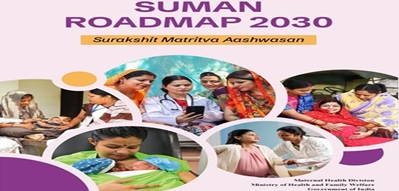
- The Union Health Minister launched the 'SUMAN Roadmap 2030' with the aim of improving healthcare services for mothers and newborns.
- This strategic framework has been designed to strengthen maternal and newborn healthcare in India and to achieve the United Nations Sustainable Development Goals (SDGs) by 2030.
Related Facts:
- The roadmap envisions achieving the goals of reducing the Maternal Mortality Ratio (MMR) to below 70 per 100,000 live births by 2030, further lowering the Neonatal Mortality Rate (NMR) and Infant Mortality Rate (IMR), ensuring universal availability of maternal and newborn health services across all states and Union Territories, and ultimately eliminating preventable maternal and newborn deaths.
- Launched by: Union Health Minister Jagat Prakash Nadda
Key Objectives:
- Reduction in Maternal Mortality Ratio (MMR): Reducing the country's MMR to below 70 per 100,000 live births by 2030.
- Improvement in Infant Mortality Rates: Bringing the Neonatal Mortality Rate (NMR) and Infant Mortality Rate (IMR) down to minimal levels.
- Eliminating Preventable Deaths: Completely eliminating preventable maternal and newborn deaths through appropriate medical care.
- Universal Healthcare: Ensuring the full availability of quality healthcare services across all states and Union Territories of the country.
|
Delhi Government Approves New EV Policy
- The Delhi government has approved a new electric vehicle policy aimed at transforming Delhi into a pollution-free city with zero-emission transport by March 31, 2030.
- Under this policy, electric cars costing up to ₹30 lakh will be exempt from registration fees and road tax.
Key Facts:
- Effective Period: July 1, 2026, to March 31, 2030 (subject to final approval by the Lieutenant Governor)
- Total Budgetary Outlay: ₹15,000 crore (comprising ₹7,000 crore for direct incentives and ₹8,000 crore for infrastructure and tax exemptions)
- Main Goal: To ensure that fully electric vehicles constitute at least 30% of Delhi's total vehicle fleet by 2030
- Priority Focus: Preference for pure electric vehicles (Pure EVs) over hybrid vehicles
- Registration of new petrol two-wheelers in Delhi will be completely discontinued after March 31, 2028
- From January 1, 2027, only electric three-wheelers and light goods vehicles (N1 trucks) will be eligible for new registration
- School buses will be required to convert at least 10% of their fleet to EVs within two years of the policy's implementation
- The Delhi government has set a target to install 32,000 new EV charging points across the city, for which land has already been identified
|
'Sujalam Sufalam Jal Abhiyan'
- Gujarat's 'Sujalam Sufalam Jal Abhiyan' has increased water storage capacity by 20,789 lakh cubic feet this year, bringing the total increase over the past eight years to 1,38,039 lakh cubic feet.
Sujalam Sufalam Jal Abhiyan:
- State: Gujarat
- Launch of latest phase: Inaugurated by Chief Minister Bhupendra Patel from Gandhinagar on February 23, 2026
- Increase in water capacity this year: 20,789 lakh cubic feet
- Total cumulative capacity increase over 8 years: 1,38,039 lakh cubic feet
- Employment generated this year: Approximately 2.30 lakh man-days of employment generated through this campaign
- Total employment generated over 8 years: A total of 206.73 lakh man-days of employment generated over the past eight years
- Alignment with central scheme: This campaign is fully aligned with the objectives of Prime Minister Narendra Modi's national 'Catch the Rain' campaign.
|
International News
Agreement between India and Saudi Arabia
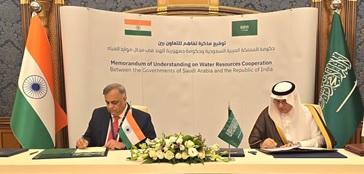
- India and Saudi Arabia signed a Memorandum of Understanding (MoU) for cooperation in the water resources sector.
- This bilateral agreement was concluded during the inaugural 'Saudi Water Week' conference held in the city of Jeddah, Saudi Arabia.
Related Facts:
- Venue and Date: The agreement was signed on June 29, 2026, during the first edition of the national water conference ('Saudi Water Week') held in Jeddah.
- Signatories: It was signed by Dr. Suhel Khan, India's Ambassador to Saudi Arabia, on behalf of India, and by Abdul Rahman Abdul Mohsin Al-Fadley, Saudi Arabia's Minister of Environment, Water and Agriculture. Fahad Suri, India's Consul General in Jeddah, was also present on the occasion.
- Capital: Riyadh
- Currency: Saudi Riyal
- Maritime Boundaries: Persian Gulf, Red Sea
- Bordering Countries: Jordan, Iraq, Kuwait, Qatar, Bahrain, United Arab Emirates, Oman, Yemen
|
Important Day
International Day of Parliamentarism
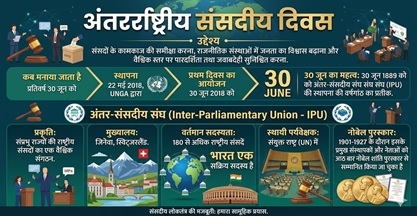
- Observed annually on June 30 to focus on the role of parliaments and parliamentary democracy.
International Day of Parliamentarism:
- Objective: To review the functioning of parliaments, boost public trust in political institutions, and ensure transparency and accountability at the global level.
- When observed: Annually on June 30.
- Established: May 22, 2018, by the UNGA.
- First observance: June 30, 2018.
- Significance of June 30: Marks the anniversary of the founding of the Inter-Parliamentary Union (IPU) on June 30, 1889.
- Inter-Parliamentary Union (IPU):
- Nature: A global organization of national parliaments of sovereign states.
- Headquarters: Geneva, Switzerland.
- Current membership: Over 180 national parliaments; India is an active member.
- Permanent Observer: At the United Nations (UN).
- Nobel Prize: Its key founders and leaders were awarded the Nobel Peace Prize eight times between 1901 and 1927.
|
Hool Diwas
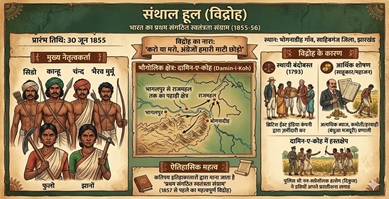
- Hool Diwas is observed annually on June 30th in Jharkhand to commemorate the sacrifices of the tribal revolutionaries—Sidho, Kanho, Chand, Bhairav, Phulo, and Jhano.
Santhal Hool (Rebellion):
- Start Date: June 30, 1855 (Bhognadih village, Sahibganj district, Jharkhand)
- Key Leaders: Sidho, Kanho, Chand, and Bhairav Murmu (four brothers) and Phulo and Jhano (sisters)
- Geographical Area: Damin-i-Koh (the hilly region stretching from Bhagalpur to Rajmahal)
- Slogan of the Rebellion: "Do or Die; British, leave our land"
- Historical Significance: Some historians regard this as India's "first organized freedom struggle."
Causes of the Rebellion:
- Permanent Settlement (1793): This system, implemented by the British East India Company, imposed the *Zamindari* (landlord) tax system on the traditional lands of the Santhals.
- Economic Exploitation: Moneylenders and merchants charged exorbitant interest rates and forced tribals into the 'Kamoti/Harwahi' (bonded labor) system when they failed to repay loans.
- Interference in Damin-i-Koh: The entry of British-backed outsiders (whom tribals called 'Diku') into this region of the Rajmahal Hills and the oppressive attitude of the police.
Tribal Unity and Nature of the Movement:
- On June 30, 1855, approximately 20,000 Santhals and people from other local communities gathered at Bhognadih and sounded the bugle for armed struggle.
- This rebellion united around 32 non-tribal castes/communities against British rule, serving as an example of rare social harmony.
- In his book *Notes on Indian History*, Karl Marx specifically mentioned the guerrilla warfare tactics adopted by the Santhals and the brutal suppression of the movement by the British.
Consequences and Impact of the Rebellion:
- Creation of Santhal Pargana: To establish administrative control, the British carved out parts of the Bhagalpur and Birbhum districts to form a new non-regulation district named 'Santhal Pargana'.
- Santhal Pargana Tenancy Act (SPT Act), 1876: This special legislation was enacted to protect tribal land, prohibiting the transfer of tribal land to non-tribals.
|
Mizoram Peace Accord Day

- Mizoram Peace Accord Day is observed annually on June 30.
- This year marked the 40th anniversary of the Mizoram Peace Accord.
Key Facts:
- Date of the Accord: June 30, 1986.
- Local Name: In Mizoram, this day is celebrated as 'Remna Ni'.
- Signatories: Three main parties signed this historic tripartite agreement:
- Central Government (then Union Home Secretary R.D. Pradhan)
- Mizo National Front - MNF (its then underground leader Laldenga)
- Government of Mizoram (then Chief Secretary Lalkhama)
- Prime Minister at the time: The accord was signed during the tenure of Prime Minister Rajiv Gandhi.
Historical Background and Outcome:
- Cause of the Insurgency: The MNF was formed in 1959 to protest the Centre's alleged inaction in dealing with the devastating 'Mautam Famine' that struck the Mizo Hills (now Mizoram) in the late 1950s. Subsequently, an armed insurgency began in 1966 under the leadership of Laldenga.
- Full Statehood: As a direct result of this peace accord, Mizoram was granted full statehood as the 23rd state of the Indian Union on February 20, 1987 (prior to this, it had been a Union Territory since 1972).
- Why in the News?: As the accord completes 40 successful years (Ruby Jubilee), Mizoram's current Governor General (Dr.) V.K. Singh (Retd.) and Chief Minister Lalduhoma have hailed it as the world's best 'Conflict Resolution' model.
|
Economy and Banking
Government of India's Total Investment in NIIF
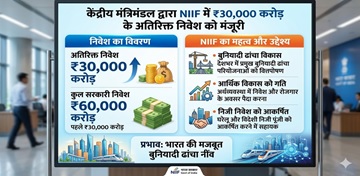
- Following the Union Cabinet's approval of an additional investment of ₹30,000 crore in the National Investment and Infrastructure Fund (NIIF), the Government of India's total investment in the fund has reached ₹60,000 crore.
Key Facts:
- This reflects the Centre's investment commitment towards infrastructure and other sectors of national importance.
- According to the Ministry of Finance, this additional investment will be utilized to establish the NIIF's second fund, which is focused on infrastructure.
- An outlay of approximately ₹30,000 crore is proposed for 'Infrastructure Fund II', which will invest in sectors such as transport, energy, digital and urban infrastructure, and emerging areas like e-mobility.
- The National Investment and Infrastructure Fund (NIIF) is India's sovereign wealth fund; it is operated and managed by the National Investment and Infrastructure Fund Limited (NIIFL).
- The Central Government holds a 49% stake in the NIIF.
- Management: It is managed by the National Investment and Infrastructure Fund Limited (NIIFL).
Key NIIF Funds:
- Master Fund: This is India's largest domestic infrastructure fund. It primarily invests in large-scale infrastructure projects.
- Strategic Opportunities Fund: This fund invests in major strategic companies and critical national projects.
- Private Markets Fund: This fund invests capital in funds managed by other independent fund managers.
- India-Japan Fund: This bilateral fund focuses on projects related to environmental conservation and the India-Japan trade corridor.
|
India's Industrial Production in May 2026 (Year-on-Year)
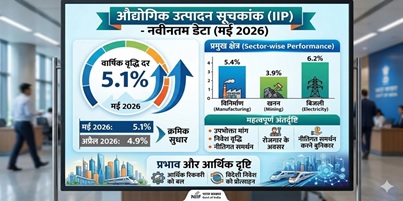
- According to the latest data from the Index of Industrial Production (IIP), India's industrial production grew by 5.1 percent year-on-year in May 2026, up from the previous month (4.9% in April 2026).
- The government has revised the base year to 2022-23 for measuring the industrial production growth rate.
Related Facts:
|
Sector-wise Performance:
- Manufacturing Sector: Recorded a growth of 5.5%. Out of the 23 manufacturing groups under the National Industrial Classification (NIC), 16 groups registered positive growth.
- Electricity and Gas Supply: Recorded the strongest growth at 9.9%, driven by intense heat and high demand.
- Water Supply and Waste Management: Saw a growth of 5.5%.
- Mining Sector: Recorded a contraction (decline) of 1.6%, exerting some pressure on the overall index.
Use-based Classification:
- Capital Goods: Registered impressive growth of 12.9%, signaling a robust investment cycle in the economy.
- Consumer Durables: Grew by 7.2%, driven by strong domestic demand.
- Infrastructure/Construction Goods: Grew by 5.9% due to sustained investment in the infrastructure sector.
- Intermediate Goods: Recorded a growth of 5.8%.
- Primary Goods: This sector grew by 2.6%.
India's Index of Industrial Production (IIP):
- Function: It measures changes in the production output of India's industrial sector over a specific period.
- Issuer: This index is released by the National Statistical Office (NSO) under the Ministry of Statistics and Programme Implementation (MoSPI).
- Frequency: It is released monthly.
- New Base Year: Currently, the base year for the IIP has been changed to 2022-23.
- Old Base Year: Previously, the base year was 2011-12.
|
Science and Technology
Discovery of a New Millisecond Pulsar: PSR J0125-5854
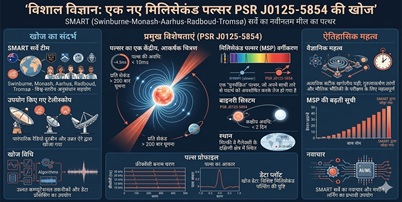
- In a significant breakthrough in the field of astronomy, scientists have discovered a new millisecond pulsar, PSR J0125-5854, during the SMART (Southern MeerKAT ATCA Pulsar Timing) survey of the southern sky.
- This discovery was made with the help of the Murchison Widefield Array (MWA) radio telescope located in Australia.
Related Facts:
- Name of the discovery: Scientists have discovered a new millisecond pulsar in the southern sky, named PSR J0125-5854.
- Survey under which the discovery was made: This discovery was made during the SMART (Southern MeerKAT ATCA Pulsar Timing) survey.
- Telescopes involved in the discovery: The MeerKAT radio telescope, located in South Africa, was primarily used for this discovery.
- Additionally, the ATCA (Australia Telescope Compact Array) in Australia also contributed to the effort.
- What is a pulsar?: It is a highly magnetized, rapidly rotating neutron star that emits beams of electromagnetic radiation from its magnetic poles. When viewed from Earth, it appears to flash on and off like a lighthouse.
- What is a millisecond pulsar (MSP)?: It is a pulsar with a rotational period in the range of 1 to 10 milliseconds; meaning, it rotates on its axis hundreds of times per second.
- Characteristics of PSR J0125-5854: It is an "accreting" pulsar that is part of a binary system. It accelerates its rotation speed by pulling material from its companion star. Its rotational period is approximately 3.99 milliseconds.
|
Sports News
AVC Men's Volleyball Cup 2026
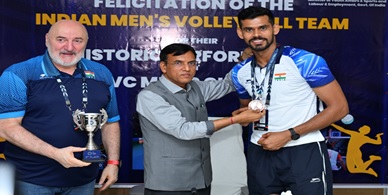
- Indian players secured the bronze medal at the AVC Men's Volleyball Cup 2026 held in Ahmedabad.
Related Facts:
- Host Country: India (Ahmedabad, Gujarat)
- This tournament was hosted by India for the first time.
- India's position in the International Volleyball Federation world rankings: The men's volleyball team moved from 60th to 42nd place.
- Indian Captain: Jerome Vinith Charles
- Historic Achievement: India won its first (debut) bronze medal in the tournament by defeating Bahrain 3-1.
- Tournament Winner: Indonesia won its first gold medal (first title) in this competition.
- Runner-up: The Korean team won the silver medal.
- Organizer: Asian Volleyball Confederation (AVC)
- The AVC is the highest continental governing body for volleyball in Asia.
- The sport of volleyball was invented in 1895 by William G. Morgan in Massachusetts, USA.
- A structured framework for the sport was established in India in 1951 with the formation of the Volleyball Federation of India (VFI).
- The sport was officially included in the Olympics for the first time at the 1964 Tokyo Olympics.
- Court Dimensions: A volleyball court is 18 meters long and 9 meters wide. It is divided into two equal halves (9m x 9m) by a net.
- Ball Weight: A volleyball weighs approximately 260 to 280 grams and has a circumference of 65 to 67 centimeters.
- Total Players: A team consists of 12 players, but only 6 players play on the court at a time during the game.
- Libero: This is a specialized defensive player on the team. This player wears a jersey of a different color and is not permitted to serve, block, or attack from the front zone of the court.
- Maximum Touches: A team can touch the ball a maximum of three times before sending it over the net. (A block does not count as a touch).
- No Consecutive Touches: A single player cannot touch the ball twice in succession.
- Scoring System: Matches are usually played as a 'best-of-five' sets. The first four sets are played to 25 points, requiring a minimum margin of two points to win (e.g., 25-23). If the match goes to a fifth set (tie-breaker), it is played to 15 points.
- Rally Point System: A point is awarded for winning every rally, regardless of whether the serving team or the receiving team wins it.
Key Techniques and Terminology:
- Service: Hitting the ball over the net from behind the baseline to start the game.
- Dig: Defensively handling an opponent's powerful shot or smash by getting low.
- Set/Pass: Tossing the ball into the air so a teammate can execute an attack. The player performing this action is called the 'setter'.
- Spike/Smash: Hitting the ball downward into the opponent's court with full force.
- Block: Jumping near the net to intercept and stop an opponent's smash.
|
Global Skills Challenge Australia 2026
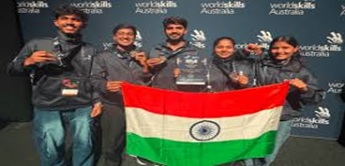
- The Indian team won a total of five medals—three gold, one silver, and one bronze—at the Global Skills Challenge Australia 2026.
Global Skills Challenge Australia 2026:
- India's Performance: A total of 5 medals, including 3 gold, 1 silver, and 1 bronze.
- Approximately 600 competitors, experts, interpreters, and officials from 16 WorldSkills member nations—including India, Australia, Austria, China, the USA, Japan, France, and Korea—participated in this international competition.
- Among the Indian competitors, Pawan Bhadravathi Suresh (Karnataka) won gold in Additive Manufacturing, Mausam Kumar Giri (Bihar) in Cloud Computing, and Vishnupriya Sunil (Delhi) in Health and Social Care.
- Harsh Ramesh Pawar (Maharashtra) secured a silver medal in 3D Digital Game Art, while Muskan (Haryana) won a bronze medal in Painting and Decorating.
- The Indian contingent participated in 15 skill categories with a 30-member team comprising 15 competitors and 15 experts. The categories included 3D Digital Game Art, Additive Manufacturing, Automobile Technology, Beauty Therapy, Bricklaying, Cloud Computing, Floristry, Graphic Design Technology, Hairdressing, Health and Social Care, Industrial Mechanics, Painting and Decorating, Restaurant Service, Wall and Floor Tiling, and Web Technologies.
Global Skills Challenge:
- Nature: It is a large-scale international simulation event organized by WorldSkills Australia.
- Participants: Approximately 600 competitors from 16 member nations—including India, the USA, China, Japan, and France—participated in the event.
- Objective: This competition serves as a crucial pre-competition (practice session) for the 48th WorldSkills Competition, scheduled to be held in Shanghai (China) later this year.
|
Reports and Indices
National Study Report on 'Low Participation in Gram Sabhas across States and Union Territories'
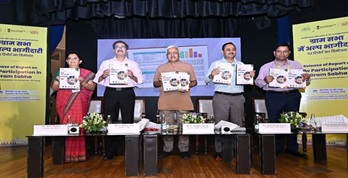
- The Ministry of Panchayati Raj released a national study report titled 'Low Participation in Gram Sabhas across States and Union Territories' in New Delhi.
- Released by NITI Aayog member Dr. R. Balasubramaniam, this report provides an evidence-based framework to strengthen participatory democracy, local accountability, and community-centric development in rural India.
Related Facts:
- Extensive Field Research: This report was prepared by the National Institute of Rural Development and Panchayati Raj (NIRD&PR) for the Ministry of Panchayati Raj.
- Scope of Survey: An extensive field survey was conducted across approximately 400 Gram Panchayats in 26 states and Union Territories.
- Inclusive Approach: Opinions were gathered from a total of 7,790 respondents, with specific inclusion of PESA (Panchayats Extension to Scheduled Areas) regions and women-led Gram Panchayats.
Key Factors for Low Participation in Gram Sabhas:
- Socio-economic and Behavioral Factors: Low levels of awareness among various sections and an indifferent attitude of citizens towards local governance.
- Institutional and Governance Deficiencies: Weaknesses in information and communication systems and a lack of transparency in the decision-making processes of Panchayats.
- Status of Marginalized Sections and Women: Participation of women and marginalized groups is affected by the timing and venue of the meetings.
- Lack of Institutional Credibility: A perception among citizens that their priorities and suggestions are not adequately reflected in the Gram Panchayat Development Plans (GPDP).
Key Recommendations of the Report:
- Engagement Beyond Mere Mobilization: Instead of merely encouraging citizens to attend meetings, it is essential to make the Gram Sabha more relevant, credible, and responsive.
- Ensuring Inclusivity: To develop the Gram Sabha as a cornerstone of participatory democracy under Article 243A of the Indian Constitution, it is necessary to provide an empowering platform for women and marginalized groups. Local Accountability: The accountability of local institutions must be established to ensure the review of public resources and the revitalization of Gram Sabhas as public forums.
|
Appointments
General Dheeraj Kumar Seth
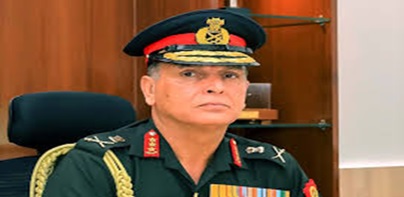
- General Dheeraj Kumar Seth assumed the office of the 31st Chief of Army Staff of the Indian Army on June 30.
Related Facts:
- Date of assuming office: June 30, 2026
- Sequence: He will be India's 31st Chief of Army Staff
- Succession: He will succeed the current Army Chief, General Upendra Dwivedi
- Current Position: Currently serving as the Deputy Chief of the Indian Army
- Tenure: His tenure as Army Chief will last until August 31, 2028
- Commission: Commissioned into the Armoured Corps in December 1986
Indian Army:
- Supreme Commander: The President of India is the Supreme Commander of the Indian Armed Forces
- Administrative Control: It functions entirely under the Ministry of Defence
- Motto: "Service Before Self"
- Army Chief: The head of the Indian Army is the Chief of Army Staff (COAS), a four-star General
- Establishment: The British Indian Army was officially established on April 1, 1895
- Indian Army Day (January 15): Indian Army Day is celebrated annually on January 15. On this day in 1949, Field Marshal K.M. Cariappa took over command of the Indian Army from the last British Commander-in-Chief (General Sir Francis Butcher)
- The Indian Army is divided into 7 commands for administrative and operational ease, comprising 6 operational commands and 1 training command
- Western Command: Chandimandir (Haryana)
- Eastern Command: Kolkata (West Bengal)
- Northern Command: Udhampur (Jammu and Kashmir)
- Southern Command: Pune (Maharashtra)
- Central Command: Lucknow (Uttar Pradesh)
- South-Western Command: Jaipur (Rajasthan)
- Army Training Command: Shimla (Himachal Pradesh)
|


 Don't Have an Account?