NCB Annual Report 2025 & Vision Document on Drug Control (2026–2029)
 
  • Mobile Menu
HOME BUY MAGAZINEnew course icon
LOG IN SIGN UP

Sign-Up IcanDon't Have an Account?


SIGN UP


Login Icon

Have an Account?


LOG IN
 

or
By clicking on Register, you are agreeing to our Terms & Conditions.


or


NCB Annual Report 2025 & Vision Document on Drug Control (2026–2029)

Sun 28 Jun, 2026

Context :

  • Union Home Minister Amit Shah released the 'NCB Annual Report 2025' and the 'Vision Document on Drug Control (2026–2029)' while chairing the 10th Apex-Level Meeting of the Narco-Coordination Centre (NCORD) in New Delhi.

10th Apex-Level Meeting of the Narco-Coordination Centre (NCORD) :

  • Chair: Union Home Minister Amit Shah
  • Organiser: Narcotics Control Bureau (NCB)
  • Participants: 108 representatives, including heads of 44 Central Ministries and Departments, State Governments and Law Enforcement Agencies, participated in the meeting in hybrid mode.
  • Inauguration of New Regional Offices: Newly constructed NCB Regional Offices at Jammu and Guwahati were digitally inaugurated.

Vision Document on Drug Control (2026–2029) :

  • Objective: To achieve the goal of making India completely 'Drug-Free (Nasha Mukt Bharat)' by the year 2029.
  • Duration: It is a three-year time-bound national strategy that will remain effective from 2026 to 2029.
  • Key Mantra/Strategy: The Home Minister gave the mantra "Detect, Disrupt and Destroy" to successfully implement this vision.
  • Released During: Released during the 10th Apex-Level Meeting of the Narco-Coordination Centre (NCORD) held at Vigyan Bhawan, New Delhi.
  • Mandatory Financial Investigation: The Home Minister directed that financial investigations under the Enforcement Directorate (ED) and the Prevention of Money Laundering Act (PMLA) should be made mandatory in all major drug cases to break the financial backbone of drug cartels.
  • Special NDPS Courts: Work is underway to establish special courts for speedy disposal of cases and to improve the conviction rate.
  • Anti-Narcotics Task Force (ANTF): States have been directed to transform their ANTF units into full-time, well-equipped and accountable wings.
  • International Fugitives: Efforts will be intensified to issue Red Corner Notices (RCNs) and expedite extradition proceedings against drug traffickers and gangsters hiding abroad.

Four Main Pillars of the Vision Document :

  1. Enforcement, Intelligence and Operations: The primary focus is on dismantling the entire network of drug traffickers and international cartels.
  2. Precursor and Synthetic Drug Control: This includes preventing the illegal diversion of precursor chemicals and tightening control over synthetic drugs such as methamphetamine.
  3. Demand Reduction and Rehabilitation: Focus on reducing drug demand among youth and ensuring treatment and rehabilitation of drug addicts with a compassionate approach.
  4. Capacity Building, Coordination and Monitoring: Strengthening coordination among various Ministries (around 40+ Ministries and Departments) and State Governments.

NCB Annual Report 2025 :

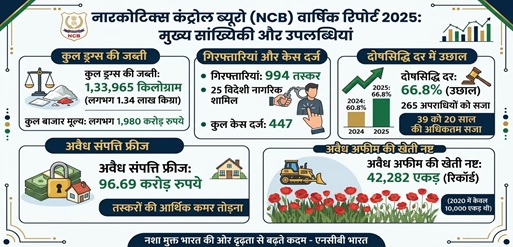
  • Total Drug Seizures: During 2025, a total of 133,965 kilograms (about 1.34 lakh kg) of narcotic drugs were seized across the country, with an estimated market value of around ₹1,980 crore.
  • Arrests: 994 drug traffickers, including 25 foreign nationals, were arrested. A total of 447 cases were registered.
  • Rise in Conviction Rate: Due to strong follow-up by NCB, the conviction rate increased to 66.8%, up from 60.8% in 2024. In 2025, 265 offenders were convicted, of whom 39 received the maximum sentence of 20 years.
  • Illegal Assets Frozen: Illegal assets worth ₹96.69 crore belonging to drug traffickers were frozen.
  • Illegal Opium Cultivation Destroyed: A record 42,282 acres of illegal opium cultivation was destroyed in 2025 (compared to only 10,000 acres in 2020).

New Threats Highlighted in the Report :

  • Myanmar Emerges as the New Hub: According to the report, after the Taliban imposed a ban on opium cultivation in Afghanistan in 2022, Myanmar has emerged as the world's primary source of opium supply.
  • New Route: Due to the ongoing ethnic unrest in Manipur, traffickers have shifted to the eastern border route through Mizoram for smuggling drugs, particularly Amphetamine-Type Stimulants (ATS). Out of the total 3,485 kg ATS seized in India in 2025, 1,477 kg was seized in Mizoram alone.
  • High-Tech Smuggling: Drug traffickers are increasingly using drones, darknet platforms, cryptocurrency payments, and courier/parcel networks instead of conventional methods. To counter this, NCB signed an MoU with Rashtriya Raksha University, Gandhinagar.

Comparative Data of the Last Decade (2004–14 vs 2014–26) :

  • Synthetic Drug Seizures: While 26 lakh kilograms of drugs were seized during 2004–2014, the figure increased to 1.18 crore kilograms during 2014–2026.
  • Value of Seized Drugs: The value of drugs seized during 2004–2014 was around ₹40,000 crore, which increased to ₹1.84 lakh crore during 2014–2026.

Narco-Coordination Centre (NCORD) :

  • Established: By the Ministry of Home Affairs (MHA) in 2016.
  • Reorganisation (2019): The system was reorganised into a four-tier mechanism under the leadership of Home Minister Amit Shah to make it more effective.
  • Apex-Level Committee: Chaired by the Union Home Secretary/Home Minister.
  • Executive-Level Committee: Chaired by the Special Secretary (Internal Security), Ministry of Home Affairs.
  • State-Level Committee: Chaired by the Chief Secretaries of the States.
  • District-Level Committee: Chaired by the District Magistrates.

Narcotics Control Bureau (NCB) :

  • It is India's apex central nodal agency responsible for combating drug trafficking and the illegal use of narcotic drugs.
  • Established: March 1986.
  • Constitutional and Legal Framework: Article 47 of the Constitution of India directs the State to prohibit the consumption of intoxicating drinks and drugs harmful to health except for medicinal purposes. To implement this directive, Parliament enacted the Narcotic Drugs and Psychotropic Substances (NDPS) Act, 1985, under which the NCB was established.
  • Headquarters: New Delhi
  • Ministry: Ministry of Home Affairs

Latest Courses