GK Update
 
  • Mobile Menu
HOME BUY MAGAZINEnew course icon
LOG IN SIGN UP

Sign-Up IcanDon't Have an Account?


SIGN UP


Login Icon

Have an Account?


LOG IN
 

or
By clicking on Register, you are agreeing to our Terms & Conditions.


or


GK Update

Sat 27 Jun, 2026

Context:

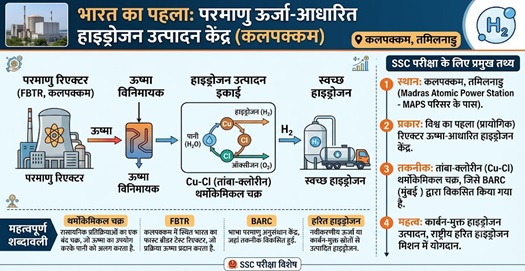
  • India inaugurated the world's first hydrogen production facility using heat generated from a nuclear reactor at Kalpakkam, Tamil Nadu.

Key Highlights:

  • Location: Indira Gandhi Centre for Atomic Research (IGCAR), Kalpakkam, Tamil Nadu
  • Inaugurated by: Ajit Kumar Mohanty, Secretary, Department of Atomic Energy (DAE) and Chairman, Atomic Energy Commission (AEC)
  • Heat Source: The facility receives process heat from the Fast Breeder Test Reactor (FBTR).
  • Technology: It uses the Copper-Chlorine (Cu-Cl) Thermochemical Cycle for hydrogen production.
  • Developer: The indigenous technology was developed by Bhabha Atomic Research Centre (BARC), Mumbai.

Strategic Significance

Rise of 'Pink Hydrogen' :

  • Hydrogen produced using renewable energy (solar/wind) is known as Green Hydrogen. Hydrogen produced using nuclear energy without carbon emissions is technically called Pink Hydrogen. India has emerged as a global leader in this technology.

Reduced Grid Dependence and Lower Cost :

  • Conventional green hydrogen production depends entirely on solar and wind power, which are weather-dependent.
  • Nuclear reactors provide continuous heat, enabling 24×7 hydrogen production and significantly reducing production costs per kilogram.

Net-Zero and Decarbonisation :

  • Industries such as refineries, fertilizers and steel require large quantities of hydrogen, which is currently produced mainly from fossil fuels (Grey Hydrogen). This facility marks a major step toward supplying these sectors with clean hydrogen.

Global and National Context :

  • Global Status: India has become the first country to use nuclear heat directly for commercial-scale hydrogen production. The United States, Japan and South Korea have so far tested this technology only at laboratory or pilot scale.
  • National Green Hydrogen Mission (NGHM): India aims to develop an annual production capacity of 5 Million Metric Tonnes (MMT) of green hydrogen by 2030. The Kalpakkam facility lays the foundation for India's nuclear-hydrogen roadmap.

Copper-Chlorine (Cu-Cl) Cycle :

  • The Copper-Chlorine (Cu-Cl) Cycle is a multi-step thermochemical process designed to split water (H₂O) into hydrogen (H₂) and oxygen (O₂).
  • Conventional hydrogen production uses electrolysis, which consumes large amounts of electricity. In contrast, the Cu-Cl cycle primarily relies on heat and chemical reactions in a closed-loop process.
  • The process generally consists of four or five stages, where copper, chlorine and water react at different temperatures.
  • Hydrogen Production Stage: Copper chloride (CuCl) reacts with hydrochloric acid (HCl) at relatively low temperatures to release hydrogen gas (H₂).
  • Oxygen Production Stage: At higher temperatures (around 500°C), oxygen gas (O₂) is released.
  • Recycling: Copper and chlorine compounds are regenerated after each cycle and reused, making water the only net consumable.

Advantages of the Cu-Cl Cycle :

  • Lower Temperature Requirement: Unlike other thermochemical cycles (such as the Sulfur-Iodine Cycle), which require temperatures above 800–900°C, the Cu-Cl cycle operates at about 500°C.
  • Use of Nuclear and Industrial Waste Heat: The process can utilize heat from current-generation nuclear reactors such as FBTR or waste heat from heavy industries.
  • Higher Efficiency: Direct utilization of thermal energy minimizes energy losses, making the process more efficient than conventional electrolysis.
  • Zero Carbon Emissions: When powered by nuclear energy or solar thermal energy, the process produces hydrogen without greenhouse gas emissions, resulting in clean Pink/Green Hydrogen.

Thermochemical Process

  • [Nuclear Heat from FBTR (~500°C)] ➔ [Cu-Cl Chemical Cycle] ➔ [Water Splitting] ➔ [Pure Hydrogen + Oxygen]

Fast Breeder Test Reactor (FBTR) :

  • The Fast Breeder Test Reactor (FBTR) is a key component of India's nuclear energy programme.
  • Location: IGCAR, Kalpakkam, Tamil Nadu.
  • Type: Fast Neutron Reactor.
  • India became the sixth country to successfully operate this technology.
  • Capacity: 40 MW (thermal) and 13.2 MW (electrical).
  • Coolant: Liquid sodium is used as the coolant because of its excellent heat-transfer capability.
  • Fuel: A mixed fuel of plutonium carbide and uranium carbide.
  • Achievement: Recently enabled the world's first facility producing clean hydrogen using nuclear heat.
  • Breeder Technology: It produces more fissile fuel than it consumes.

Indira Gandhi Centre for Atomic Research (IGCAR)

  • Headquarters: Kalpakkam, Tamil Nadu.
  • Established: 1971.
  • Specialization: Research and development of fast breeder reactor technology.

Bhabha Atomic Research Centre (BARC) :

  • Headquarters: Trombay, Mumbai, Maharashtra.
  • Established: 1954.
  • Founder: Dr. Homi Jehangir Bhabha.
  • Significance: India's premier nuclear research centre.

Fast Breeder Test Reactor (FBTR) :

  • Location: Kalpakkam, Tamil Nadu.
  • Special Feature: A sodium-cooled fast reactor used for testing and research on plutonium-uranium carbide fuel.
  • It supplies heat to the Kalpakkam hydrogen production facility.

Atomic Energy Commission (AEC) :

  • Headquarters: Mumbai, Maharashtra.
  • Special Feature: India's apex body responsible for approving policies and programmes related to atomic energy.
  • Established: August 1948.
  •  

Latest Courses