26 May, 2026
Launch of the ‘Nirbhay Chetna’ Initiative
Thu 25 Jun, 2026
Context:
- The Ministry of Panchayati Raj has launched the ‘Nirbhay Chetna’ initiative.
Key Highlights:
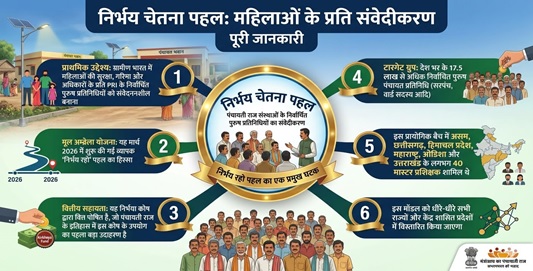
- Primary Objective: To sensitize elected male representatives of Panchayati Raj Institutions (PRIs) towards women’s safety, dignity, and rights in rural India and strengthen gender-responsive governance at the grassroots level.
- Parent Umbrella Scheme: It is a major component of the broader ‘Nirbhay Raho’ initiative launched in March 2026.
- Financial Support: It is funded through the Nirbhaya Fund, marking the first major use of this fund in the history of Panchayati Raj.
- Target Group: More than 17.5 lakh elected male Panchayat representatives (Sarpanches, Ward Members, etc.) across the country.
- The pilot batch included around 40 master trainers from Assam, Chhattisgarh, Himachal Pradesh, Maharashtra, Odisha, and Uttarakhand.
- The model will be gradually expanded to all States and Union Territories.
Implementation Strategy:
- A network of 28,500 Master Trainers will be developed at the State, District, and Block levels.
- A dedicated training module has been developed in collaboration with Transform Rural India (TRI).
- NLSIU Bengaluru is serving as the knowledge partner.
Nirbhay Raho Initiative
- Nirbhay Raho is a comprehensive nationwide campaign launched by the Ministry of Panchayati Raj, Government of India, to strengthen women’s safety, dignity, and legal awareness in rural India. It was officially launched on 11 March 2026.
- The initiative is primarily funded through the Nirbhaya Fund and is being implemented in collaboration with the Ministry of Women and Child Development and the National Law School of India University (NLSIU), Bengaluru.
Three Main Pillars of ‘Nirbhay Raho’:
- Nirbhay Netri: Legal and leadership training for women Panchayat representatives.
- Nirbhay Chetna: Gender sensitization of male Panchayat representatives.
- Nirbhay Drishti: Installation of CCTV cameras at rural hotspots to enhance safety.
Significance:
- Grassroots Social Transformation: Targets more than 32 lakh Panchayat representatives to challenge patriarchal norms and promote gender justice.
- Strengthening Local Support Systems: Enables Panchayat representatives to facilitate access to legal aid, cyber safety awareness, and various support mechanisms.
- Inclusive Governance: Integrates a gender perspective into local planning processes and contributes to the goal of a developed India through women-led development.
Panchayati Raj
- Panchayati Raj is a system of Rural Local Self-Government in India that was given constitutional status through the 73rd Constitutional Amendment Act, 1992.
Three-Tier Structure:
Under Article 243B of the Indian Constitution, a Three-Tier Structure has been provided for Panchayati Raj Institutions.
1. Gram Level (Gram Panchayat)
- Unit: Gram Panchayat
- Head: Mukhiya/Sarpanch/Pradhan (elected directly or indirectly as per State laws)
- Members: Ward Members of the Gram Panchayat elected directly by village voters.
- Role: Implementation of local development schemes and management of basic civic amenities such as sanitation, lighting, and water supply.
2. Intermediate Level (Block/Mandal Level)
- Unit: Panchayat Samiti (also known as Janpad Panchayat or Mandal Parishad in different States)
- Head: Chairperson/Pradhan (elected indirectly by elected members)
- Members: Directly elected members of the area, along with MLAs and MPs who may also be members.
- Role: Acts as a link between Gram Panchayats and the Zila Parishad and coordinates development plans at the block level.
3. District Level (District Level)
- Unit: Zila Parishad
- Head: Chairperson/Chairman (elected indirectly by elected members)
- Members: Directly elected district members, Chairpersons of all Panchayat Samitis, and MPs and MLAs of the district.
- Role: Supervises the activities of all Panchayat Samitis in the district, approves budgets, and advises the State Government.
Important Committees:
- Balwant Rai Mehta Committee (1957): Recommended the Three-Tier Panchayati Raj System.
- Ashok Mehta Committee (1977): Recommended a Two-Tier Structure.
- L.M. Singhvi Committee (1986): Strongly recommended granting constitutional status to Panchayats.
Constitutional Provisions:
- Part of the Constitution: Panchayati Raj is incorporated under Part IX (Articles 243 to 243O) of the Constitution.
- Article 243 (Definitions): Defines important terms such as “Gram Sabha,” “Panchayat,” and “Panchayat Area.”
- Article 243A (Gram Sabha): The basic unit of Panchayati Raj comprising all registered voters of a village. Its powers are determined by the State Legislature.
- Article 243B (Constitution of Panchayats): Provides for a three-tier system (Gram, Intermediate, and District levels).
- Exception: States with a population below 20 lakh are not required to establish the Intermediate Level.
- Article 243C (Composition of Panchayats): Elections to all seats shall be through direct voting. The procedure for electing Chairpersons is determined by the State Legislature.
Article 243D (Reservation of Seats):
- Reservation for SCs/STs in proportion to their population.
- At least one-third (33%) of seats, including Chairperson posts, reserved for women.
- Article 243E (Duration of Panchayats): Term of office is 5 years. If dissolved, elections must be conducted within 6 months.
- Article 243F (Disqualifications for Membership): A person cannot be disqualified on the ground of age if he/she has attained 21 years of age (compared to 25 years for State Legislature membership).
- Article 243G (Powers, Authority and Responsibilities): Empowers Panchayats to prepare plans for economic development and social justice. Includes 29 subjects listed in the Eleventh Schedule.
- Article 243H (Power to Levy Taxes): Panchayats may levy taxes, duties, tolls, and fees and receive grants-in-aid from government funds.
- Article 243I (State Finance Commission): Constituted by the Governor every 5 years to review the financial position of Panchayats.
- Article 243K (State Election Commission): An independent body responsible for the superintendence, direction, and control of Panchayat elections.
- Article 243O (Bar on Interference by Courts): Courts cannot interfere in matters relating to the delimitation of constituencies or allocation of seats for Panchayat elections.