GK Update
 
  • Mobile Menu
HOME BUY MAGAZINEnew course icon
LOG IN SIGN UP

Sign-Up IcanDon't Have an Account?


SIGN UP


Login Icon

Have an Account?


LOG IN
 

or
By clicking on Register, you are agreeing to our Terms & Conditions.


or


GK Update

Wed 24 Jun, 2026

National News

Launch of Four Digital Policing Applications
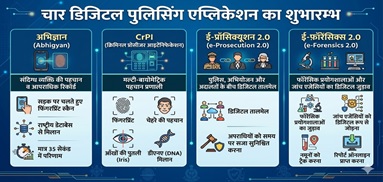
  • Union Home Minister Amit Shah launched four digital policing applications during the 26th All India Fingerprint Conference.
  • Developed by the National Crime Records Bureau (NCRB), these applications will prove to be game-changers in ensuring the speedy disposal of pending cases and the delivery of timely justice.

Related Facts:

Four New Applications:

  • NCRB-Abhigyan: For on-the-spot (field-level) fingerprint matching of suspects.
  • CrPI (Criminal Re-offender Pattern Identifier): For identifying patterns of repeat offenders.
  • e-Prosecution 2.0: To expedite investigations and court proceedings.
  • e-Forensics 2.0: For the integration of scientific investigations such as DNA, iris, and face-matching.

26th All India Fingerprint Conference:

  • Venue (City): New Delhi.
  • Venue (Auditorium): Sardar Vallabhbhai Patel Auditorium, New Delhi.
  • Inaugurator (Chief Guest): Union Home and Cooperation Minister Amit Shah.
  • Organizing Body: National Crime Records Bureau (NCRB).

NCRB (National Crime Records Bureau):

  • Establishment: 11 March 1986.
  • Headquarters: New Delhi.
  • Ministry: Ministry of Home Affairs.

Approval for 'DISHA 2.0' Programme

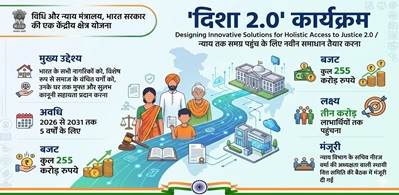
  • The Ministry of Law and Justice has approved the 'DISHA 2.0' programme, which will be implemented from April 1, 2026, to March 31, 2031.
  • This scheme fulfills the constitutional mandate—under Article 39A of the Indian Constitution—to ensure free legal aid and 'access to justice' for the underprivileged and economically weaker sections of society.

Related Facts:

  • Full Name: Designing Innovative Solutions for Holistic Access to Justice (DISHA)
  • Type of Scheme: It is a 100% Central Sector Scheme, with full financial support provided by the Government of India.
  • Total Financial Allocation: A budget of ₹255 crore has been allocated for the next five years (2026–31) (Note: The outlay for the previous DISHA scheme [2021–26] was ₹250 crore).
  • Significance of the Timeframe: This period aligns with the cycle of the 16th Finance Commission.
  • Target: The goal is to reach a total of 3 crore beneficiaries through all components of DISHA 2.0.

Four Key Components of DISHA 2.0:

  • Tele-Law: This facilitates pre-litigation legal advice for citizens from lawyers via video or tele-conferencing, utilizing the network of Common Service Centres (CSCs) operating at the Gram Panchayat level.
  • Nyaya Bandhu: This promotes a 'pro-bono' (free legal service) culture in the country, wherein registered private advocates and law school 'pro-bono clubs' provide free legal representation to eligible beneficiaries.
  • Legal Literacy and Awareness Programme (LLLAP): This aims to build the capacity of grassroots legal workers and spread awareness regarding legal rights among marginalized communities. Vidhi Sanjeevani – New Component: This new digital component has been added to DISHA 2.0. It will operate based on the vision of the 'integrated delivery of coordinated legal measures.' Under this initiative, a centralized digital platform and an AI-driven multilingual 'Nyaya Setu Chatbot' (developed in collaboration with BHASHINI) will be utilized to facilitate technology-enabled justice delivery.
  • Constitutional Provisions: This scheme gives effect to the Preamble as well as Article 14 (Equality before law), Article 21 (Right to life and personal liberty), and specifically Article 39A (Equal justice and free legal aid).
  • Sustainable Development Goal (SDG): It directly supports the United Nations Sustainable Development Goal 16 (SDG-16), which pertains to peace, justice, and strong institutions.

Launch of E-Auction Portal NAFEX.in

  • Union Minister for Cooperation Amit Shah launched NAFED's new e-auction portal, NAFEX.in.

NAFED:

  • Full Name: National Agricultural Cooperative Marketing Federation of India Limited
  • Establishment: October 2, 1958 (on Gandhi Jayanti)
  • Headquarters: New Delhi
  • Ministry: It operates under the Ministry of Agriculture and Farmers Welfare
  • Registration: It is registered under the 'Multi-State Co-operative Societies Act'

Approval for the ‘Vetri Tamilagam’ Document
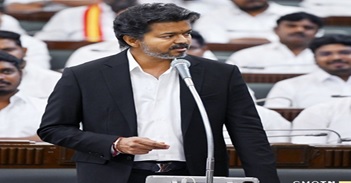
  • The Tamil Nadu government has approved the ‘Vetri Tamilagam’ document with a budget of ₹755 crore.

Key Details:

  • It entails the gifting of a gold ring by the maternal uncle.
  • Under the scheme, a one-gram gold ring will be given to newborns of permanent state residents upon their birth in government hospitals.
  • The state government has issued orders regarding this.
  • An annual budget of ₹755.83 crore has been allocated for this purpose.

Tamil Nadu:

  • Formation: November 1, 1956.
  • Capital: Chennai (known as the 'Detroit of South Asia').
  • Official Languages: Tamil (one of the oldest languages ​​in the world) and English.
  • State Animal: Nilgiri Tahr.
  • State Bird: Emerald Dove.
  • State Tree: Palm tree.
  • State Flower: Kandal or 'Gloriosa Lily'.
  • State Fruit: Jackfruit.
  • State Sport: Kabaddi.
  • State Emblem: Srivilliputhur Temple Gopuram.
  • Classical Dance: Bharatanatyam (originated in the temples here).
  • Major Festivals: Pongal (major harvest festival), Puthandu (Tamil New Year).

Installation of the Country's First 3D-Printed Artificial Reef
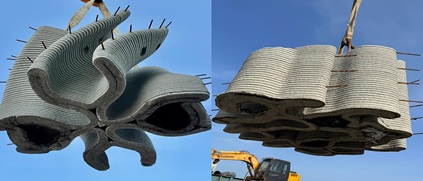
  • The country's first 3D-printed artificial reef is being installed off the coast of Ramanathapuram, Tamil Nadu.
  • This initiative will significantly help in conserving marine habitats, enhancing biodiversity, and improving the income of fishermen.

Key Facts:

  • Project Name: India's First 3D-Printed Artificial Reef
  • Location: Ramanathapuram Coast (Tamil Nadu)
  • Scheme: This initiative is part of the second phase of the Central Government's Pradhan Mantri Matsya Sampada Yojana (PMMSY).
  • Developer: It has been jointly developed by the Indian Council of Agricultural Research - Central Marine Fisheries Research Institute (ICAR-CMFRI) and TVASTA, a Chennai-based start-up supported by IIT Madras.

Key Features and Objectives:

  • 3D Printing: 3D printing (also known as additive manufacturing) is a technology that creates 3D objects in layers from materials like plastic or cement using computer designs.
  • Biodiversity: These reefs feature various crevices and specialized shapes, providing safe spaces for fish and other marine organisms to hide and spawn.
  • Marine Conservation: It helps mitigate issues related to the degradation of natural coral reefs caused by global warming and the decline in marine fish populations.

Commercial Production Begins at Swarnagiri Mine
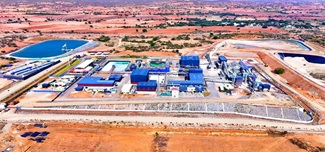
  • The Jonnagiri (Swarnagiri) gold mine, located in the Tuggali Mandal of Kurnool district, Andhra Pradesh, has commenced commercial production.
  • It has become India's first major private-sector primary gold mine since independence.

Key Facts:

  • Name of the Mine: Jonnagiri Gold Fields. Recently, the Andhra Pradesh Cabinet approved a proposal to rename this village 'Swarnagiri'.
  • Location: Kurnool district, Andhra Pradesh (Rayalaseema region).
  • Operating Company: It is being developed and operated by Geomysore Services India Private Limited (GMSI) in collaboration with Deccan Gold Mines Limited (DGML) and Thriveni Earthmovers.
  • Total Investment: An investment of approximately ₹405 crore has been made in this project.
  • Production Capacity: Gold production of approximately 400 kg is estimated for the year 2026-27, with a future target to increase this to 2 tonnes (2,000 kg) annually.
  • Royalty: The Andhra Pradesh government will receive a 4% royalty on the gold produced from this project.

Gold Mining in India:

  • Hutti Gold Mines: Prior to Jonnagiri, 'Hutti Gold Mines'—located in the Raichur district of Karnataka and under state government ownership—was the only major mine currently producing gold at a commercial scale in India.
  • Kolar Gold Fields (KGF): Located in Karnataka, this was one of India's most famous and deepest gold mines; it was closed in 2001 due to ore depletion and high operating costs.

International news

$230 million package approved

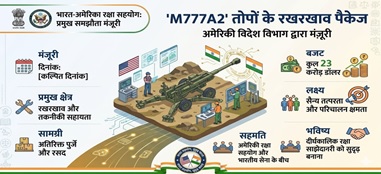
  • America approved a $230 million package for the maintenance of India's M777A2 guns.

Related facts:

  • Total military cooperation package: America has approved a total logistics package of $ 482.2 million for India.
  • M777A2 Howitzer Support: $230 million (for spare parts, repairs, training and depot-level capacity development).
  • AH-64E Apache helicopter support: $198.2 million (for technical support and logistics)
  • Main contracted company: BAE Systems will handle the main maintenance work of this cannon.
  • Process (FMS Route): This agreement has been made under the Foreign Military Sales (FMS) program of the US government, the notification of which was issued in June 2026.
  • No new cannon: Keep in mind that new cannons are not being purchased in this deal, but the infrastructure is being strengthened to keep the 145 M777 cannons already present in the Indian Army fleet always operationally ready.

America:

  • Capital: Washington D.C.
  • Largest city: New York City
  • Continent: North America
  • Head of State: President
  • Parliament: Congress (House of Representatives, Senate)
  • Currency: US Dollar (USD)
  • Main rivers: Mississippi, Missouri, Colorado
  • Main mountain ranges: Rocky Mountains, Appalachian Mountains
  • Official language: English (Donald Trump officially recognized it at the federal level by issuing an executive order in March 2025)

UNSC Resolution 2823

  • The United Nations Security Council (UNSC) unanimously adopted Resolution 2823 (2026) on June 23, 2026, aiming to strengthen accountability for attacks against UN peacekeepers and ensure their safety.

Related Facts:

  • Draft Resolution: The draft of this significant resolution was jointly prepared by Denmark and Pakistan. Both nations are non-permanent members of the Security Council for the 2025–2026 term.
  • Co-sponsors: More than 150 member states of the UN General Assembly have supported and co-sponsored this resolution.
  • Senior Focal Point: The resolution calls upon the UN Secretary-General to appoint a "Senior Focal Point" within the UN to coordinate and improve responses regarding crimes committed against peacekeepers.
  • Annual Report: An annual progress report regarding the status of investigations and judicial proceedings concerning attacks on peacekeepers must be submitted to the UN; the first report is due within 120 days.
  • War Crimes: The Security Council clarified that deliberate attacks on peacekeepers may constitute war crimes under international law.
  • Primary Responsibility: The host country bears the primary responsibility for ensuring the safety and security of UN personnel and peacekeepers.

United Nations Peacekeeping:

  • Establishment: UN peacekeeping operations began in 1948 with the deployment of the first military observer mission in the Middle East.
  • 'Blue Helmets': UN peacekeepers are also known as 'Blue Helmets' due to their distinctive blue caps or helmets.
  • Historical Toll: Since 1948, approximately 4,500 peacekeepers have lost their lives in the line of duty. In the year 2025 alone, 59 peacekeeper deaths were recorded. India has historically been one of the largest troop-contributing countries to United Nations peacekeeping missions.
  • India made history in 2007 by deploying the first-ever all-female police unit (FPU) under the United Nations in Liberia.
  • India's Major Radhika Sen has been honored by the UN Headquarters with the "UN Military Gender Advocate of the Year" award for 2023.

Reports and Indices

World's No. 1 Supercomputer

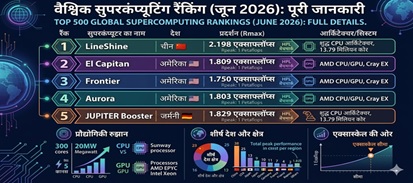
  • China's 'LineShine' has been declared the world's number-1 supercomputer in the TOP500 rankings.

Related Facts:

  • Top Spot: China's 'LineShine' has surpassed the US supercomputer 'El Capitan' to secure the number one position globally.
  • Location: This supercomputer is installed at the 'National Supercomputing Center' in the city of Shenzhen, China.
  • Processing Speed: Its speed has been recorded at 2.198 exaflops. It can perform more than 2 quintillion (a 2 followed by 18 zeros) calculations per second.
  • Chinese History: This is the first time since 2017 (Sunway TaihuLight) that a Chinese supercomputer has achieved the number-1 spot in the global rankings.
  • Special Feature: LineShine is the world's first exascale computer to operate entirely on domestically produced traditional CPU chips, without the use of any AI graphics processors (GPUs).

World's Top-5 Supercomputers:

  • Rank 1 - LineShine: Currently the world's fastest supercomputer, developed by China.
  • Rank 2 - El Capitan: The world's second-fastest supercomputer, owned by the USA.
  • Rank 3 - Aurora: Ranked third; this is also a US supercomputer.
  • Rank 4 - Frontier: Ranked fourth; this supercomputer also belongs to the USA.
  • Rank 5 - JUPITER Booster: The world's fifth-fastest supercomputer, located in Germany.

Important Exam-Relevant Facts:

  • Measurement of Supercomputer Speed: Supercomputer speed is measured in FLOPS. Currently, the fastest computers fall into the exaflop category.
  • Father of global supercomputing: Seymour Cray is considered the father of the world's supercomputers.
  • World's first supercomputer: CDC 6600 (designed by Seymour Cray in 1964).
  • Father of supercomputing in India: Dr. Vijay Bhatkar is known as the father of supercomputing in India.
  • India's first supercomputer: PARAM 8000, developed by C-DAC in 1991.
  • India's currently fastest supercomputer: India's fastest AI supercomputer is 'AIRAWAT', installed at C-DAC Pune.

QS World Future Skills Index 2027

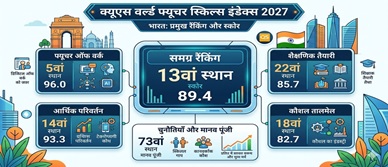
  • India ranked 13th in terms of AI-economy readiness in the QS World Future Skills Index 2027.

Key Facts:

  • India's Global Rank: India ranked 13th in AI-economy readiness.
  • Total Score: India secured 89.4 points out of 100.
  • Issuing Body: This index was released by 'QS Quacquarelli Symonds' on June 23, 2026.
  • Regional Record: India is the only South Asian country to feature in the top 15. It also holds the top position among lower-middle-income economies.

India's Performance Across Categories:

  • Future of Work: India performed strongest in this category, ranking 5th (Score: 96.0).
  • Economic Potential: India achieved a perfect score of 100 out of 100 in the economic potential sub-indicator, the highest globally.
  • Economic Transformation: India ranked 14th in this indicator.
  • Skill Alignment: India ranked 18th in skill alignment, indicating a need for further improvement in preparing a skilled workforce at the university level.

Top 5 Countries:

  • United States (USA) – 1st place (Score: 99.2)
  • Australia – 2nd place (Score: 97.5)
  • United Kingdom (UK) – 3rd place (Score: 96.6)
  • Germany – 4th place (Score: 95.5)
  • Canada – 5th place (Score: 93.7)

Science and Technology

Approval for the use of Teplizumab in the NHS
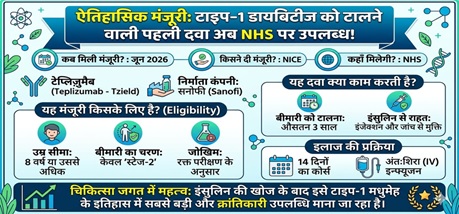
  • The National Institute for Health and Care Excellence (NICE) has approved the use of Teplizumab within the NHS for patients with early-stage Type 1 diabetes.

Key Facts:

  • Historic Approval: The first drug to delay Type 1 diabetes is now available on the NHS!
  • When was approval granted?: June 2026 (Final guidelines recently issued)
  • Who granted approval?: NICE (National Institute for Health and Care Excellence, UK)
  • Where will it be available?: Through the NHS (National Health Service, United Kingdom)
  • Drug Name (Brand): Teplizumab (Tzield)
  • Manufacturer: Sanofi

Who is this approval for? (Eligibility):

  • Age Limit: Children aged 8 years or older and adults.
  • Disease Stage: Only for 'Stage 2' (early-stage) Type 1 diabetes patients.
  • Risk: For those found to be at very high risk of developing the disease based on blood test results.

How does this drug work?:

  • Delaying the disease: It delays the onset of severe symptoms (Stage 3) by an average of "3 years."
  • Relief from insulin: Patients are spared the burden of daily insulin injections and blood sugar monitoring at an early age.

Treatment Process:

  • 14-day course: It is a liquid medication administered over 14 consecutive days.
  • Intravenous (IV) infusion: The drug is delivered directly into the body through a vein.
  • Significance in the medical world: Since the discovery of insulin, this is considered the
  • greatest and most revolutionary achievement in the history of Type 1 diabetes.

Discovery of a New Wild Eggplant Species

  • A new wild species of eggplant, *Solanum pandeyii*, has been discovered in the Andaman Islands; it is utilized by the indigenous Great Andamanese tribe.

Key Facts:

  • Discovering Organization: The discovery was made by scientists (Dr. Lal Ji Singh) from the Botanical Survey of India (BSI).
  • Exact Location: This new species was found along the fringes of the evergreen forests in Middle Andaman.
  • Local Name: It is locally known as the 'Wild Orange Eggplant'.
  • Basis of Naming: It has been named *Solanum pandeyii* in honor of Professor Arun Kumar Pandey, a renowned plant taxonomist from the University of Delhi.
  • Scientific Classification: This plant belongs to the spiny *Solanum* group known as the 'Leptostemonum clade' and bears a resemblance to the species *Solanum lasiocarpum*.

Awards and Honours

Civil Investiture Ceremony-II

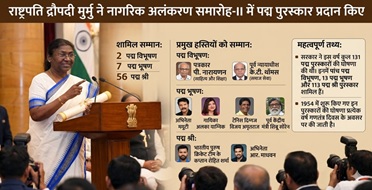
  • President Droupadi Murmu conferred Padma Awards upon 65 eminent personalities at Civil Investiture Ceremony-II.

Related Facts:

Civil Investiture Ceremony-II:

  • Honours included: 2 Padma Vibhushan, 7 Padma Bhushan, and 56 Padma Shri awards.
  • Honours conferred upon prominent personalities:
  • Padma Vibhushan: Journalist P. Narayanan (Literature and Education) and former Judge K.T. Thomas (Social Work).
  • Padma Bhushan: Actor Mammootty, singer Alka Yagnik, tennis legend Vijay Amritraj, and former Union Minister Shibu Soren.
  • Padma Shri: Indian men's cricket team captain Rohit Sharma and actor R. Madhavan.
  • The government had announced a total of 131 Padma Awards this year. These included five Padma Vibhushan, 13 Padma Bhushan, and 113 Padma Shri awards.
  • Instituted in 1954, these awards are announced annually on the occasion of Republic Day.

Books and Authors

'Regime Change: Inside the Imperial Presidency of Donald Trump'

  • The book titled 'Regime Change: Inside the Imperial Presidency of Donald Trump' is currently a subject of intense discussion in international media and political circles.

Key Facts:

  • Authors: Renowned *New York Times* senior journalists and Pulitzer Prize winners Maggie Haberman and Jonathan Swan.
  • Publication: The book was released by the famous publishing house Simon & Schuster in June 2026.
  • Unprecedented expansion of powers: The book illustrates how Trump exercised presidential powers in a novel and aggressive manner—described by the authors as an "Imperial Presidency" and an internal "regime change" within American democracy.
  • Claim regarding India and the Ukraine war: A highly startling claim made in the book is that Vice President JD Vance wanted to deploy the Indian Army to Ukraine as part of efforts to resolve the Russia-Ukraine conflict—a suggestion at which Trump laughed.


Latest Courses