Why in News?
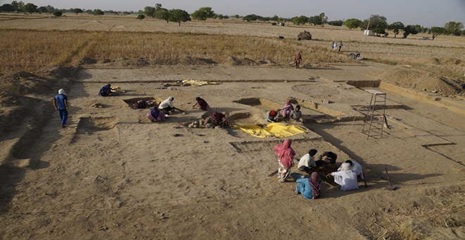
- Recently, human skeletal remains excavated from Rakhigarhi (Haryana) were formally transferred by the Archaeological Survey of India (ASI) to the Anthropological Survey of India (AnSI) for detailed scientific investigation.
- This transfer was carried out under a newly signed Memorandum of Understanding (MoU) between the two institutions.
- This initiative is expected to significantly strengthen multidisciplinary research on the Indus-Saraswati Civilization, one of the world’s ealiest urban civilizations.
About Rakhigarhi
- Located in Haryana, Rakhigarhi spreads across approximately 550 hectares.
- It is widely regarded as the largest known settlement of the Indus-Saraswati Civilization.
- The site shows evidence of continuous habitation from the Early Harappan to the Mature Harappan period.
Archaeological Findings
Excavations have revealed:
- Planned urban settlements
- Advanced drainage systems
- Craft production centers
- Trade networks
- Burial grounds
These features indicate a highly organized and sophisticated urban civilization.
Recent Excavation (2025–26)
During the 2025–26 excavation season, ASI’s Excavation Branch-II (Greater Noida) discovered:
- 8 burials at Mound No. 7 (identified as a cemetery)
- 3 complete human skeletons
- Additional skeletal fragments from other burials
These remains have now been transferred to AnSI’s ancient human skeletal repository and laboratory in Kolkata for advanced analysis.
Why is this Important?
The skeletal remains provide a rare opportunity to study the biological history of the Harappan people using modern scientific tools.
Scientists will apply:
1. Ancient DNA (aDNA) Analysis
Helps determine:
- Genetic ancestry
- Population origins
- Migration routes
2. Stable Isotope Analysis
Provides clues about:
- Diet
- Water sources
- Mobility patterns
3. Osteological Studies
Used to understand:
- Bone structure
- Age
- Gender
- Physical characteristics
4. Palaeopathology
Helps identify:
- Diseases
- Injuries
- Nutritional deficiencies
- Stress markers
5. Environmental Reconstruction
Used to analyze:
- Ancient climate
- Habitat conditions
- Human-environment interaction
Institutional Collaboration
The research will be conducted in collaboration with leading institutions:
- Archaeological Survey of India (ASI)
- Anthropological Survey of India (AnSI)
- Birbal Sahni Institute of Palaeosciences (BSIP)
- University College London (UCL)
- Banaras Hindu University (BHU)
- Centre for Cellular and Molecular Biology (CCMB)
This collaboration will boost India’s research capabilities in palaeoanthropology and palaeogenomics.
Significance of the Study
The study may reveal crucial information about:
- Origins of Harappan populations
- Health and disease patterns
- Food habits
- Mobility and migration
- Adaptation to climate change
- Evolution of human genomes since 3000 BCE
It may also help resolve long-standing debates regarding the population history of the Harappan Civilization.
Conclusion
- The transfer of skeletal remains from Rakhigarhi marks a major milestone in Indian archaeological research.
- By integrating archaeology, anthropology, genetics, and environmental science, this initiative can provide unprecedented insights into the origins, lifestyle, health, and biological evolution of the Indus-Saraswati Civilization.
Indus-Saraswati Civilization
- The Indus-Saraswati Civilization, traditionally known as the Indus Valley Civilization or Harappan Civilization, was one of the largest and most advanced urban cultures of the ancient world.
- Chronology: Belongs to the Bronze Age (Proto-historic period). Iron was completely unknown to these people.
Geographical Extent: Triangular shaped, covering roughly 1.3 million sq. km.
- Northernmost point: Manda (Jammu & Kashmir) or Shortughai (Afghanistan)
- Southernmost point: Daimabad (Maharashtra)
- Westernmost point: Sutkagan Dor (Pakistan-Iran border)
- Easternmost point: Alamgirpur (Uttar Pradesh)
Major Sites
| Site |
Location & River |
Key Discoveries & Features |
| Harappa |
Punjab, Pakistan (Ravi) |
First excavated site (1921 by Daya Ram Sahni). 6 Granaries in a row, stone symbol of Lingam/Yoni, mother goddess clay figurines. |
| Mohenjo-daro |
Sindh, Pakistan (Indus) |
Literally "Mound of the Dead" (1922 by R.D. Banerjee). The Great Bath, Great Granary, Bronze Dancing Girl, Pashupati Seal, Bearded Priest, woven cotton. |
| Lothal |
Gujarat, India (Bhogava) |
Manchester of IVC. World's earliest artificial Brick Dockyard, double burial (male/female together), rice husk, fire altars, chess-like game pieces. |
| Kalibangan |
Rajasthan, India (Ghaggar) |
Literally "Black Bangles". Evidence of earliest ploughed field, wooden furrow, fire altars, camel bones, and both brick types (burnt and sun-dried). |
| Dholavira |
Gujarat, India (Kutch) |
UNESCO World Heritage Site. Divided into three parts (instead of two). Unique water-harvesting system with huge reservoirs, a stadium, and a 10-alphabet signboard. |
| Chanhudaro |
Sindh, Pakistan (Indus) |
The only Indus city without a citadel. An industrial hub famous for bead-making factories, inkpots, and footprints of a dog chasing a cat. |
| Surkotada |
Gujarat, India |
Notable for providing the actual bone remains of a horse. Also known for pot burials. |
| Rakhigarhi |
Haryana, India (Ghaggar) |
Currently recognized as the largest geographical site of the Indus-Saraswati Civilization. |
| Banawali |
Haryana, India (Saraswati) |
Lack of systematic drainage system. Good quality barley found alongside a terracotta model of a plough. |
|


 Don't Have an Account?