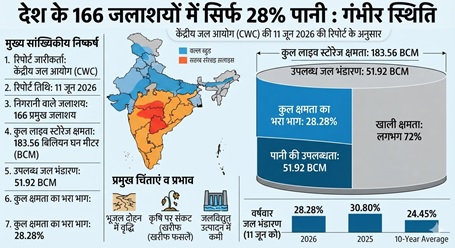
Only 28% Water Left in India’s 166 Reservoirs
 
  • Mobile Menu
HOME BUY MAGAZINEnew course icon
LOG IN SIGN UP

Sign-Up IcanDon't Have an Account?


SIGN UP


Login Icon

Have an Account?


LOG IN
 

or
By clicking on Register, you are agreeing to our Terms & Conditions.


or


Only 28% Water Left in India’s 166 Reservoirs

Sun 21 Jun, 2026

Context :

  • According to a report by the Central Water Commission (CWC), only 51.92 Billion Cubic Metres (BCM) of water is available in India’s 166 major reservoirs, which is just 28.28% of their total live storage capacity of 183.56 BCM.

Key Points :

  • The report highlights challenges related to water security, agriculture, energy and climate change ahead of the monsoon season.

Major Statistics of the Report :

  • Total Live Storage Capacity: The combined capacity of these 166 reservoirs is 183.56 BCM, accounting for about 71.2% of India’s estimated total reservoir capacity (257.81 BCM).
  • Current Storage: As of 11 June 2026, only 51.92 BCM (28.28%) of water was available.
  • Annual Comparison: The current storage is 8.17% lower than the storage recorded during the same period in 2025.
  • Long-term Average: However, the present storage level is 15.8% higher than the historical ten-year average (Normal Storage).

Regional Disparities: Geographical Analysis :

Northern & Western Regions Storage conditions are relatively better and near normal Punjab, Himachal Pradesh, Gujarat
Central Region Storage remains close to normal Madhya Pradesh, Uttar Pradesh
Southern Region Storage has fallen to a critically low level (around 20.98%) Karnataka, Tamil Nadu, Andhra Pradesh
Eastern & North-Eastern Regions Significant decline in storage levels has been recorded Jharkhand (Chandan Dam has virtually dried up), West Bengal

Nearly Empty Reservoirs :

  • Chandan Dam (Jharkhand)
  • Bhima-Ujjani Reservoir (Maharashtra)
  • Maudaha Reservoir (Uttar Pradesh)
  • Nanak Sagar Reservoir (Uttarakhand)

Major Reservoirs with Low Water Levels :

  • Bhadra (Karnataka) – 3.17%
  • Vaigai (Tamil Nadu) – 10.88%
  • Kabini (Karnataka) – 17.08%
  • Krishnaraja Sagar (Karnataka) – 33.47%
  • Tungabhadra (Karnataka) – 36.53%
  • Basins with Above-Normal Storage : Ganga, Indus, Narmada, Tapi, Mahi, Sabarmati, Godavari, Brahmaputra, Pennar, Mahanadi

Basins with Below-Normal Storage :

  • East-flowing rivers between the Mahanadi and Pennar basins
  • Barak and other river basins
  • Hydropower Projects :
  • Out of the reservoirs associated with 20 hydropower projects, 9 reservoirs have water levels at or below normal.
  • This may adversely affect hydroelectric power generation.

Major Reasons for the Decline in Water Levels :

  • Slow Progress of the Southwest Monsoon: In 2026, the monsoon reached the Kerala coast late and remained weak until mid-June, resulting in a significant rainfall deficit.
  • Impact of El Niño: Active El Niño conditions in the Pacific Ocean have negatively affected the Indian monsoon.
  • High Summer Evaporation: Record-breaking heatwaves during March–May increased evaporation losses from reservoirs.
  • Reservoir Siltation: Deforestation and mining activities in river basins have accelerated sediment deposition, reducing the effective storage capacity of major reservoirs such as the Bhakra Dam.

Latest Courses