Context:
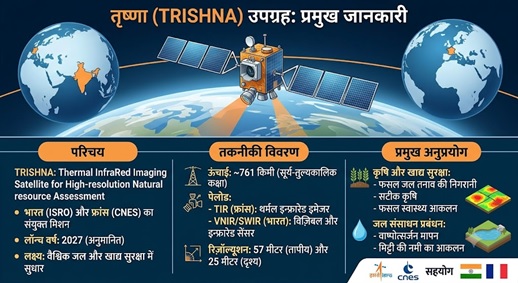
- India and France will jointly launch the TRISHNA satellite in 2027 to contribute to global water and food security.
Key Highlights:
- Full Form: Thermal InfraRed Imaging Satellite for High-resolution Natural Resource Assessment
- Collaborating Agencies:
- ISRO (Indian Space Research Organisation), India
- CNES (Centre National d'Études Spatiales), France
- Primary Objective:
To map Land Surface Temperature (LST), Evapotranspiration (ET), and the water cycle globally with high spatial and temporal resolution.
The mission will directly contribute to the United Nations Sustainable Development Goals (SDGs), particularly:
-
- SDG 2: Zero Hunger
- SDG 6: Clean Water and Sanitation
- SDG 13: Climate Action
Key Technical Features:
The satellite will be placed in a Sun-Synchronous Orbit (SSO) at an altitude of approximately 761 km above Earth.
- Local Time of Equator Crossing:
Scheduled at 12:30 PM local time, considered ideal for recording maximum thermal activity.
Two Major Payloads:
- Thermal Infrared (TIR) Payload
- Developed by CNES (France).
- Equipped with a four-channel long-wave infrared imaging sensor.
- Will provide high-resolution mapping of surface temperature and emissivity.
Visible and Near Infrared / Short Wave Infrared (VNIR/SWIR) Payload
- Developed by ISRO.
- Will provide data for:
- Vegetation indices
- Soil moisture
- Albedo estimation
- Atmospheric corrections
Role of TRISHNA in Global Water and Food Security
Precise Agriculture and Crop Health
- Measurement of Evapotranspiration
- TRISHNA will accurately measure the amount of water released by plants and soil into the atmosphere.
- This will help assess crop water stress in real time.
Irrigation Planning
- Farmers and policymakers will be able to optimize irrigation according to crop requirements.
- This will reduce water wastage and improve efficiency.
Crop Yield Forecasting
- Early detection of drought conditions and crop diseases will support food security and agricultural planning.
Efficient Water Resource Management
Surface Water Monitoring
- The satellite will monitor water levels and quality in:
- Lakes
- Rivers
- Wetlands
- Reservoirs
- Coastal regions
Groundwater Recharge Assessment
- Analysis of soil moisture and evapotranspiration data will help estimate groundwater availability and recharge conditions.
Indian Space Research Organisation (ISRO)
- India's national space agency.
- Established: 1969
- Origin: 1962 as the Indian National Committee for Space Research (INCOSPAR) under the leadership of Dr. Vikram Sarabhai.
- Headquarters: Bengaluru, Karnataka
Objectives
- Develop indigenous satellite and launch vehicle technologies.
- Utilize space technology for India's social and economic development.
- Support telecommunications, weather forecasting, telemedicine, and resource management.
Major Achievements
- Aryabhata (1975): India's first satellite.
Major missions:
- Chandrayaan-1 (2008)
- Mars Orbiter Mission/Mangalyaan (2013)
- Chandrayaan-2 (2019)
World Record (2017):
PSLV-C37 successfully launched 104 satellites in a single mission.
- Upcoming and recent missions:
- Aditya-L1
- Gaganyaan
- Mangalyaan-2
- Developed the:
- PSLV (Polar Satellite Launch Vehicle)
- GSLV (Geosynchronous Satellite Launch Vehicle)
Major Centres
- Vikram Sarabhai Space Centre (VSSC), Thiruvananthapuram
- Rocket design and development.
- U. R. Rao Satellite Centre (URSC), Bengaluru
- Satellite design and development.
- Satish Dhawan Space Centre (SDSC), Sriharikota
- Satellite and launch vehicle launches.
- Liquid Propulsion Systems Centre (LPSC), Valiamala & Bengaluru
- Development of cryogenic and liquid propulsion systems.
- National Remote Sensing Centre (NRSC), Hyderabad
- Remote sensing data processing and management.
- Space Applications Centre (SAC), Ahmedabad
- Communication and remote sensing applications.
Leadership
- The Chairman of ISRO also serves as the Secretary of the Department of Space.
- Dr. V. Narayanan has been serving as the Chairman of ISRO since January 2025, succeeding S. Somanath.
Commercial Arm
- Antrix Corporation Limited is ISRO’s commercial arm.
- It markets space products and services and facilitates technology transfer.
Launch Vehicles of ISRO
| Launch Vehicle |
Description |
| SLV (Satellite Launch Vehicle) |
ISRO’s first launch vehicle, developed in the 1980s; capable of launching small payloads (~40 kg). |
| ASLV (Augmented Satellite Launch Vehicle) |
Enhanced version of SLV; capable of launching satellites up to 150 kg. |
| PSLV (Polar Satellite Launch Vehicle) |
ISRO’s most reliable and widely used launch vehicle; used for Chandrayaan-1 and Mangalyaan missions. |
| GSLV (Geosynchronous Satellite Launch Vehicle) |
Designed for geostationary missions; capable of launching 2–4 tonne satellites using cryogenic technology. |
| GSLV Mk III / LVM3 |
ISRO’s heaviest launch vehicle; can place up to 8 tonnes in Low Earth Orbit and 4 tonnes in Geostationary Orbit; developed for human spaceflight missions. |
| SSLV (Small Satellite Launch Vehicle) |
Designed for small satellites (10–500 kg); low-cost, quick deployment, and flexible launch capability. |
Historic Missions
Chandrayaan-1 (2008)
- India’s first lunar mission.
- Successfully entered lunar orbit and conducted scientific observations.
- Included the Moon Impact Probe (MIP), which made a hard landing on the Moon.
Mars Orbiter Mission (Mangalyaan) – 2013
- India’s first Mars mission.
- Successfully entered Mars orbit on its first attempt.
- Made India the first Asian nation to achieve this feat.
Chandrayaan-2 (2019)
- The orbiter remains operational.
- The Vikram Lander crashed during the landing attempt.
- The orbiter continues scientific studies of the Moon.
Aditya-L1 (2023)
- India’s first dedicated solar mission.
- Positioned at the Sun-Earth L1 Lagrange Point.
Chandrayaan-3 (2023)
- India’s third lunar mission.
- Launched on 14 July 2023.
- Achieved successful soft landing near the Moon’s south pole on 23 August 2023.
- India became the first country to successfully land near the lunar south pole.
- The mission consisted of a Lander and Rover, without an orbiter.


 Don't Have an Account?