26 May, 2026
QS World University Rankings 2027
Fri 19 Jun, 2026
Context:
- Global higher education analytics firm Quacquarelli Symonds (QS) has released the QS World University Rankings 2027.
Key Highlights:
Issuing Organization:
- The rankings are published annually by Quacquarelli Symonds (QS), a global higher education analytics organization.
Evaluation Criteria (9 Indicators and Their Weightage):
- Academic Reputation – 30%
- Employer Reputation – 15%
- Faculty-Student Ratio – 10%
- Citations per Faculty (Research Impact) – 20%
- International Faculty Ratio – 5%
- International Student Ratio – 5%
- International Research Network – 5%
- Employment Outcomes – 5%
- Sustainability – 5%
Global Scenario:
Top Position:
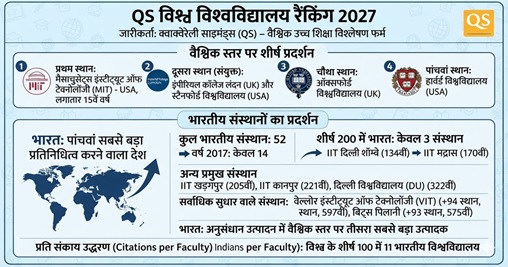
- The Massachusetts Institute of Technology (MIT), USA, has retained its position as the world's best university for the 15th consecutive year.
Top 5 Global Universities:
- Massachusetts Institute of Technology (MIT) – United States
- Imperial College London – United Kingdom (Joint 2nd)
- Stanford University – United States (Joint 2nd)
- University of Oxford – United Kingdom
- Harvard University – United States
Performance of Indian Institutions:
- India has recorded its strongest-ever representation in the rankings, with 52 universities featured in the 2027 edition.
Top Indian Institutions in QS World University Rankings 2027
| National | Rank Global Rank 2027 | Global Rank 2026 | Institution | Type |
| 1 | 118 | 123 | IIT Delhi | Public |
| 2 | 134 | 129 | IIT Bombay | Public |
| 3 | 170 | 180 | IIT Madras | Public |
| 4 | 205 | 215 | IIT Kharagpur | Public |
| 5 | 221 | 219 | IISc Bengaluru | Public |
| 6 | 222 | 222 | IIT Kanpur | Public |
| 7 | 323 | 328 | University of Delhi (DU) | Public |
| 8 | 335 | 339 | IIT Roorkee | Public |
| 9 | 350 | 334 | IIT Guwahati | Public |
| 10 | 454 | 503 | Shoolini University | Private |
Major Achievements for India:
Historic Performance by IIT Delhi:
- IIT Delhi climbed five places to reach 118th position, equalling the best-ever ranking achieved by an Indian institution. Previously, IIT Bombay attained Rank 118 in 2025.
Representation in Top 200:
- Only three Indian institutions—IIT Delhi, IIT Bombay, and IIT Madras—feature among the world's top 200 universities.
Rise of Private Universities:
- Shoolini University (454th) remains India's highest-ranked private university. Chandigarh University (526th), BITS Pilani (575th), and VIT Vellore (599th) have also made significant gains.
Research Impact:
- Indian institutions perform strongly in research impact. IISc Bengaluru ranks 21st globally on this indicator.
Positive Factors Supporting India:
Research Quality:
- Indian institutions demonstrate strong citation performance. IISc Bengaluru, Anna University, and IIT Roorkee produce globally recognized research.
Industry Recognition:
- Graduates from Indian Institutes of Technology (IITs) are highly sought after worldwide. IIT Bombay ranks 32nd and IIT Delhi 39th globally in Employer Reputation.
Impact of Government Policies:
- Initiatives such as the Institutions of Eminence (IoE) scheme and the autonomy provided under NEP 2020 have contributed to improved institutional performance.
Focus on Sustainability:
- Institutions such as IIT Delhi have integrated sustainability into their curriculum and infrastructure, resulting in better scores.
Challenges Facing India:
Lack of Internationalization:
- Indian universities have relatively low proportions of international students and faculty. Visa-related issues, comparatively lower salary structures, and infrastructure constraints contribute to this challenge.
Faculty-Student Ratio:
- A shortage of faculty members relative to student enrollment continues to affect academic quality. Unfilled vacancies and dependence on contractual appointments remain concerns.
Insufficient Funding:
- India spends only 0.6%–0.7% of GDP on Research and Development (R&D), compared with over 3% in the United States and approximately 2.4% in China.
Subject Imbalance:
- Indian success in rankings is largely concentrated in technical and scientific institutions. Universities focused on social sciences, humanities, and arts continue to lag behind globally.
Slow Pace of Global Advancement:
- According to QS Vice President Ben Sowter, Indian institutions are improving, but the pace of improvement remains slower than that of many global competitors.
Important Government Initiatives:
NEP 2020 (National Education Policy 2020):
- Aims to achieve 100% Gross Enrolment Ratio (GER) in school education by 2030 and replaced the National Education Policy of 1986.
ANRF Act:
- Anusandhan National Research Foundation (ANRF) aims to strengthen research and development (R&D) through funding support. The Prime Minister serves as the Chairperson of its Governing Board.
IoE Scheme:
- Institutions of Eminence (IoE) provides selected institutions with financial and administrative autonomy to help them achieve global top-100 status.
NIRF:
- National Institutional Ranking Framework (NIRF) is India's domestic ranking system for higher educational institutions, released by the Ministry of Education.
SPARC:
- Scheme for Promotion of Academic and Research Collaboration (SPARC) promotes joint research and academic collaboration with leading foreign institutions.
Study in India:
- A joint initiative of the Ministry of Education and the Ministry of External Affairs aimed at attracting international students to pursue higher education in India.