26 May, 2026
Tripura's Indigenous Musical Instrument "Tripura Sarinda" Receives GI Tag
Wed 17 Jun, 2026
Context:
- The traditional stringed musical instrument "Sarinda", played by the indigenous communities of Tripura, has been granted a Geographical Indication (GI) Tag.
Key Highlights:
- Type of Instrument: Sarinda is a stringed musical instrument played with a bow. In the Indian classification of musical instruments, it belongs to the category of "Tat Vadya" (string instruments).
- Structure and Craftsmanship: It is carved from a single piece of wood and features a hollow resonating chamber at the bottom.
- Cultural Significance: Sarinda is an integral part of the folk music traditions, weddings, socio-religious ceremonies, and devotional Kirtans of Tripura's indigenous communities.
- Comparison: It resembles the Indian classical instrument Sarangi in structure and melodious sound but possesses its own unique regional design and tonal quality.
- Associated Communities: It is deeply associated with the Tripuri and other indigenous tribal communities of Tripura.
- Usage: The instrument is widely used as an accompanying instrument in traditional folk dances, tribal folk songs, religious Kirtans, and festivals.
Other GI-Tagged Products of Tripura:
- Tripura Queen Pineapple: Famous for its distinctive taste and aroma.
- Risa: A traditional handwoven cloth of Tripura's tribal communities.
- Pachra/Rignai: Traditional attire worn by tribal women.
- Matabari Peda: A milk-based sacred offering associated with the Tripura Sundari Temple in Udaipur.
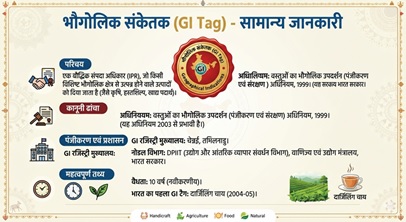
Geographical Indication (GI Tag):
- Act: Geographical Indications of Goods (Registration and Protection) Act, 1999.
- Implemented: 15 September 2003.
- First GI Product in India: Darjeeling Tea (2004).
- Validity: A GI Tag remains valid for 10 years and can be renewed thereafter.
- Headquarters: The GI Registry Office of India is located in Chennai, Tamil Nadu.
Tripura: General Information
Geography:
- Borders: Tripura is surrounded by Bangladesh on three sides (North, West, and South). Assam and Mizoram lie to its East.
- Zero Line: The Tripura-Bangladesh border is often referred to as the "Zero Line."
- Area: Third smallest state in India after Goa and Sikkim.
- Statehood: 21 January 1972 (under the North-Eastern Areas Reorganisation Act, 1971).
- Capital: Agartala.
- Parliamentary Representation: 2 Lok Sabha seats and 1 Rajya Sabha seat.
- Legislative Assembly: 60-member unicameral legislature.
State Symbols:
- State Animal: Phayre's Leaf Monkey.
- State Bird: Green Imperial Pigeon (Dark-rumped form).
- State Tree: Agarwood (Agar).
- State Flower: Nageswar.
- State Fruit: Queen Pineapple (also GI-tagged).
Major Folk Dances:
- Hojagiri: Performed by the Reang community while balancing on earthen pots.
- Garia Dance: Performed by the Tripuri community during the sowing festival.
- Biju Dance: Traditional New Year dance of the Chakma community.
- Lebang Boomani: Dance performed with bamboo instruments.
Major Festivals:
- Kharchi Puja: The most famous festival of Tripura, dedicated to the worship of 14 deities.
- Ker Puja: A highly sacred tribal ritual observed about two weeks after Kharchi Puja.
Important Tourist and Historical Sites:
- Ujjayanta Palace: Royal palace in Agartala built by Maharaja Radha Kishore Manikya.
- Neermahal: Water palace situated in the middle of Rudrasagar Lake, built by Maharaja Bir Bikram Kishore Manikya.
- Unakoti: Massive rock-cut sculptures dedicated to Lord Shiva; often called the "Khajuraho of Northeast India."
- Tripura Sundari Temple: One of the 51 Shakti Peethas, located in Udaipur, Tripura.
Demographics (Census 2011):
- Literacy Rate: 87.22%.
- Sex Ratio: 960 females per 1,000 males.
- Official Languages: Bengali and Kokborok (the native language of Tripura's indigenous communities).
Historical Facts:
- Manikya Dynasty: Ruled Tripura before Independence; established in the 14th century.
- Merger with India: Tripura became part of India on 15 October 1949 following the Merger Agreement.