Community Seed Banks: India’s First Standard
 
  • Mobile Menu
HOME BUY MAGAZINEnew course icon
LOG IN SIGN UP

Sign-Up IcanDon't Have an Account?


SIGN UP


Login Icon

Have an Account?


LOG IN
 

or
By clicking on Register, you are agreeing to our Terms & Conditions.


or


Community Seed Banks: India’s First Standard

Tue 16 Jun, 2026

Context:

  • The Bureau of Indian Standards (BIS) has released IS 20201:2026, India's first standard for Community Seed Banks (CSBs).

Key Highlights:

  • Objective: To conserve indigenous seed varieties, protect agricultural biodiversity, and strengthen climate-resilient agriculture.
  • Nodal Agency: Developed by the Biodiversity Sectional Committee (EED 06) of the Environment and Ecology Department under the Bureau of Indian Standards (BIS), functioning under the Ministry of Consumer Affairs.
  • Technical Collaboration: Drafted under the leadership of the ICAR–National Bureau of Plant Genetic Resources (NBPGR) in collaboration with the National Biodiversity Authority (NBA) and the Protection of Plant Varieties and Farmers’ Rights (PPV&FR) Authority.

Key Features of the Standard:

  • Voluntary and Free: A voluntary certifiable management system standard, available free of cost to stakeholders through the official BIS portal.
  • Lifecycle Management: Provides uniform guidelines for seed collection, acquisition, processing, storage systems, germination/viability testing, and regeneration.
  • Traceability and Documentation: Emphasizes proper documentation, risk management, and transparency in seed exchange mechanisms.
  • Global Goal Alignment: Supports food security under Sustainable Development Goal 2 (SDG 2: Zero Hunger) of the United Nations.

Significance:

  • Preserves drought-resistant and locally adapted crop varieties.
  • Enhances resilience against climate change.
  • Promotes sustainable agriculture practices.

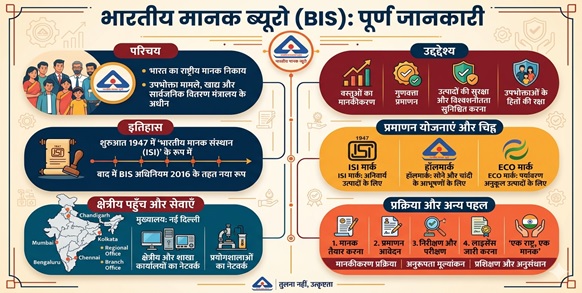
Bureau of Indian Standards (BIS)

  • India's National Standards Body.
  • Functions under the Ministry of Consumer Affairs, Food and Public Distribution, Government of India.
  • Primary Objective: To ensure standardization, quality certification, and product safety across the country.
  • Headquarters: New Delhi.
  • Origin: Established in 1947 as the Indian Standards Institution (ISI). It was reconstituted as the Bureau of Indian Standards (BIS) under the BIS Act, 2016, which came into effect on 12 October 2017.

Community Seed Bank (CSB)

  • A local group or organization of farmers that collects, conserves, and exchanges indigenous, traditional, and rare seeds at the community level.
  • Primary Objective: To provide farmers with quality seeds for sowing at little or no cost.

Objectives and Importance:

  • Biodiversity Conservation: Protects local and traditional crop varieties that are disappearing due to the increasing use of hybrid seeds.
  • Climate Resilience: Indigenous seeds are often more resistant to local climatic stresses such as drought, floods, and pests.
  • Cost Reduction: Reduces farmers’ dependence on expensive market-purchased and chemically treated seeds.
  • Food Security and Seed Sovereignty: Ensures local seed availability during crises such as crop failures or natural disasters.

Structure and Maintenance:

  • Storage: Seeds are stored in traditional earthen pots, bamboo baskets, or modern airtight containers to protect them from moisture and pests.
  • Natural Treatment: Neem leaves, ash, turmeric, and other natural materials are used to preserve seeds.
  • Documentation: Records are maintained for each seed variety, including maturity period, water requirements, and medicinal properties.
  • Successful Examples in India: Community Seed Banks are operating successfully in the Mahanadi River Basin (Odisha), Deccan Development Society (Telangana), and the hilly regions of Uttarakhand.
  •  

Latest Courses