Tripartite Agreement for Exploration and Production of Crude Oil and Natural Gas
 
  • Mobile Menu
HOME BUY MAGAZINEnew course icon
LOG IN SIGN UP

Sign-Up IcanDon't Have an Account?


SIGN UP


Login Icon

Have an Account?


LOG IN
 

or
By clicking on Register, you are agreeing to our Terms & Conditions.


or


Tripartite Agreement for Exploration and Production of Crude Oil and Natural Gas

Sun 14 Jun, 2026

Context:

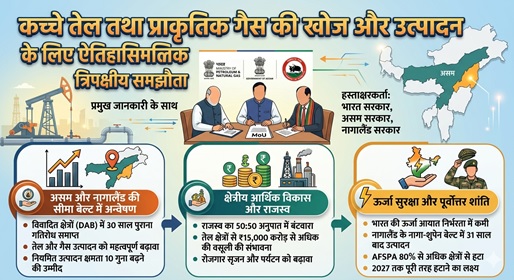
  • The Central Government signed a Tripartite Memorandum of Understanding (MoU) with the Governments of Assam and Nagaland for the exploration and production of crude oil and natural gas.

Key Points:

  • Signatories: Government of India (Ministry of Petroleum and Natural Gas), Government of Assam, and Government of Nagaland.
  • Key Dignitaries Present: Union Home Minister Amit Shah, Union Petroleum Minister Hardeep Singh Puri, Assam Chief Minister Himanta Biswa Sarma, and Nagaland Chief Minister Neiphiu Rio.
  • Area Covered: The agreement covers more than 1,000 sq. km along the Assam–Nagaland border and includes six identified disputed oil fields.
  • Revenue Sharing: Revenue generated from oil and gas will be shared between the two states in a 50:50 ratio.
  • Production Potential: At present, the region produces 1,000–1,500 barrels of crude oil per day, with the potential to increase by more than ten times. A single field alone is expected to yield a recovery of over ₹15,000 crore.

Background:

  • Three-Decade Deadlock: Due to jurisdictional and administrative disputes along the 434-km Assam–Nagaland border, oil exploration in the Disputed Area Belt (DAB) had remained completely stalled since the mid-1990s.
  • Special Status of Nagaland (Article 371A): Article 371A of the Indian Constitution grants Nagaland special rights over its land and natural resources. The Nagaland Government maintained that the Centre or external companies should not exercise direct control over its resources, resulting in legal and administrative deadlock.

Crude Oil Reserves and Distribution in India:

  • Largest Reserve Region: India's largest crude oil reserves are located in the Western Offshore region (such as Mumbai High), accounting for about 31% of total reserves.
  • Leading State: Among the states, Assam has the highest crude oil reserves (about 21.5%–22%), followed by Rajasthan and Gujarat.

Major Oil Fields of Assam:

  • Digboi: The first and oldest operating oil field and refinery in both India and Asia. The refinery was established in 1901. Digboi is also known as the "Oil City of Assam."
  • Other Oil Fields: Naharkatiya, Rudrasagar, Lakwa, Moran-Hugrijan, and Lakhamani.
  • Nagaland's Potential: The Naga-Shupen Belt, a part of the Assam-Arakan Basin, is highly rich in hydrocarbons. Oil production is set to resume here after 31 years.

India's Global Position:

  • India is the third-largest consumer of crude oil in the world.
  • India is the third-largest importer of crude oil globally.
  • India is the fourth-largest oil refining country in the world.

Important Exam Facts:

  • Digboi (1889): First oil well in India and Asia.
  • Digboi Refinery (1901): Oldest continuously operating refinery in Asia.
  • Assam: One of India's major producers of crude oil and natural gas.
  • Naga-Shupen Belt: Major hydrocarbon (oil and gas) region of Nagaland.
  • Four Major Refineries of Assam: Digboi, Noonmati (Guwahati), Bongaigaon, and Numaligarh.

Latest Courses