'13th BRICS Urbanisation Forum'
 
  • Mobile Menu
HOME BUY MAGAZINEnew course icon
LOG IN SIGN UP

Sign-Up IcanDon't Have an Account?


SIGN UP


Login Icon

Have an Account?


LOG IN
 

or
By clicking on Register, you are agreeing to our Terms & Conditions.


or


'13th BRICS Urbanisation Forum'

Sat 13 Jun, 2026

Context:

  • Under India's BRICS Chairship, the '13th BRICS Urbanisation Forum' was organized in New Delhi.

Key Points:

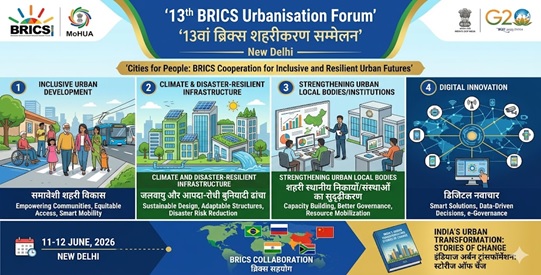
  • Event Date: June 11-12, 2026
  • Host City: New Delhi, India
  • Organizing Ministry: Union Ministry of Housing and Urban Affairs (MoHUA)
  • Inaugurated by: Manohar Lal (Union Minister of Housing and Urban Affairs)
  • Main Theme: "Cities for People: BRICS Cooperation for Inclusive and Resilient Urban Futures"
  • Adopted Declaration: 'Urban Ministerial Declaration' was adopted unanimously
  • India's Hosting: This is the fourth time India has hosted this platform (previously hosted in 2013-New Delhi, 2016-Visakhapatnam, and 2021-through Virtual mode)
  • Participant Countries (Expanded BRICS): Along with traditional members (Brazil, Russia, India, China, South Africa), delegations from newly expanded members such as Egypt, Ethiopia, Indonesia, Iran, and United Arab Emirates (UAE) participated.
  • Major Launch: On this occasion, a book titled "India's Urban Transformation: Stories of Change" was released.
  • 4 Main Pillars of the Forum: Inclusive Urban Development, Climate and Disaster-Resilient Infrastructure, Strengthening of Urban Local Bodies/Institutions, and Digital Innovation.

Constitutional Framework of Urban Governance in India:

  • The constitutional framework of urban governance in India is primarily based on the 74th Constitutional Amendment Act, 1992, which granted constitutional status to Urban Local Bodies (ULBs) and established a three-tier governance structure (Centre-State-Local) in India.

Constitutional Position:

  • New Part: Through this Act, Part IX-A (Articles 243P to 243ZG) was added to the Constitution.
  • New Schedule: The Twelfth Schedule was included in the Constitution, which specifies 18 functional items for urban bodies.
  • Three-Tier Structure of Urban Local Bodies (Article 243Q):
    • The Act makes it mandatory to constitute three types of urban local bodies in every state:
    • Nagar Panchayat: For transitional areas that are transforming from rural to urban areas.
    • Municipal Council (Nagar Parishad): For smaller urban areas or towns.
    • Municipal Corporation (Nagar Nigam): For large metropolitan or urban areas.

Structure and Key Constitutional Provisions:

  • Direct Election (Article 243R): All seats in municipal areas are filled by direct election from territorial constituencies (wards).
  • Ward Committees (Article 243S): Provision for the constitution of Ward Committees consisting of one or more wards in Municipalities having a population of 3 lakhs or more.
  • Reservation of Seats (Article 243T): Seats are reserved for Scheduled Castes (SC) and Scheduled Tribes (ST) in proportion to their population. It is mandatory to reserve at least one-third (1/3) of the total seats for women.
  • Fixed Tenure (Article 243U): The tenure of urban bodies is fixed for 5 years. If a body is dissolved prematurely, new elections must be held within 6 months.

Mandatory Institutional Mechanism:

  • State Election Commission (Article 243ZA): Vested with the complete responsibility of preparing electoral rolls and conducting free and fair municipal elections.
  • State Finance Commission (Article 243Y): Constituted every 5 years to make recommendations regarding the distribution of taxes, duties, and financial resources between the State and Urban Local Bodies.
  • Planning Committees (Article 243ZD & 243ZE): It is mandatory to constitute a District Planning Committee (DPC) to consolidate rural and urban plans at the district level, and a Metropolitan Planning Committee (MPC) in large cities.

Major Urban Missions of India:

Smart Cities Mission (SCM):

  • Launch: June 25, 2015
  • Objective: Development of core infrastructure, clean environment, and providing a better quality of life to citizens through digital/smart solutions (such as Integrated Command and Control Centres - ICCC) in 100 selected cities of the country.
  • Approach: It primarily works on 'Area-Based Development' and 'Pan-City Solutions' for the entire city.

Atal Mission for Rejuvenation and Urban Transformation (AMRUT & AMRUT 2.0):

  • Launch: AMRUT was launched in June 2015, followed by the more comprehensive implementation of AMRUT 2.0.
  • Objective: To ensure safe tap water supply and sewerage/septage management to all urban households.
  • Feature: AMRUT 2.0 aims to promote a 'Circular Economy' (recycling and reuse of wastewater) and the rejuvenation of water bodies. Along with 500 major cities, it now covers all Statutory Towns.

Pradhan Mantri Awas Yojana - Urban (PMAY-U & PMAY-U 2.0):

  • Launch: Its first phase started on June 25, 2015, and currently, PMAY-U 2.0 is under execution.
  • Objective: Under 'Housing for All', to ensure pucca houses equipped with basic amenities for the urban poor, slum dwellers, EWS, and LIG categories.
  • Four Key Pillars (Verticals): In-Situ Slum Redevelopment (ISSR), Credit Linked Subsidy Scheme (CLSS), Affordable Housing in Partnership (AHP), and Beneficiary-Led individual house Construction (BLC).
  • Women Empowerment: Under this mission, most of the houses are being registered in the name of the female member of the family.

Swachh Bharat Mission - Urban (SBM-U 2.0):

  • Objective: To make cities completely garbage-free and ensure 100% scientific solid waste management.
  • Key Focus: Sustaining Open Defecation Free status (ODF, ODF+, and ODF++ sustainability), grey and black water management, and ensuring 'Safaimitras Safety'.

PM SVANidhi:

  • Launch: June 2020 (To provide support to street vendors after the pandemic).
  • Objective: To provide affordable and collateral-free working capital loans to urban street vendors to restart their livelihoods.
  • Feature: An interest subsidy of 7% is provided on timely repayment, and there is a cashback provision to encourage digital transactions.

Deendayal Antyodaya Yojana - National Urban Livelihoods Mission (DAY-NULM):

  • Objective: To reduce poverty and vulnerability of urban poor households by providing them access to self-employment and skilled wage employment opportunities.
  • Key Components: Shelters for Urban Homeless (SUH), Employment through Skills Training and Placement (EST&P), and formation of Self-Help Groups (SHGs).

BRICS:

  • It is a group of the world's leading emerging economies.
  • Full Name: BRICS stands for Brazil, Russia, India, China, and South Africa.
  • Concept: The term 'BRIC' was first coined in 2001 by British economist Jim O'Neill.
  • First Formal Meeting: The first meeting of Foreign Ministers took place in September 2006 in New York.
  • First Summit: Held on June 16, 2009, in Yekaterinburg, Russia.
  • Inclusion of South Africa: South Africa joined the group in 2010, after which the name changed from BRIC to BRICS.
  • New Members (Effective January 1, 2024): Egypt, Ethiopia, Iran, and United Arab Emirates (UAE).
  • In the year 2025, Indonesia joined as a full member.
  • New Development Bank (NDB): It is also known as the 'BRICS Bank'. It was established in July 2014 (during the Fortaleza Summit).
  • NDB Headquarters: Shanghai, China.
  • Contingent Reserve Arrangement (CRA): A framework created to tackle global liquidity crises.
  • BRICS accounts for 45% of the world's population and 37.3% of the global GDP, which is higher than the European Union's 14.5% and the G7's 29.3%.
  • With Iran and the UAE joining BRICS, the group now accounts for approximately 44% of global crude oil production.

Summit and Chairship:

  • 16th Summit (2024): Kazan, Russia
  • 17th Summit (2025): Brazil
  • 18th Summit (2026): India, starting from January 1, 2026.

Latest Courses