Context:
- The first meeting of the National Level Policy Implementation and Monitoring Committee, constituted under the National Cooperation Policy-2025, was organized in New Delhi.
Key Points:
- Meeting Chaired by: Dr. Ashish Kumar Bhutani, Secretary of the Ministry of Cooperation and Chairman of the Committee.
- Whole-of-Government Approach: For the successful implementation of the policy, a coordinated action plan was discussed with various ministries such as Center, States/UTs, Panchayati Raj, Rural Development, Agriculture, and Farmers Welfare.
- Digital Transformation: To bring transparency and speed to the cooperative sector, special emphasis was laid on strengthening the National Cooperative Database, Cooperative Ranking Framework, and data-driven monitoring mechanisms.
- Capacity Building and Education: Reviewed the institutionalization of cooperative education, research, and training through the "Tribhuvan" Cooperative University.
- Innovation and Inclusiveness: Emphasis was placed on promoting startup culture in the cooperative sector, connecting youth, and ensuring the participation of women and small farmers.
National Cooperation Policy 2025:
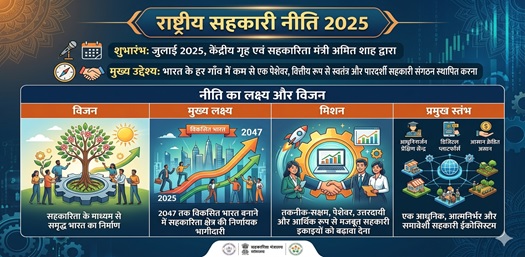
- Launch: July 2025, by Union Home and Cooperation Minister Amit Shah.
- Main Objective: To establish at least one professional, financially independent, and transparent cooperative organization in every village of India.
Policy Vision and Goal:
| Aspect |
Description |
| Vision |
"Prosperity through Cooperation" (Sahkar se Samriddhi) |
| Main Goal |
Decisive participation of the cooperative sector in making India a developed nation by 2047 |
| Mission |
To promote technology-enabled, professional, responsive, and economically strong cooperative units |
Key Targets:
| Objective |
Target |
| Contribution to GDP |
Three-fold increase by 2034 |
| Cooperative Members |
50 crore active members |
| New Societies |
30% increase, at least 1 cooperative unit in every village |
| Employment |
Career opportunities for youth in the cooperative framework |
| Model Villages |
5 model cooperative villages in every Tehsil |
Focus Areas:
- Village and agriculture-based cooperatives
- Participation of women, tribals, and Dalits
- New sectors like Taxi, Tourism, Insurance, and Green Energy
- Multi-functional model of PACS (e.g., Fuel, Pharmacy, LPG distribution)
- Global Marketing and Export Cooperatives
Features of the Policy:
| Area |
Description |
| Empowerment of the Foundation |
Enhancing the internal capacity and autonomy of institutions |
| Digital Transformation |
Computerization of PACS, transparent MIS system |
| Human Resource Development |
Establishment of "Tribhuvan Cooperative University" |
| Monitoring System |
Cluster-based monitoring and performance audit |
| Member-Centric Model |
The core of the policy is – Member's welfare and self-esteem |
Institutional Framework and Reforms:
- 83 Intervention Points: Out of which work has been completed on 58.
- Reforms in Laws: Provision to update every 10 years.
- Model Byelaws: Adopted by all states.
Financial and Global Outlook:
- Scheduled Cooperative Banks given status equivalent to commercial banks.
- Establishment of Export Cooperatives $\rightarrow$ Access of Indian cooperative products to the global market.
- Making PACS active in fuel, pharmacy, solar energy, seed distribution, etc.
Future Plans:
- ‘Sahkar Taxi’ scheme (Direct benefit to the driver)
- White Revolution 2.0 $\rightarrow$ Increasing women's participation in the dairy sector
- At least 1 PACS in every Panchayat
- Completion of the computerization process for all societies
Social and Inclusive Development:
| Target Group |
Contribution / Role |
| Women |
White Revolution, employment, PACS operations |
| Youth |
Career in cooperation, startup model |
| Rural |
Economic empowerment and local employment |
| Dalit/Tribal |
Ensuring participation on a priority basis |
Cooperative Society:
- It is a voluntary association where people come together collectively to meet their economic, social, and cultural needs, and operate the institution in a democratic manner.
Cooperative Movement in India:
- The Cooperative Movement in India is a socio-economic movement aimed at protecting the economic interests of weaker sections such as farmers, laborers, artisans, milk producers, etc., by bringing them together.
- This movement is based on the principle of "Sahkar se Samriddhi" (Prosperity through Cooperation).
| Year / Period |
Important Event / Phase |
Description |
| 1904 |
Cooperative Credit Societies Act |
First cooperative law in India, legal recognition to cooperative societies |
| 1912 |
Cooperative Societies Act |
Marketing, handloom, and artisan societies were included |
| 1914 |
Maclagan Committee Report |
Proposed a three-tier cooperative banking system |
| 1919 |
Government of India Act (Montagu-Chelmsford Reforms) |
Made cooperation a provincial subject and gave states the power to make laws |
| 1925 |
Bombay Cooperative Societies Act |
First provincial cooperative law |
| 1945 |
Cooperative Planning Committee Formed |
Reviewed the role and management of cooperation for economic planning |
| 1963 |
National Cooperative Development Corporation (NCDC) |
Financial assistance for the development of cooperative societies |
| 1981 |
Establishment of NABARD |
Support for rural development and cooperative credit system |
| 2002 |
National Policy on Cooperatives |
Policy framework for the cooperative sector |
Types of Cooperative Societies:
In addition, cooperative societies exist at multiple levels:
- Primary Cooperative Societies: Work at the local level
- Central Cooperative Societies: At the district or regional level
- State Cooperative Societies: At the state level
- Multi-State Cooperative Societies: Societies operating across multiple states
Key Organizations:
| Organization |
Main Function |
| NAFED |
Agricultural marketing and export |
| IFFCO |
Fertilizer production |
| KRIBHCO |
Fertilizer production |
| AMUL (GCMMF) |
Dairy products |
| NCUI |
Training and promotion |
| NCDC |
Providing financial assistance |
Cooperation in the Constitution:
- Cooperation is recognized as an important and structurally sound institution in the Constitution.
- Cooperatives were granted constitutional status through the 97th Constitutional Amendment Act, 2011.
- Before this, cooperative societies were merely legal entities, but now they enjoy constitutional protection.
97th Constitutional Amendment Act, 2011:
This amendment became effective from October 12, 2011. Three main changes were made through this Act:
| Amended Part |
Description |
| Part III (Fundamental Rights) |
"Right to form cooperative societies" was added to Article 19(1)(c). Now it is a Fundamental Right. |
| Part IV (Directive Principles of State Policy) |
Article 43-B was added - "The State shall endeavor to promote voluntary formation, democratic control, and professional management of cooperative societies." |
| Part IX-B (Newly Added) |
Clear provisions regarding the management, elections, tenure, audit, etc., of cooperative societies were added from Article 243-ZH to 243-ZT. |
Key Features of Part IX-B (Article 243ZH to 243ZT):
- Democratic Election: Mandatory to conduct timely, free, and fair elections every 5 years.
- Number of Members: Maximum number of board members fixed at 21.
- Reservation: Reservation on the board for Scheduled Castes/Scheduled Tribes and women.
- Tenure: The tenure of the elected board of cooperative societies shall be a maximum of 5 years.
- Supersession: Clear conditions for the suspension of the board — generally not exceeding 6 months.
- Audit: Mandatory annual audit by registered auditors.
- Robust Structure: The autonomy, transparency, and accountability of the societies received strength from the Constitution.
Cooperation - A State Subject:
- Cooperation is included in the 'State List' of the Seventh Schedule of the Constitution. Therefore, making laws related to cooperative societies is the right of the State Legislatures.
- Meanwhile, Multi-State Cooperative Societies come under the Center, on which the Parliament can make laws.
Tribhuvan Sahkari University (TSU):
- It is India's first National Cooperative University.
- It has been declared an 'Institution of National Importance'.
- Foundation Stone: July 2025, by Union Cooperation and Home Minister Amit Shah.
- Location: Anand, Gujarat.
- Passed in Lok Sabha: March 26, 2025; Passed in Rajya Sabha: April 1, 2025.
- Naming: This university is named after Tribhuvandas Kishibhai Patel, the pioneer of the cooperative movement in India and the founder of 'AMUL'.
- Nodal Ministry: This university functions under the Ministry of Cooperation.


 Don't Have an Account?