Bonn Climate Conference 2026 (SB64)
 
  • Mobile Menu
HOME BUY MAGAZINEnew course icon
LOG IN SIGN UP

Sign-Up IcanDon't Have an Account?


SIGN UP


Login Icon

Have an Account?


LOG IN
 

or
By clicking on Register, you are agreeing to our Terms & Conditions.


or


Bonn Climate Conference 2026 (SB64)

Thu 11 Jun, 2026

Context:

  • The Bonn Climate Conference 2026 (SB64), the annual mid-year technical negotiations held under the United Nations Framework Convention on Climate Change (UNFCCC), is being organized in Bonn, Germany.

Key Points:

  • Official Name: 64th Sessions of the Subsidiary Bodies (SB64) of the United Nations Framework Convention on Climate Change (UNFCCC).
  • Venue: World Conference Center, Bonn, Germany.
  • Significance: It is the first major multilateral climate conference after COP30, held in Belém, Brazil, in November last year. It is considered a "preparatory bridge" for the upcoming COP31, to be jointly hosted by Australia and Türkiye.

Major Agenda and Discussion Topics:

  • Increase in Adaptation Finance: Various health and climate organizations have demanded that public adaptation finance for affected developing countries be increased to at least $120 billion annually by 2035.
  • Transition Away from Fossil Fuels: Building upon the decisions of COP28 and COP30, emphasis has been placed on shifting global energy systems toward clean and renewable energy.
  • Baku-to-Belém Roadmap: Discussions focused on the practical implementation of the roadmap to increase climate finance for developing countries to at least $1.3 trillion per year.
  • Belém Adaptation Indicators: Technical discussions have begun to implement the 59 adaptation indicators adopted at COP30.

India's Position:

  • Concern over Climate Finance Gap: India's Second Secretary at the Embassy, Harkirat Singh Randhawa, expressed serious concern over declining climate finance and the widening adaptation finance gap at the international forum.
  • Principle of Equity: India emphasized that developed countries should recognize their historical responsibility and rapidly reduce emissions so that developing countries have sufficient "carbon space" for poverty eradication and sustainable development.
  • Opposition to Trade Barriers: India strongly opposed unilateral trade measures such as the European Union's Carbon Border Adjustment Mechanism (CBAM).

Crisis of Failing Global Green Targets:

  • During the conference, global experts warned that rising geopolitical tensions, increased energy prices due to the Iran conflict, and a severe shortage of climate finance have heightened the risk of failing to achieve global green targets.
  • Demand for Financing: Health organizations urged developed countries to triple public adaptation finance to $120 billion annually by 2035. The fund is primarily intended to protect developing countries facing water crises and health emergencies.
  • Moving Away from Fossil Fuels: Negotiators are demanding a clear, phased, and domestic roadmap from developed countries to phase out coal, oil, and gas. Under the Paris Agreement, keeping global temperature rise within 1.5°C is considered essential.
  • Trust Deficit and COP31 Hosting: COP31, to be held at the end of 2026, will be jointly hosted by Australia and Türkiye. The current Bonn negotiations are largely focused on gaining the confidence of Pacific Island nations, which are among the most vulnerable to rising sea levels.
  • Global Progress Indicators: Teams at the conference are working on implementing the 59 Belém Adaptation Indicators and the Just Transition Mechanism. The Just Transition Mechanism ensures that as green energy is adopted, local communities working in traditional energy sectors (such as coal mining) receive fair employment opportunities and reskilling support.

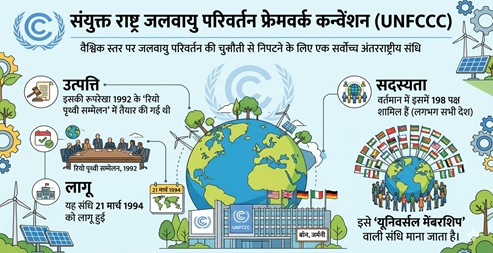
United Nations Framework Convention on Climate Change (UNFCCC):

  • It is the premier international treaty to address the global challenge of climate change.
  • Origin: The framework was developed at the 1992 Rio Earth Summit.
  • Entry into Force: The convention came into force on 21 March 1994.
  • Secretariat: Headquartered in Bonn, Germany.
  • Membership: It currently has 198 Parties (nearly all countries) and is regarded as a treaty with universal membership.

Conference of the Parties (COP):

  • It is the highest decision-making body of the UNFCCC.
  • Meaning: "Parties" refers to the countries that have signed and ratified the 1992 UNFCCC Convention.
  • Meetings: COP is held annually, unless the Parties decide otherwise.
  • Presidency: The COP Presidency generally rotates among the five UN regional groups (Africa, Asia-Pacific, Eastern Europe, Latin America and the Caribbean, and Western Europe and Others). The host country's Environment Minister usually serves as the COP President.

Major COP Meetings:

  • COP1 (1995 – Berlin, Germany): First official meeting of the UNFCCC, where the framework for future binding targets was established.
  • COP3 (1997 – Kyoto, Japan): The historic Kyoto Protocol was adopted, imposing legally binding emission reduction targets on developed countries.
  • COP15 (2009 – Copenhagen, Denmark): Failed to reach a binding agreement, but developed countries made a political commitment to mobilize $100 billion annually by 2020.
  • COP21 (2015 – Paris, France): The historic Paris Agreement was adopted, aiming to limit global temperature rise to 1.5°C and introducing the system of Nationally Determined Contributions (NDCs).
  • COP26 (2021 – Glasgow, UK): Emphasized the phased reduction of coal use, while India announced its Panchamrit commitments and the LiFE movement.
  • COP28 (2023 – Dubai, UAE): The first Global Stocktake was completed, and a historic consensus was reached on transitioning away from fossil fuels.
  • COP29 (2024 – Baku, Azerbaijan): A new collective quantified goal (NCQG) of $300 billion annually by 2035 was set as financial assistance for developing countries.
  • COP30 (2025 – Belém, Brazil): Held at the mouth of the Amazon, where countries submitted more ambitious NDCs with 2035 targets and approved 59 adaptation indicators.
  • COP31 (November 2026 – Australia & Türkiye): The upcoming conference where the technical roadmap and financial delivery framework prepared during the Bonn Climate Conference (SB64) are expected to be finalized.

Two Subsidiary Bodies of the UNFCCC:

  • SBSTA: Subsidiary Body for Scientific and Technological Advice.
  • SBI: Subsidiary Body for Implementation.

Latest Courses