GK Update
 
  • Mobile Menu
HOME BUY MAGAZINEnew course icon
LOG IN SIGN UP

Sign-Up IcanDon't Have an Account?


SIGN UP


Login Icon

Have an Account?


LOG IN
 

or
By clicking on Register, you are agreeing to our Terms & Conditions.


or


GK Update

Thu 11 Jun, 2026

National News

11th Governing Council Meeting of NITI Aayog
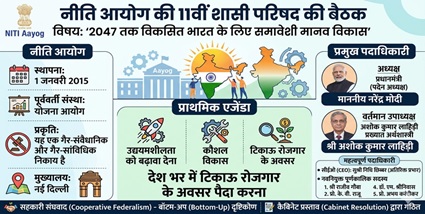
  • The 11th Governing Council meeting of NITI Aayog was held in New Delhi under the chairmanship of Prime Minister Narendra Modi.

Related Facts:

  • Chaired by: Prime Minister Narendra Modi
  • Theme: Inclusive Human Development for Viksit Bharat @2047
  • Primary Agenda: Promoting entrepreneurship, skill development, and creating sustainable employment opportunities across the country
  • Key Pillars: Basic human capital and future-ready skills; productive employment; entrepreneurship and decentralized development; health, nutrition, and well-being; equity and dignity for all
  • Additional Focus: Implementation of recommendations from the 5th National Conference of Chief Secretaries held in December 2025 (e.g., early childhood education, school education, sports, etc.)

NITI Aayog:

  • NITI Aayog: National Institution for Transforming India
  • It is the Government of India's premier policy 'think tank'
  • Establishment: 1 January 2015
  • Predecessor Body: Planning Commission
  • Nature: It is a non-constitutional and non-statutory body
  • Headquarters: New Delhi
  • Chairperson: Prime Minister (Ex-officio Chairperson)
  • Vice-Chairperson: Appointed by the Prime Minister (holds the rank of a Cabinet Minister); Current: Ashok Kumar Lahiri (appointed in April 2026; succeeded Suman K. Bery)
  • Full-time Members: Hold the rank of Minister of State
  • Ex-officio Members: Maximum of 4 ministers from the Union Council of Ministers (nominated by the Prime Minister)
  • Chief Executive Officer (CEO): Ms. Nidhi Chhibber (assigned additional charge; succeeded B.V.R. Subrahmanyam)

Approval for Phase 2A of the Ahmedabad Metro Rail Project
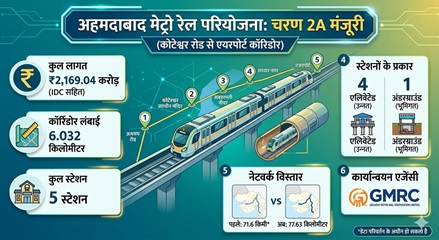
  • The Union Cabinet has approved Phase 2A of the Ahmedabad Metro Rail Project (Koteshwar Road to Airport Corridor).

Key Facts:

  • Total project cost: ₹2,169.04 crore (including Interest During Construction, or IDC)
  • Corridor length: 6.032-kilometer metro route
  • Total number of stations: The corridor will comprise 5 stations
  • Station types: Out of the 5 stations, 4 will be elevated and 1 will be underground
  • Network expansion: Upon implementation of this phase, the operational metro rail network connecting Ahmedabad and Gandhinagar will increase to 77.63 kilometers
  • Implementing agency: Gujarat Metro Rail Corporation (GMRC)

Approval for the Construction of a Shared Central Secretariat in Amaravati

  • Chaired by Prime Minister Narendra Modi, the Cabinet Committee on Economic Affairs (CCEA) has approved two major infrastructure projects in Amaravati, the capital of Andhra Pradesh, with a total outlay exceeding ₹2,534 crore.

Key Details:

  • Total Approved Budget: ₹2,534 crore (revised combined cost approximately ₹2,533–₹2,534 crore)
  • Location: Amaravati, the capital of Andhra Pradesh
  • Implementing Agency: Central Public Works Department (CPWD)
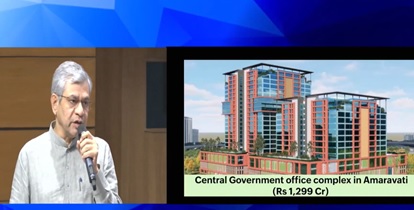
  • Shared Central Secretariat (CGPO): ₹1,299 crore approved to bring various central government departments under one roof
  • Residential Complex (GPRA): ₹1,235 crore (or ₹1,234.91 crore) allocated for central government employee housing
  • Residential Complex (GPRA):
  • Area: The complex will span 17 acres
  • Towers and Flats: 11 multi-story towers will be constructed, comprising a total of 1,504 residential flats ranging from Type-II to Type-VI categories

'Priyadarshini' Free Bus Travel Scheme
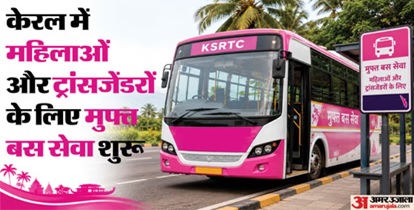
  • The Kerala Cabinet approved the ‘Priyadarshini’ free bus travel scheme for women and transgender individuals.
  • This scheme will be implemented across the state starting June 15, 2026, allowing free travel on ordinary Kerala State Road Transport Corporation (KSRTC) buses without any income or age restrictions.

Related Facts:

  • State Name: Kerala.
  • Scheme Name: Priyadarshini Scheme (one of the five 'Indira Guarantees').
  • Implementation Date: June 15, 2026.
  • Announced by: Kerala Chief Minister V.D. Satheesan.
  • Eligibility: Women and transgender individuals of all age groups and economic backgrounds.
  • Bus Service Type: Initially, this facility will be available only on ordinary KSRTC (Kerala State Road Transport Corporation) buses.

Kerala:

  • Capital: Thiruvananthapuram.
  • Main Language: Malayalam.
  • Other Languages: English, Tamil, Hindi (understood).
  • State Formation: November 1, 1956 (through the merger of Travancore, Cochin, and Malabar).
  • Major Neighbors: Karnataka (North), Tamil Nadu (East), Arabian Sea (West).
  • Major Cities: Thiruvananthapuram, Kochi (Ernakulam), Kozhikode (Calicut), Thrissur, Kollam.

Kerala is divided into three main regions:

  • Hilly Region (Western Ghats) — Anamudi (2,695 meters), the highest mountain peak in Peninsular India, is located here. Midlands — Plantations of rice, coconut, rubber, tea, and coffee
  • Coastal region — Over 580 km of coastline, backwaters (such as Alappuzha), lagoons, and beaches (Kovalam, Varkala, Fort Kochi)
  • Classical dance: Kathakali and Mohiniyattam
  • Martial art: Kalaripayattu (one of the world's oldest martial arts)
  • Festivals: Onam (harvest festival) and Vishu
  • Major rivers: Periyar (longest), Bharathapuzha, and Pamba
  • Lakes: Vembanad Lake (India's longest lake) and Ashtamudi Lake

Economy and Banking

Waiver of Central Excise Duty on High-Ethanol Blended Petrol
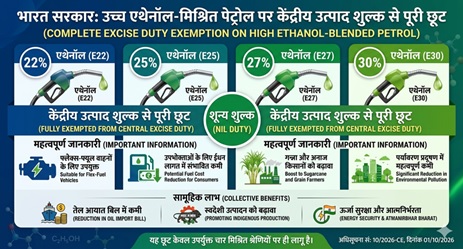
  • The Central Government has announced a complete exemption from central excise duty for petrol blended with 22%, 25%, 27%, and 30% ethanol.
  • This step has been taken to strengthen India's 'Ethanol Blending Programme' and promote eco-friendly green fuel.

Related Facts:

  • Taxes Included: The scope of this exemption covers Basic Central Excise Duty, Special Additional Excise Duty (SAED), Road and Infrastructure Cess (RIC), and Agriculture Infrastructure and Development Cess (AIDC).
  • Standardization: The blended fuel must comply with the specific standard IS 19850 of the Bureau of Indian Standards (BIS).

Composition Ratios of Fuel Categories:

  • E22 Fuel Category: Contains a blend of 22% ethanol and 78% petrol (motor spirit) by volume. Its gazette notification code is 5E.
  • E25 Fuel Category: Contains a blend of 25% ethanol and 75% petrol (motor spirit) by volume. Its gazette notification code is 5F.
  • E27 Fuel Category: Contains a blend of 27% ethanol and 73% petrol (motor spirit) by volume. Its gazette notification code is 5G.
  • E30 Fuel Category: Contains a blend of 30% ethanol and 70% petrol (motor spirit) by volume. Its gazette notification code is 5H.
  • Early Achievement of Target: India achieved the national target of 20% ethanol blending (E20) in petrol ahead of schedule in December 2025; following this, the government is now moving towards the E30 target.

Key Facts for Exams:

  • Revised Target (E20): The National Policy on Biofuels, 2018, was amended in 2022. Under this, the target for 20% ethanol blending in petrol (E20)—originally set for 2030—was advanced to the Ethanol Supply Year (ESY) 2025-26.
  • Nationwide Rollout of E20: Blending up to 20% ethanol in petrol has been made mandatory across India starting April 1, 2026.
  • Early History: The Ethanol Blended Petrol (EBP) programme was launched in India in 2003.
  • New BIS Standard Code: The Bureau of Indian Standards (BIS) has notified a new standard, IS 19850:2026, for high ethanol blends (E22 to E30). This standard came into effect on May 15, 2026.
  • Octane Rating and RON: A minimum RON (Research Octane Number) of 95 has been mandated for ethanol-blended petrol. A higher octane number reduces engine 'knocking' (a phenomenon caused by premature fuel combustion).
  • Energy Density: The energy density of ethanol is approximately one-third (1/3) lower than that of pure petrol. Consequently, older vehicles may experience a slight reduction in mileage (fuel efficiency) of 3 to 7 percent.
  • The chemical formula for ethanol (ethyl alcohol) is C₂H₅OH.
  • Production Process: It is naturally produced through the fermentation of sugars with the help of yeast.
  • Environmental Impact: Blending ethanol with petrol significantly reduces harmful carbon monoxide (CO) and hydrocarbon (HC) emissions from vehicles.

FDI between 2014-15 and 2025-26

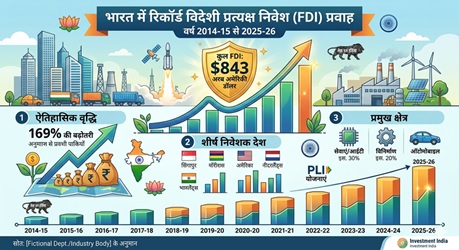
  • India attracted a total of $843 billion in Foreign Direct Investment (FDI) between 2014-15 and 2025-26, marking a 169% increase compared to the preceding 12 years.

Key Facts:

  • Total Investment: $843 billion (USD)
  • Growth Rate: A historic rise of 169% compared to the previous 12 years
  • Peak Year: Record inflow of over $94 billion in the 2025-26 fiscal year
  • Primary Channel: Over 90% of the investment came via the 'Automatic Route'
  • Key Catalysts: 'Make in India' and 'PLI' (Production Linked Incentive) schemes
  • Automatic Route: More than 90% of investments arrived through this route
  • 99.2% of mobile phones are now manufactured in India
  • 32 central ministries and 34 states/Union Territories have processed over 13 lakh applications and facilitated more than 8 lakh approvals through a unified central system, thereby enhancing the ease of doing business
  • India is home to over 2.35 lakh DPIIT-recognized startups, which have generated approximately 24 lakh direct employment opportunities
  • Largest FDI-receiving sector: Historically, the services sector (e.g., finance, banking, insurance, non-financial business, etc.) has been the largest recipient of FDI in India, followed by the computer software and hardware sector
  • Top investing countries: Singapore, Mauritius, and the USA remain the leading sources of investment in India
  • Nature of FDI: It is a non-debt-creating capital inflow, meaning it does not increase the country's debt burden.

Awards and Honours

Statistical Overview of Awards (2024-2025)
  • The Ministry of Culture has announced the Sangeet Natak Akademi Fellowships (Akademi Ratna), Sangeet Natak Akademi Awards, and Ustad Bismillah Khan Yuva Puraskars for the years 2024 and 2025.

Relevant Details:

Statistical Overview of Awards (2024-2025):

Sangeet Natak Akademi Fellowship (Akademi Ratna):

  • Total Recipients: 7 artists
  • Prize Money: ₹3,00,000 (3 lakh rupees)
  • Key Facts: This is the Akademi's highest honour. Its membership cannot exceed 40 members at any given time. It also includes a *Tamrapatra* (citation plaque) and an *Angavastram* (ceremonial stole).
  • This year's 7 prominent 'Akademi Ratna' recipients: Ramlal Bareth (Kathak dance), Puru Dadheech (Kathak dance), Rita Ganguly (Classical vocal music), A. V. Anand (Carnatic music), Chittaranjan Jyotishi (Classical vocal music), Pasumarthi Rattaiah Sarma (Kuchipudi dance), Sudharani Raghupathy (Bharatnatyam dance).

Sangeet Natak Akademi Award (Akademi Award):

  • Total Recipients: 108 artists
  • Prize Money: ₹1,00,000 (1 lakh rupees)
  • Key Facts: This national award was instituted in 1952. It is the highest national award conferred upon practicing artists in the field of performing arts. Recipients also receive a Tamrapatra* and an Angavastram.

Ustad Bismillah Khan Yuva Puraskar:

  • Total Recipients: 106 artists
  • Prize Money: ₹25,000 (25 thousand rupees)
  • Key Facts: It was instituted in the year 2006. This award is presented to outstanding young artists up to the age of 40 to showcase and encourage their talent.
  • Establishment of the Academy: The Sangeet Natak Akademi was established on May 31, 1952, through a resolution by the then Ministry of Education, Government of India. It was inaugurated on January 28, 1953, by Dr. Rajendra Prasad, the first President of India.
  • Nodal Ministry: It functions as an autonomous body under the Ministry of Culture.
  • Award Presentation: The Akademi Fellowships and main awards are presented by the Hon'ble President of India, while the Yuva Puraskar (Young Artist Award) is presented by the Chairperson of the Akademi.

Defence News

Contract for the Procurement of ECGNSS Jammers
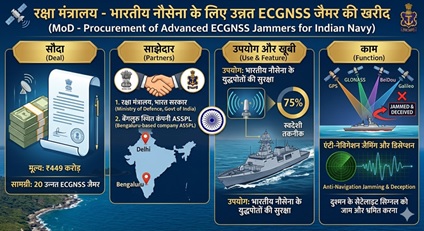
  • The Ministry of Defence signed a contract worth ₹449 crore with Bengaluru-based ASSPL for the procurement of 20 Enhanced Capability Global Navigation Satellite System (ECGNSS) jammers for the Indian Navy.

Key Details:

  • Deal: Procurement of 20 ECGNSS jammers for ₹449 crore
  • Partners: Ministry of Defence and Bengaluru-based company ASSPL
  • Usage: For the protection of Indian Navy warships
  • Feature: Over 75% indigenous technology ('Atmanirbhar Bharat' / Self-Reliant India)
  • Function: To jam and spoof enemy satellite signals

Indian Navy:

  • Established: 26 January 1950
  • Navy Day: 4 December
  • Motto: "Sham No Varunah"
  • Chief: Admiral Krishna Swaminathan; assumed charge as the 27th Chief of the Indian Navy on 31 May 2026

Naval Commands:

  • Western Naval Command (Mumbai)
  • Southern Naval Command (Kochi)
  • Eastern Naval Command (Visakhapatnam)

Solar Power Project Approved in Sitapur


  • The Ministry of Defence has approved a 250 MW capacity solar power project in Sitapur, Uttar Pradesh.

Key Details:

  • Project Name and Capacity: 250 MW capacity Solar-BESS project.
  • Location: Sitapur (Ex-Cantonment Area), Uttar Pradesh.
  • Significance (First in India): This is India's first large-scale renewable energy project to be established on defence land that incorporates an integrated Battery Energy Storage System (BESS).
  • Land Use: The project will be developed on approximately 850 acres of vacant defence land.
  • Solar Energy:
  • An unlimited and clean source of energy derived from the sun; it is a crucial option for meeting current and future global energy needs.
  • Source of Energy: Nuclear fusion occurring at the sun's core, where hydrogen nuclei combine to form helium.
  • Photovoltaic Effect: Solar panels operate on this principle. When sunlight (photons) strikes a semiconductor, electrons begin to flow, generating Direct Current (DC).
  • Global Standing: According to the Union Environment Minister, India ranked second globally in terms of solar energy capacity addition in 2025... India ranks third globally in terms of installed renewable energy capacity.

Other Important Facts:

  • Global Standing: India is among the top 5 countries in the world in terms of solar energy capacity.
  • Leading States: Rajasthan holds the top position in India for total installed solar energy capacity, followed by Gujarat and Karnataka.
  • World's Largest Solar Park: Bhadla Solar Park, located in the Jodhpur district of Rajasthan, is one of the world's largest solar parks, with a capacity of approximately 2,245 MW.

International News

World's Largest Nuclear Power Plant Restarts
  • Amid the global energy crisis, Japan has restarted Reactor No. 6 at the Kashiwazaki-Kariwa Nuclear Power Plant—the world's largest nuclear power plant—to meet rising electricity demand.

Related Facts:

  • Plant Name: Kashiwazaki-Kariwa Nuclear Power Plant (NPP)
  • Location: Situated in Niigata Prefecture, Japan, northwest of Tokyo.
  • Key Feature: It is the world's largest nuclear power plant in terms of installed capacity (total capacity of approximately 8.2 gigawatts across 7 reactors).
  • Operating Company: Operated by Tokyo Electric Power Company (TEPCO).
  • Fukushima Disaster (2011): A severe meltdown (accident) occurred at the Fukushima Daiichi nuclear plant due to the massive earthquake and tsunami that struck Japan in March 2011.

Other Important Facts:

  • Largest Producer of Nuclear Energy: The United States (USA) produces the most nuclear energy in the world.
  • Worst Nuclear Accident in History: The Chernobyl disaster, which occurred on April 26, 1986, in Ukraine (then part of the Soviet Union/USSR).
  • India's First Nuclear Power Station: Tarapur Nuclear Power Plant (Tarapur, Maharashtra) – established in 1969 with US assistance.
  • India's Largest Nuclear Power Plant: Kudankulam Nuclear Power Plant (Kudankulam, Tamil Nadu) – operated with Russian assistance.
  • India's First Research Reactor: Apsara – established in 1956 at the Bhabha Atomic Research Centre (BARC), Trombay. KAMINI Reactor: It is located in Kalpakkam (Tamil Nadu) and is the world's only reactor that runs on thorium-based Uranium-233 fuel.

Annual Inflation in the US

  • The annual inflation rate in the US rose to 4.2 percent in May.
  • This increase is the highest in the last three years.
  • According to the US Bureau of Labor Statistics, a 0.5 percent rise in prices was recorded compared to April.
  • Energy prices contributed approximately 60 percent to this increase.

United States of America (USA):

  • Capital: Washington, D.C.
  • Largest City: New York City
  • Currency: US Dollar (USD)
  • National Day: July 4 (Independence Day)
  • Continent: North America

Major Landmarks:

  • Statue of Liberty (New York)
  • White House (Washington, D.C.)
  • Grand Canyon (Arizona)
  • Disneyland (California)

Bill to Restrict Children's Access to Social Media

  • The Canadian government has introduced Bill C-34 (Safe Social Media Act) in Parliament, aiming to ban social media for children under the age of 16.

Related Facts:

  • First Country: Australia became the first country in the world to ban social media for children under 16 in November 2024.
  • Other Countries: Apart from Canada, countries like Brazil and Indonesia have also implemented or proposed age-based social media restrictions.

Canada:

  • Capital: Ottawa
  • Current Prime Minister: Justin Trudeau
  • Currency: Canadian Dollar
  • Name of Parliament: Parliament (Lower House: House of Commons)
  • Influence on the Indian Constitution: Features such as a "federal system with a strong center" and the "vesting of residual powers in the center" in the Indian Constitution were adopted from the Canadian Constitution.

Person In News

Srishti Kiran

  • Bengaluru's Srishti Kiran has achieved the world number 1 ranking among Under-13 tennis players.

Key Details:

  • Player Name: Srishti Kiran
  • Sport: Lawn Tennis
  • Hometown: Bengaluru, Karnataka
  • Age: 13 years
  • Achievement: Became the world's top-ranked (Number 1) player in the Under-13 age category.
  • Career-Best Ranking: She has reached a career-high rank of 357 in the International Tennis Federation (ITF) Junior rankings, the highest globally among Under-13 players.
  • She has won five consecutive ITF Junior titles on the international circuit.
  • Notable Record: Srishti achieved this milestone by participating in just eight ranking tournaments.

Angelina Arora

  • Angelina Arora, an Australian student of Indian origin, has developed a special biodegradable plastic using prawn shells and silk cocoons.

Related Facts:


  • Chitin: A natural polymer/structural polysaccharide found in the outer shells of crustaceans (like prawns), the exoskeletons of insects, and the cell walls of fungi.
  • Chitosan: Derived by processing chitin; it is used in packaging and medical applications.
  • Fibroin: The primary structural protein found in silk fibers and silk cocoons.
  • Rapid Decomposition: While conventional petroleum-based plastics take hundreds of years to break down, this new plastic decomposes completely into the soil in just 33 days.
  • Soil Fertility: During decomposition, this plastic releases nitrogen, a nutrient highly beneficial for plant growth and soil health.
  • Physical Properties: It is a low-cost, strong, transparent, and water-insoluble material.


Latest Courses