


 Don't Have an Account?




SSC Foundation Eklavya - 2 Offline Cum Online Batch Lucknow Branch
10 September, 2026



Enter your Email ID and we'll send you a link to get back into your account.

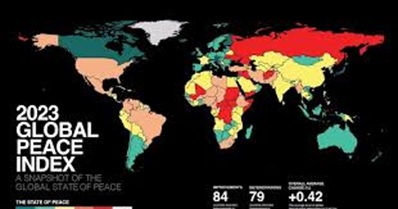

Global Peace Index (GPI) 2026
Tue 09 Jun, 2026
Why in News?
The Global Peace Index (GPI) 2026, released by the Institute for Economics & Peace (IEP) on 9 June 2026, has reported that global peacefulness has declined to its lowest level since the index was first launched in 2007. The report highlights the growing impact of geopolitical conflicts, military modernization, drone warfare, artificial intelligence (AI)-enabled targeting systems and increasing economic costs of violence.
India was ranked 115th among 163 countries with a score of 2.229, while Iceland retained its position as the world's most peaceful country for the nineteenth consecutive year.
What is the Global Peace Index?
The Global Peace Index is the world's leading measure of peacefulness.
Publisher: Institute for Economics & Peace (IEP), Sydney, Australia.
Coverage: 163 independent states and territories, representing over 99% of the world's population.
Methodology
The index is based on 23 qualitative and quantitative indicators grouped into three broad domains:
A lower score indicates a more peaceful country.
Major Findings of GPI 2026
1. Global Peace at Historic Low
The report notes that global peacefulness has deteriorated continuously over the last decade. The number of countries experiencing conflict has increased sharply, reflecting an increasingly unstable international order.
2. Surge in External Conflicts
The number of countries involved in external conflicts increased from 59 in 2008 to 103 in 2026, indicating a near doubling of interstate tensions.
This rise is linked to:
3. Emergence of AI-driven Warfare
One of the most significant observations of the report is the rapid militarisation of Artificial Intelligence.
Key trends include:
This marks a transformation in the nature of warfare from manpower-intensive conflicts to technology-driven engagements.
4. Economic Cost of Violence
The global economic impact of violence reached US$ 21.81 trillion, representing approximately 10.5% of global GDP.
The costs include:
The report highlights that resources spent on violence could otherwise be directed towards education, healthcare and sustainable development.
Global Rankings: Best and Worst Performers
Most Peaceful Countries
Rank Country
1 Iceland
2 New Zealand
3 Switzerland
4 Slovenia
5 Ireland
Iceland continues to maintain extremely low levels of militarisation, crime and political instability.
Least Peaceful Countries
| Rank | Country |
| 159 | Israel |
| 160 | Ukraine |
| 161 | Democratic Republic of Congo |
| 162 | Sudan |
| 163 | Russia |
For the first time, Russia ranked at the bottom of the index due to prolonged war involvement and heightened militarisation.
India's Performance in GPI 2026
Rank
115th out of 163 countries.
Score
2.229
Key Factors Influencing India's Ranking
Positive Factors:
Challenges:
Regional Context
South Asia witnessed the steepest deterioration in peace during the year. Political instability, internal unrest and security challenges across neighbouring countries significantly impacted the region's overall performance.
Implications for India
Strategic Implications
The increasing use of AI-enabled warfare demonstrates the need for India to accelerate:
Economic Implications
Peace is directly linked to economic development. Lower levels of violence improve:
Diplomatic Implications
India's emphasis on:
can contribute positively towards regional peace and stability.
Way Forward
The GPI 2026 highlights that future conflicts will increasingly be shaped by emerging technologies such as Artificial Intelligence, autonomous weapons, drones and cyber warfare.
India must strengthen its internal security architecture while promoting regional cooperation and peaceful dispute resolution. Simultaneously, investments in technological innovation and responsible AI governance will be crucial to addressing evolving security challenges.
India's Rank in Important Global Indices (2026)
| Index | India's Rank |
| Global Peace Index (GPI) 2026 | 115 |
| Human Development Index (HDI) | 130 |
| Global Hunger Index (Latest Available) | 105 |
| World Happiness Report | 118 |
| Corruption Perceptions Index | 96 |
| Global Innovation Index | 39 |
| Global Gender Gap Index | 131 |
| Network Readiness Index | 49 |
| Logistics Performance Index | 38 |
| Sustainable Development Goals (SDG) Index | 99 |
10 September, 2026
24 August, 2026
06 August, 2026
28 July, 2026
27 July, 2026
22 July, 2026
20 July, 2026
26 May, 2026
08 May, 2026
20 April, 2026
