26 May, 2026
GK Update
Sun 07 Jun, 2026
Context:
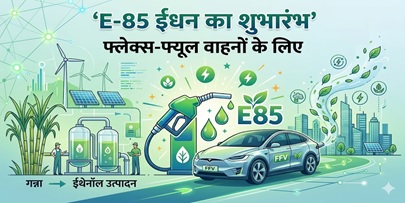
- Union Minister Hardeep Singh Puri launched E-85 fuel for flex-fuel vehicles.
Key Highlights:
- Launch: Inaugurated by Union Minister for Petroleum and Natural Gas Hardeep Singh Puri at the Indian Oil (IOC) Pusa Road outlet.
- It is ₹20 per litre cheaper than petrol.
- Price of E85 fuel in Delhi: ₹82.12 per litre.
- The station opened at Pusa Road, Delhi, is the country's first E85 fuel pump.
- In the initial phase, the government plans to establish around 50 to 100 E85 fuel stations in the Delhi-NCR and Mumbai-Pune-Nagpur corridors.
- The government has recently notified higher ethanol-blended fuel standards such as E22, E25, E27, and E30.
E85 Flex Fuel:
- It is a high-ethanol blended biofuel containing 80–85% ethanol and 14–19% conventional petrol.
- High Octane Rating: E85 has a Research Octane Number (RON) of approximately 108. A high octane rating prevents pre-ignition in engines and improves engine performance.
- Flex-Fuel Vehicles (FFVs):
- Definition: Flex-Fuel Vehicles are vehicles equipped with an Internal Combustion Engine (ICE) capable of operating on more than one type of fuel, such as pure petrol or varying blends of petrol and ethanol ranging from E20 to E100.
- Technical Modifications: These vehicles have a single fuel tank similar to conventional vehicles, but their fuel pumps, fuel injection systems, and engine calibration are specially modified to withstand ethanol’s corrosive properties and lower energy density.
Compatible Models Available in India:
- Hero MotoCorp: Splendor+ Flex Fuel and HF Deluxe Flex Fuel
- Suzuki: Gixxer SF 250 FFV
- Toyota: Innova HyCross Flex-Fuel (Prototype)
Government's Major Targets and Roadmap:
- Initial Rollout: Introduced through 48 retail outlets of public sector Oil Marketing Companies (OMCs) across the country.
- Medium-Term Target: Increase the number of outlets to 500 by December 2026.
- Long-Term Target: Ensure E85 availability at 5,000 outlets nationwide by December 2027.
- Integrated Blending Goal: Increase India's overall ethanol blending level to around 26% by 2030–31.
- Historical Background: India has already achieved its target of 20% ethanol blending (E20) ahead of schedule. In 2014, the blending level was only 1.53%.
Economic Benefits:
- Foreign Exchange Savings: India imports approximately 85–88% of its crude oil requirements. The Ethanol Blending Programme has already saved more than ₹1.84 lakh crore in foreign exchange. Large-scale adoption of E85 will multiply these savings.
- Cost-Effective for Consumers: E85 fuel has been priced approximately ₹20 per litre lower than regular petrol (or E20 blended petrol).
- Boost to Agricultural Economy: It will significantly increase the income of sugar mills, maize producers, and farmers involved in agricultural waste management. In line with the Prime Minister’s vision, it is a major step toward transforming Indian farmers from “Annadata” (food providers) to “Urjadata” (energy providers).
Environmental Benefits:
- Reduction in Emissions: Flex-fuel vehicles running on E85 can reduce lifecycle greenhouse gas (GHG) emissions by up to 61% compared to conventional petrol vehicles.
- Improved Urban Air Quality: Due to the higher oxygen content in ethanol, combustion is more complete, resulting in near-zero emissions of particulate matter (PM2.5 and PM10) and carbon monoxide.
- Climate Commitments: This initiative will help India achieve its Panchamrit target of Net-Zero emissions by 2070.
Ethanol:
- Chemical Name: Ethyl Alcohol (IUPAC Name: Ethanol)
- Chemical Formula: C₂H₅OH or CH₃CH₂OH
- Functional Group: Alcohol Group (-OH)
Physical Properties:
- It is a colourless, volatile, and highly flammable liquid.
- It has a characteristic sweet odour.
- Solubility: Completely miscible with water in all proportions due to hydrogen bonding with water molecules.
- Boiling Point: Approximately 78.37°C (351.5 K)
- Melting Point: -114.1°C (159 K), which is why it is also used in thermometers for extremely cold regions.