26 May, 2026
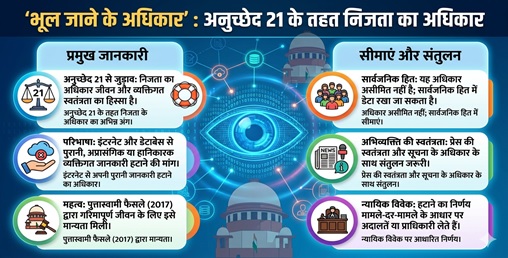
Right to be Forgotten: Right to Privacy under Article 21
Wed 03 Jun, 2026
Context:
- In a landmark judgment delivered in June 2026, the Delhi High Court recognized the "Right to be Forgotten" (RTBF) as an integral part of the Right to Privacy under Article 21 of the Constitution.
Key Points:
- Judge: The judgment was delivered by the single bench of Justice Sachin Datta.
Background of the Case:
- The Court heard more than 30 petitions together (lead case: Lakshya Veer Singh Yadav vs Union of India).
- The petitioners included individuals who had been acquitted in criminal cases, whose family disputes had been resolved, or whose cases had been quashed, but whose names still revealed details of old litigation when searched on the internet.
Court's Decision:
- The Court observed that the continued visibility of a person's past negative legal entanglements on the internet adversely affects their dignity and livelihood opportunities.
- If a case has already concluded, an individual should be granted the "Right to be Forgotten" in the digital world.
- Restriction on Name-Based Searches: The Court directed search engines such as Google and digital legal databases such as "Indian Kanoon" to de-index judicial records of acquitted individuals.
Constitutional and Legal Framework:
| Area | Constitutional Provision / Case Law | Description |
| Fundamental Right | Article 21 | Right to Life and Personal Liberty. The right to live with dignity includes the Right to Privacy and the Right to be Forgotten. |
| Landmark Judgment | K.S. Puttaswamy vs Union of India (2017) | A nine-judge bench of the Supreme Court declared the Right to Privacy a Fundamental Right under Article 21. RTBF (informational privacy) was mentioned for the first time in this case. |
| Existing Law | Digital Personal Data Protection (DPDP) Act, 2023 | Section 12 of the Act grants citizens the right to correct, complete, and erase their personal data. |
Right to Privacy:
- Under the Constitution of India, the Right to Privacy is a Fundamental Right under Article 21 and is considered an intrinsic part of the Right to Life and Personal Liberty.
- In the landmark Justice K.S. Puttaswamy (Retd.) vs Union of India case (2017), the Supreme Court unanimously held that privacy forms part of the freedoms guaranteed under Part III of the Constitution.
Judicial Evolution:
- M.P. Sharma Case (1954) and Kharak Singh Case (1962): In these early cases, the Supreme Court held that the Constitution of India did not explicitly protect the Right to Privacy as a Fundamental Right.
- Govind vs State of Madhya Pradesh (1975): The Court began to recognize privacy, though in a limited manner, within the scope of Fundamental Rights.
- K.S. Puttaswamy Judgment (2017): A nine-judge Constitution Bench overruled the earlier judgments (Sharma and Kharak Singh) and held privacy to be an inalienable natural right and a core element of human dignity.
Fundamental Rights:
- Fundamental Rights are provided under Part III (Articles 12 to 35) of the Constitution of India and are often referred to as the "Magna Carta of India."
- Originally, the Constitution contained seven Fundamental Rights. However, the 44th Constitutional Amendment (1978) removed the Right to Property (Article 31) and converted it into a legal right under Article 300A.
- At present, Indian citizens enjoy six Fundamental Rights.
Classification of the Six Fundamental Rights:
- Right to Equality (Articles 14–18): Ensures equality before law and equality of opportunity.
- Right to Freedom (Articles 19–22): Guarantees freedom of speech and expression, peaceful assembly, and protection of life and liberty.
- Right against Exploitation (Articles 23–24): Prohibits human trafficking, forced labour (begar), and child labour.
- Right to Freedom of Religion (Articles 25–28): Provides freedom to profess, practice, and propagate any religion.
- Cultural and Educational Rights (Articles 29–30): Protect the interests, language, and script of minorities.
- Right to Constitutional Remedies (Article 32): Gives citizens the right to directly approach the Supreme Court when their rights are violated. Dr. B.R. Ambedkar called it the "Soul of the Constitution."
Features of Fundamental Rights:
- Justiciable: In case of violation of Fundamental Rights, citizens may directly approach the Supreme Court or High Courts, which can issue writs (such as Habeas Corpus and Mandamus) under Articles 32 and 226.
- Not Absolute: These rights are not unlimited. The State may impose "reasonable restrictions" on them.
- Amendable: Parliament may amend these rights, but it cannot alter the "Basic Structure" of the Constitution (Kesavananda Bharati Case, 1973).
- Suspension during Emergency: During a National Emergency (Article 352), all Fundamental Rights except Articles 20 and 21 may be suspended.
Difference between Citizens and Foreigners:
| Rights Available Only to Indian Citizens | Rights Available to Both Citizens and Foreigners (except enemy aliens) |
| Article 15: Prohibition of discrimination on grounds of religion, race, caste, sex, or place of birth. | Article 14: Equality before law and equal protection of laws. |
| Article 16: Equality of opportunity in matters of public employment. | Article 20: Protection in respect of conviction for offences. |
| Article 19: Freedom of speech and expression, assembly, association, movement, residence, and profession. | Articles 21 & 21A: Protection of life and personal liberty and Right to Education. |
| Article 29: Protection of language, script, and culture of minorities. | Article 22: Protection against arrest and detention in certain cases. |
| Article 30: Right of minorities to establish and administer educational institutions. | Articles 23–24: Right against exploitation. |
| Articles 25–28: Right to Freedom of Religion. | — |