GK Update
 
  • Mobile Menu
HOME BUY MAGAZINEnew course icon
LOG IN SIGN UP

Sign-Up IcanDon't Have an Account?


SIGN UP


Login Icon

Have an Account?


LOG IN
 

or
By clicking on Register, you are agreeing to our Terms & Conditions.


or


GK Update

Wed 03 Jun, 2026

National News

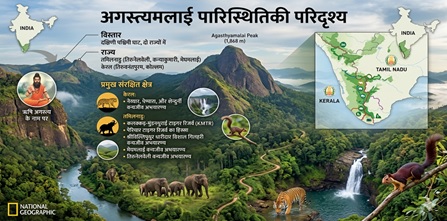
'Agasthyamalai Ecological Landscape'

  • The Supreme Court has directed the removal of encroachments from the protected areas within the 'Agasthyamalai Ecological Landscape'.

Relevant Facts:

  • In its interim report dated July 2025, the Central Empowered Committee (CEC) noted that the Agasthyamalai Ecological Landscape spans an area of ​​3,500.36 square kilometers.
  • Within the reserved forests of the district, a total of 4,601 encroachers have occupied 5,072.653 hectares of land; to date, only 1.8 percent of the total encroached forest land has been successfully reclaimed.
  • Among those listed as encroachers, 118 individuals have been identified as serving or retired government employees.
  • These individuals include personnel from the Army, Police, CRPF, Forest Department, Revenue Department, Electricity Board, Anganwadi services, School Education Department, Panchayats, Survey Department, and various other services.

Agasthyamalai Ecological Landscape:

  • Extent: Located within the southern section of the Western Ghats.
  • States: The landscape extends across the states of Tamil Nadu (Tirunelveli, Kanyakumari, Meghamalai) and Kerala (Thiruvananthapuram, Kollam).
  • Nomenclature: Named after the renowned Hindu sage, Agastya.
  • Highest Peak: Agasthyamalai Peak (1,868 meters).
  • Indigenous Tribes: This region serves primarily as the habitat of the Kani tribe.

Major Protected Areas:

  • In Kerala: Neyyar, Peppara, and Shendurney Wildlife Sanctuaries.
  • In Tamil Nadu: Kalakkad-Mundanthurai Tiger Reserve (KMTR), a part of the Periyar Tiger Reserve, Srivilliputhur Grizzled Giant Squirrel Wildlife Sanctuary, Meghamalai Wildlife Sanctuary, and Tirunelveli Wildlife Sanctuary.

Inauguration of 15 CFCs in Ladakh

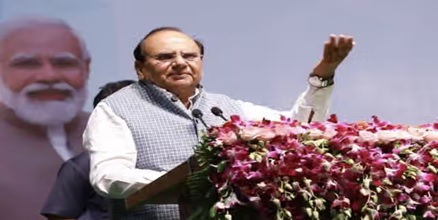
  • Ladakh's Lieutenant Governor, Vinai Kumar Saxena, inaugurated and dedicated 15 Common Facility Centres (CFCs) across the Union Territory.
  • The objective of these centers is to strengthen micro-enterprises, create livelihood opportunities for women and youth within their own villages, and help reduce migration.
  • The newly established centers are located in Skurbuchan, Wanla, Saspol, Chuchot, Kharu, Anle, Koyul, Korzok, Chushul, Phobrang, Sato, Panamik, Diskit, Turtuk, and Digar.

Ladakh:

  • It is known as the "Land of High Passes."
  • India's northernmost Union Territory and, in terms of area, its largest. Became a Union Territory on: October 31, 2019.
  • Capital: Leh serves as the capital and largest city of Ladakh.
  • Borders: It is bordered by Tibet (China) to the east, Himachal Pradesh to the south, and Jammu & Kashmir to the west.
  • Administration: The administration is headed by a Lieutenant Governor. Currently, Vinai Kumar Saxena serves as the Lieutenant Governor.
  • Lakes: Pangong Tso and Tso Moriri are renowned for their scenic beauty and ever-changing colors.
  • Valleys: The Nubra Valley is famous for its double-humped camels and sand dunes.
  • Cultural Heritage: The Leh Palace, Shanti Stupa, and renowned Buddhist monasteries—such as Hemis, Thiksey, and Alchi—are the region's key cultural landmarks.
  • Astronomy: The Dark Sky Reserve located in Hanle is one of the world's highest sites for astronomical observation.
  • Major Festivals: Hemis Tsechu, Losar (the Tibetan New Year), and the Sindhu Darshan Festival are the region's primary attractions. Local Cuisine: Thukpa, Momos, and the local savory tea—known as *Noon Chai* or *Gur-Gur Chai* (Butter Tea)—are extremely popular here.
  • Language: Primarily, Ladakhi, Bhoti, Purgi, and Hindi are spoken here.
  • First Petroglyph Conservation Park: On April 19, 2026, the foundation stone for India's first Petroglyph Conservation Park was laid in the Indus Valley region of Leh. Its objective is to preserve the centuries-old carvings etched into the rocks.
  • Shyok Tunnel: In December 2025, the 920-meter-long Shyok Tunnel—which holds immense strategic significance—was inaugurated on the Darbuk-Shyok-Daulat Beg Oldie road.
  • World's Highest Road: Located at the Umling La pass in Ladakh, at an altitude of 19,300 feet, lies the world's highest motorable road.
  • Mountain Ranges: Ladakh is situated amidst the Karakoram, Ladakh, Zanskar, and Great Himalayan mountain ranges. The highest peak in this region is Saltoro Kangri (7,742 meters).
  • Rivers: The Indus River serves as the region's primary lifeline. Additionally, the Shyok, Nubra, Zanskar, and Suru rivers are also prominent waterways.

Agreement between the Ministry of Jal Shakti and ISRO

  • The Ministry of Jal Shakti and the Indian Space Research Organisation (ISRO) have signed a significant Memorandum of Understanding (MoU) to strengthen the utilization of satellite technology for the improved management and monitoring of water resources across the country.
  • Under this agreement, the Department of Water Resources and ISRO will collaborate on 24 key research areas.
  • These primarily include reservoir monitoring, water-spread assessment, river-flow analysis, satellite-based water quality assessment, and studies regarding the excessive accumulation of plastic waste in water bodies.
  • This technical collaboration between ISRO and the water resources sector is not a new development; rather, this partnership between the two organizations dates back to 1982.

'Jal Sanchay Jan Bhagidari' (JSJB) Campaign – Phase 3:

  • The third phase of this campaign was launched by the Union Minister of Jal Shakti, C. R. Patil.
  • Objective: To ensure the construction of 20 million (two crore) water conservation structures across the country between June 2026 and May 2027.

Indian Space Research Organisation (ISRO):

  • India's national space agency, which operates under the Department of Space (DOS) and reports directly to the Prime Minister.
  • Establishment: August 15, 1969
  • Founder: Dr. Vikram Sarabhai (often referred to as the 'Father of the Indian Space Programme')
  • Headquarters: Bengaluru, Karnataka
  • Predecessor Organization: Prior to ISRO, the Indian National Committee for Space Research (INCOSPAR) was constituted in 1962.
  • First Indian Satellite: Aryabhata (Launched on April 19, 1975, using a Soviet Union rocket).
  • First Satellite Launched from Indian Soil: Rohini (RS-1) (Launched in 1980 using India's first indigenous rocket, the SLV-3).
  • First Indian Astronaut: Rakesh Sharma (Traveled to space on April 3, 1984, as part of the Soviet Union's 'Soyuz T-11' mission).

Launch of ‘Mission Snehajori’

  • The Minister for Development of the North Eastern Region, Jyotiraditya Scindia, and the Chief Minister of Assam, Himanta Biswa Sarma, launched ‘Mission Snehajori’ for Assam’s Muga silk.
  • This initiative has been launched with the objective of developing Assam’s unique Muga silk industry into a globally competitive and high-value textile sector.

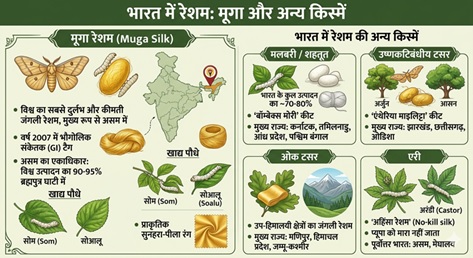
Muga Silk:

  • The world's rarest and most precious wild silk, produced primarily in the Indian state of Assam.
  • Granted Geographical Indication (GI) status for the state of Assam in 2007.
  • Assam's Monopoly: More than 90–95% of the world's total Muga silk production is produced solely in the Brahmaputra Valley of Assam.
  • Host Plants: Muga silkworms primarily feed on the aromatic leaves of the *Som* and *Soalu* plants.

Other Varieties of Silk in India:

  • Mulberry: Accounts for approximately 70–80% of India's total silk production; produced by the *Bombyx mori* moth.
  • Major Producing States: Karnataka, Tamil Nadu, Andhra Pradesh, West Bengal.
  • Tropical Tasar: Produced by the *Antheraea mylitta* moth; reared on Arjun and Asan trees.
  • Major Producing States: Jharkhand, Chhattisgarh, Odisha.
  • Oak Tasar: A wild silk found in the sub-Himalayan regions.
  • Major Producing States: Manipur, Himachal Pradesh, Jammu & Kashmir.
  • Eri: Also known as 'Ahimsa Silk' (Non-violent Silk) because the pupa is not killed to extract the filament. It feeds on Castor leaves.
  • Assam, Meghalaya (Northeast India).
  • Muga: Possesses a natural golden-yellow hue; unique specifically to India (Assam).
  • Assam (the sole major producer).

'The Right to be Forgotten'

  • In a landmark verdict delivered in June 2026, the Delhi High Court recognized the 'Right to be Forgotten' (RTBF) as an integral part of the 'Right to Privacy' under Article 21 of the Constitution.
  • The Court clarified that a persistent digital presence can cause irreparable harm to an individual's dignity and reputation.

Relevant Facts:

  • Constitutional Recognition: The Court held that the 'Right to be Forgotten' primarily stems from the right to 'informational privacy' enshrined under Article 21.
  • De-indexing vs. Deletion: The Court clarified the distinction between the complete removal of data from the internet and the removal of links from search engine results.
  • Historical Background and Judicial Evolution:
  • R. Rajagopal v. State of Tamil Nadu (1994): The Supreme Court held that citizens have the right to protect their private lives from unwarranted public disclosure.
  • K.S. Puttaswamy v. Union of India (2017): A nine-judge bench declared the Right to Privacy a fundamental right under Article 21. In this very judgment, Justice Sanjay Kishan Kaul endorsed the right to have digital data removed or erased from the system (informational autonomy).
  • Zorawar Singh Mundy v. Union of India (2021): The Delhi High Court permitted the de-indexing of a court order from Google at the request of an acquitted individual.
  • This right was recognized by the Court of Justice of the European Union (CJEU) in the 'Google Spain' case in 2014.

Economy and Banking

‘Project Shikhar’

  • The e-commerce platform Meesho and the Bombay Stock Exchange (BSE) have jointly launched a new initiative named ‘Project Shikhar’.
  • This project will assist Micro, Small, and Medium Enterprises (MSMEs) and e-commerce sellers in getting publicly listed on the BSE’s SME platform.

Bombay Stock Exchange (BSE):

  • Establishment: July 1875
  • Name: ‘The Native Share and Stock Brokers Association’ (Original Name)
  • Location: Mumbai (Dalal Street, Mumbai)
  • Asia’s Oldest: It is the first stock exchange in Asia and the 10th oldest in the world.
  • Electronic Trading: In 1995, the BSE discontinued the open outcry system and adopted a fully electronic trading system (BSE On-line Trading System – BOLT).
  • Base Year and Value: Its base year is 1978–79, and its base value is 100.
  • Regulator: The BSE, like all other stock exchanges in India, operates under the regulations and control of the Securities and Exchange Board of India (SEBI).

PPI System to Replace Wholesale Price Index

  • The Central Government has taken a major decision to phase out the Wholesale Price Index (WPI) over the next five years and implement a more comprehensive Producer Price Index (PPI) system in its place.
  • This decision has been taken to modernize the country's inflation and pricing data structure and to align it with global best practices.

Key Facts:

  • New Base Year (Base Year Revision): Effective June 15, the Department for Promotion of Industry and Internal Trade (DPIIT) under the Ministry of Commerce and Industry will revise the base year for the WPI from 2011-12 to 2022-23; the new PPI framework will also be introduced based on this same base year.
  • Expansion of the Commodity Basket: The number of items in the new WPI basket has been increased from 697 to 957. This includes the incorporation of new emerging sectors such as solar energy, wind energy, and nuclear power.

International News

Transit Visa Requirement Waived for Indian Citizens: Germany

  • Effective June 3, 2026, Germany has completely abolished the mandatory requirement for an 'Airport Transit Visa' for Indian citizens.

Key Facts:

  • This decision came into effect following its publication in Germany's Official Gazette. Under this new rule, Indian passport holders can now board connecting flights at German airports without a transit visa while traveling to a third (non-Schengen) country.
  • Previously, if an Indian citizen was traveling to the USA, Canada, or any other non-Schengen country via Germany (e.g., Frankfurt or Munich), they were required to possess an Airport Transit Visa (ATV) even to remain within the international transit zone of the German airport. An exemption was granted only to those Indians who already held a valid visa or residence permit for the USA, Canada, or the European Union.
  • The foundation for this historic exemption was laid in January 2026 during German Chancellor Friedrich Merz's visit to India, where a consensus on the matter was reached during bilateral discussions with Prime Minister Narendra Modi.

Germany:

  • Capital: Berlin
  • Geographical Location: It is situated in Central Europe. To its north lie the North Sea, Denmark, and the Baltic Sea; to the east, Poland and the Czech Republic; to the south, Austria and Switzerland; and to the west, France, Luxembourg, Belgium, and the Netherlands. Germany shares its borders with a total of 9 countries.
  • Major Rivers: Rhine, Danube, and Elbe
  • Currency: Euro

Parliament: Germany's legislature is bicameral:

  • Bundestag: The Lower House (Its members are directly elected by the public)
  • Bundesrat: The Upper House (It comprises representatives from the state governments)

Reports and Indices

'Indian Coastal Regions: Climate Forecast 2021-2040'
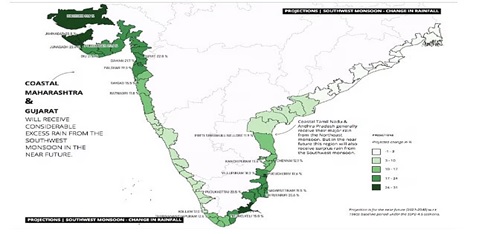
  • A recent report titled 'Indian Coastal Regions: Climate Forecast 2021-2040', released by Azim Premji University, warns of a severe, hyper-local climate crisis along India's 11,000-kilometer-long coastline (including island regions).

Key Findings:

  • By the year 2040, the coastal districts of Gujarat and Maharashtra are projected to experience significantly higher average rainfall during the Southwest Monsoon (SWM) season (June to September) compared to historical levels.
  • In Kutch—Gujarat's vast saline marshland desert—average rainfall during the monsoon season is estimated to increase by 31 percent by 2040.
  • The coastal regions of Eastern India, including the Sundarbans, are projected to witness a decline in average rainfall during the Southwest Monsoon season.
  • Coastal Tamil Nadu and Andhra Pradesh—regions that typically receive higher rainfall during the Northeast Monsoon season (October to December)—are likely to experience excess rainfall during the Southwest Monsoon season.
  • In Kerala's Ernakulam district, the average summer temperature is projected to rise by 1.3 degrees Celsius—the highest increase among all regions studied.
  • On the East Coast, the maximum (average) summer temperatures in Tirunelveli (Tamil Nadu) and Khordha (Odisha) are projected to rise by up to 1.1 degrees Celsius.

Defence News

Successful Flight Test of 'Rudram-2' Missile
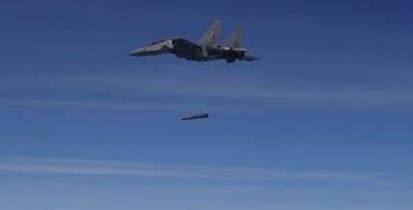
  • The Defence Research and Development Organisation (DRDO) and the Indian Air Force (IAF) have successfully conducted a flight test of the indigenously developed air-to-ground 'Rudram-II' missile.
  • This missile was launched from a Sukhoi-30 MKI (Su-30 MKI) fighter aircraft from the Dr. APJ Abdul Kalam Range located off the coast of Odisha.

Rudram-II Missile:

  • Missile Type: This is India's next-generation anti-radiation missile and an air-to-surface guided missile.
  • Developer: It has been primarily developed by the Research Centre Imarat (RCI), Hyderabad (the nodal DRDO laboratory), in collaboration with other partner laboratories and Defence Public Sector Undertakings (such as HAL).
  • Strike Capability: This missile can destroy enemy targets at a range of approximately 300 kilometers.
  • Maximum Speed: It belongs to the hypersonic/supersonic category of missiles and can attain a top speed of Mach 5.5.
  • Payload Capacity: It is capable of carrying a warhead (weapon) weighing up to approximately 200 kilograms.
  • Launch Platform: It can be launched from fighter aircraft, such as the Sukhoi, from an altitude ranging between 3 and 15 kilometers.
  • Navigation System: It utilizes a hybrid navigation system comprising an Inertial Navigation System (INS), GPS, and a state-of-the-art Passive Homing Head (PHH).


Latest Courses